Correction (July 23, 2026): An earlier version said the three-year slide of 14,540 students was more than the COVID drop and the pre-pandemic growth before it combined. That combined figure is 14,601 students, so the three-year slide nearly equals it rather than exceeding it. The sentence has been adjusted.
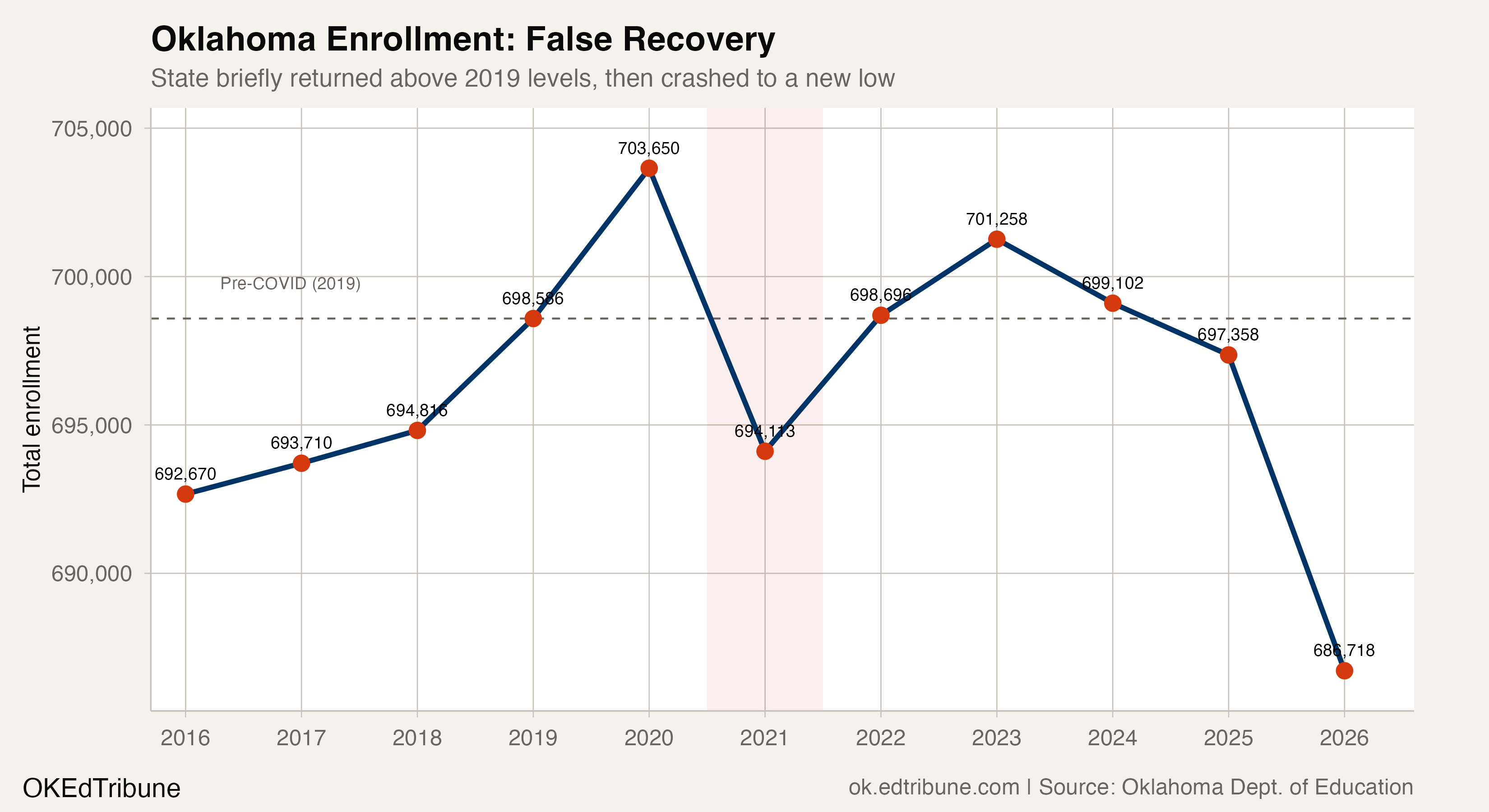
Oklahoma's public school enrollment returned above pre-pandemic levels in 2022. It stayed there for three years. Then, in 2025-26, the bottom fell out: 10,640 students vanished in a single year, the largest one-year drop in at least a decade and bigger than the COVID year itself. The state now sits at 686,718 students, an all-time low in the data going back to 2016 and 11,868 students below where it stood before the pandemic.
The recovery was a mirage. Of 515 Oklahoma districts with data in both 2018-19 and 2025-26, only 136 (26.4%) have more students now than they did before COVID-19. The other 379 districts never got back to where they started, or got there briefly and lost it again.
A bounce, not a recovery
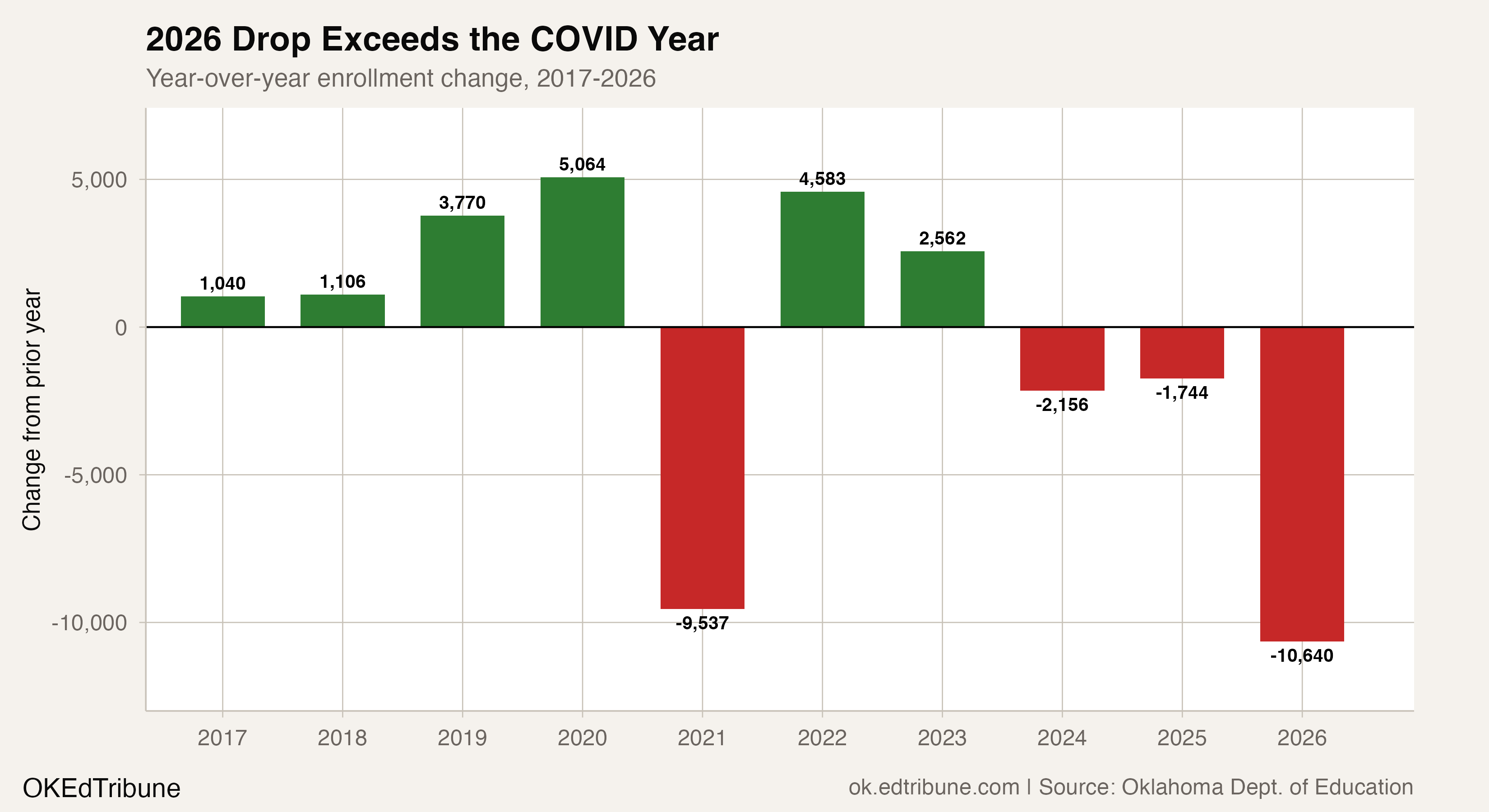
The statewide trajectory tells the story in three acts. Oklahoma peaked at 703,650 students in 2019-20, lost 9,537 in the COVID year, then clawed back 7,145 over the next two years to reach 701,258 by 2022-23. That number was 2,672 above the pre-COVID baseline. It looked like a recovery.
It was not. Enrollment slipped by 2,156 in 2023-24, another 1,744 in 2024-25, then cratered by 10,640 in 2025-26. The three-year slide of 14,540 students nearly equals the COVID drop and the years of growth before it combined. Oklahoma did not recover from the pandemic; it took a breather before a steeper fall.
Four trajectories, one dominant pattern
Tracking each district's enrollment in 2018-19, 2022-23, and 2025-26 reveals four distinct paths. The largest group, 283 districts (55%), never recovered at all: they were below 2019 levels in 2023 and still below in 2026. Another 96 districts (19%) appeared to recover by 2023 but then relapsed below their pre-COVID baseline by 2026. Edmond↗ET, the state's third-largest district, fits this pattern: it grew from 25,281 to 26,190 between 2019 and 2023, then fell to 24,993.
Only 108 districts (21%) sustained their recovery through 2026. A final 28 districts (5%) were late recoverers, below 2019 levels in 2023 but above them by 2026.
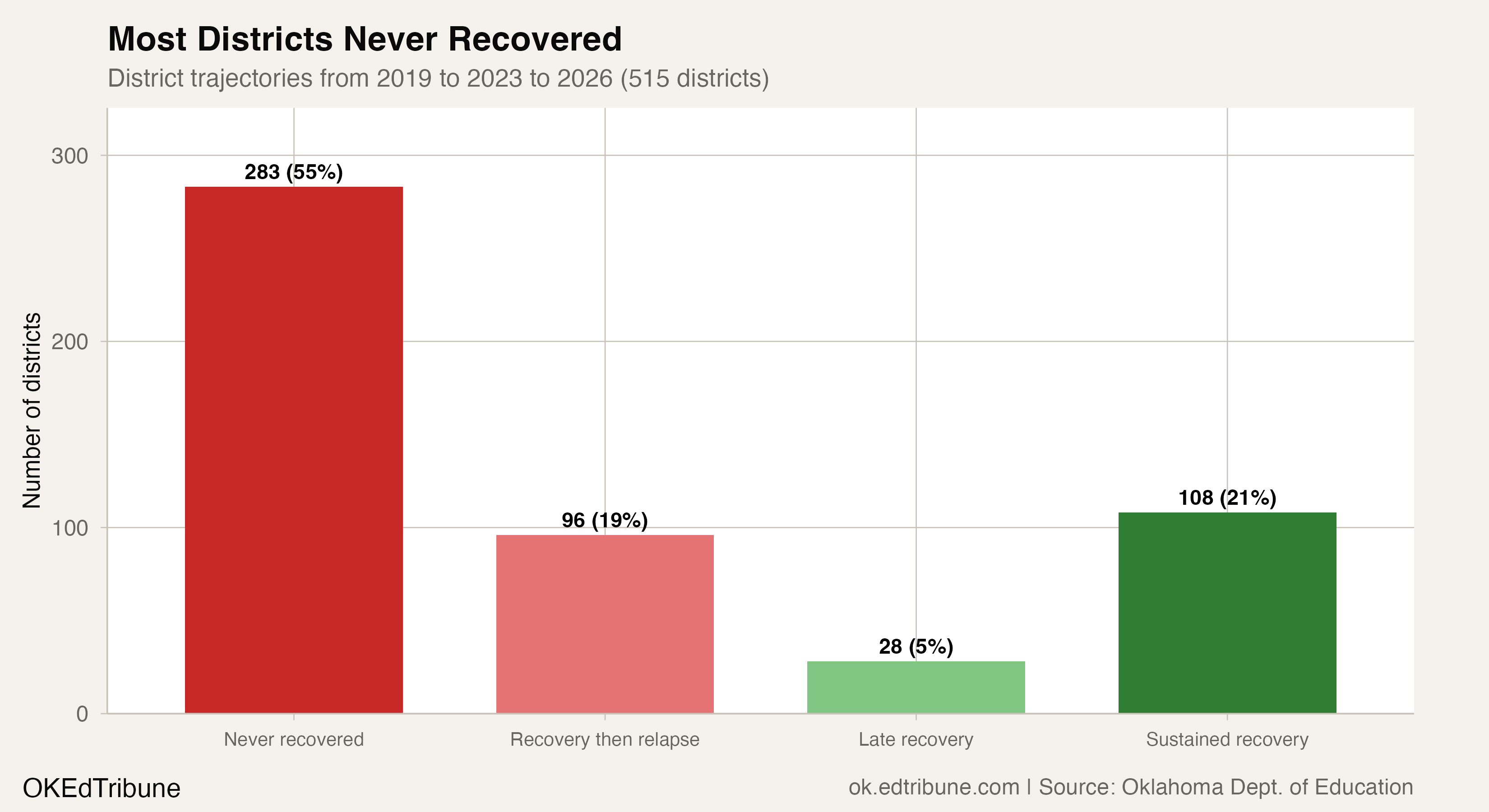
The recovery-then-relapse group deserves particular attention. These 96 districts represent false positives in every statewide recovery narrative between 2022 and 2024. Their enrollment gains were real but temporary, suggesting that whatever drove the post-COVID return to school was a one-time event, not a trend reversal.
Two cities account for a third of the damage
The losses are heavily concentrated. Oklahoma City↗ET and Tulsa↗ET, the state's two largest traditional districts, have lost a combined 19,640 students since 2019, a figure that accounts for 34.9% of all district-level losses statewide.
Oklahoma City's decline is especially severe: from 44,138 students in 2018-19 to 31,104 in 2025-26, a 29.5% contraction. That is not a COVID effect. OKC was already losing students before the pandemic (down to 42,513 by 2019-20) and never saw even a partial rebound. Its trajectory is a straight line down for a full decade.
Tulsa has followed a parallel path, falling from 39,056 to 32,450 (16.9%). Together, the two urban anchors have shed more students than 490 of the state's other districts lost or gained combined.
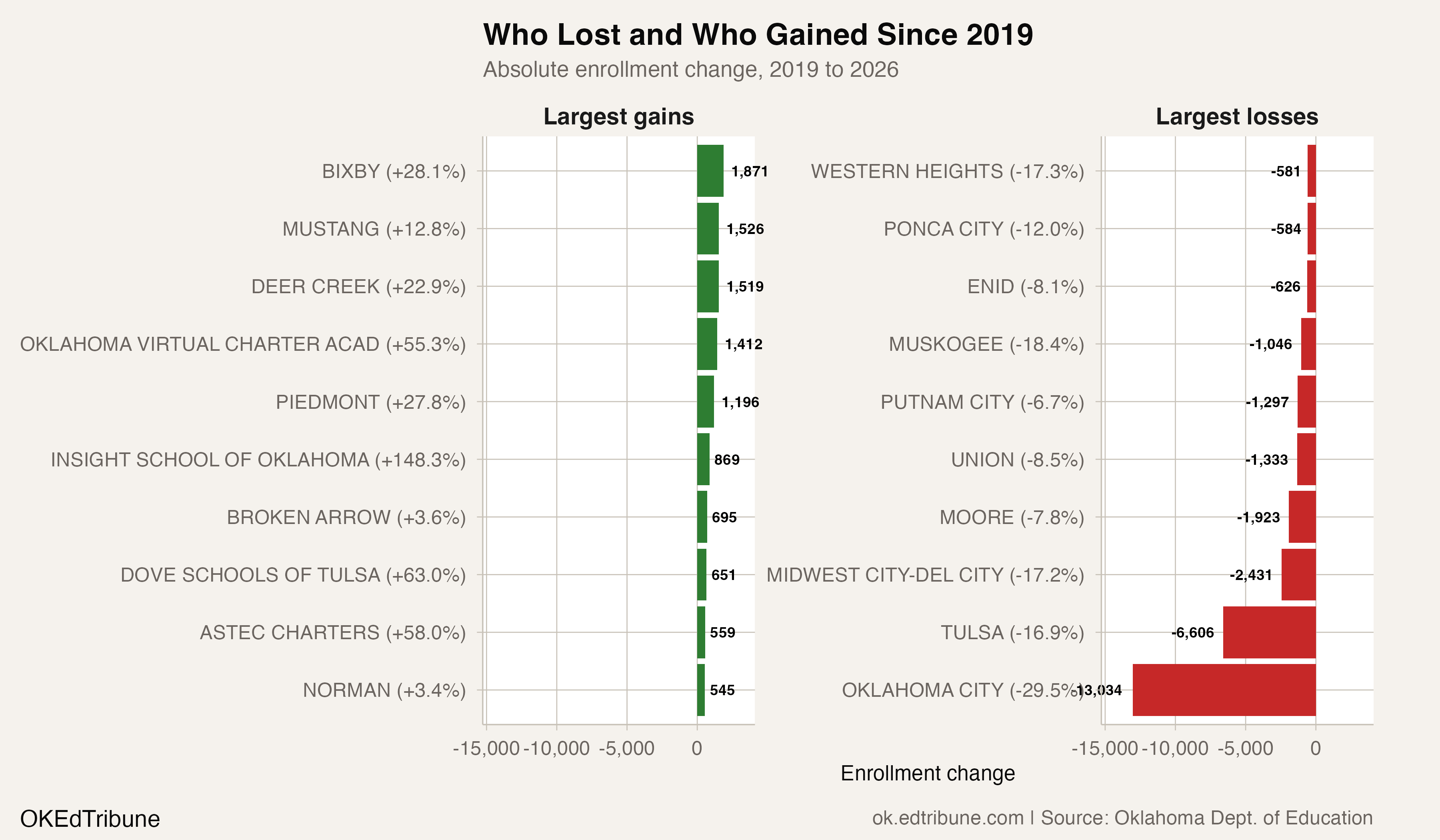
The districts that did grow since 2019 are concentrated in OKC's outer suburbs: Bixby↗ET (+1,871), Mustang↗ET (+1,526), Deer Creek↗ET (+1,519), and Piedmont↗ET (+1,196). Virtual charter schools also gained substantially, with Oklahoma Virtual Charter Academy↗ET adding 1,412 students and Insight School of Oklahoma↗ET adding 869.
Where the students went
Three forces are pulling students out of traditional public schools, and the data cannot fully distinguish among them.
The most visible is the virtual and charter sector. Entities identifiable by name as virtual or charter schools enrolled 28,970 students in 2018-19. By 2025-26, that figure had nearly doubled to 57,136, an increase of 28,166. Over the same period, traditional districts lost 40,034 students. The virtual/charter share of total public enrollment rose from 4.1% to 8.3%. Epic Charter Schools alone enrolled 29,201 students in 2025-26 after a scandal-driven collapse from a peak of 59,445 in 2020-21 to a restructured enrollment of 28,478 by 2022-23.
The second force is private school choice. Oklahoma's Parental Choice Tax Credit, enacted in 2023, subsidized private tuition for more than 37,000 students in 2025-26, with 3,278 children switching from public to private school for the first time that year. The program's cap grew from $150 million to $250 million over two years. Because these students leave the public enrollment count entirely, the tax credit represents a direct reduction in the numbers reported here.
The third force is demographic. The Tulsa World reported that Oklahoma State Department of Education officials "don't know why Oklahoma has suddenly lost" so many students. Union Public Schools Superintendent John Federline cited "a relatively cool housing market" and declining birth rates, adding that private school vouchers have "siphoned off" both students and funding. The U.S. fertility rate of 1.6 in 2024, according to Oklahoma Watch, is well below the 2.1 replacement level. In the past, immigration offset declining births, but that buffer appears to be shrinking.
Oklahoma does not require families to register when they choose homeschooling, so there is no official count of homeschool students. Census Bureau estimates suggest roughly 46,000 Oklahoma children were being homeschooled as of mid-2024, though the precision of that figure is uncertain.
The pipeline is collapsing from the bottom
The grade-level pattern makes the demographic story concrete. Pre-K enrollment is down 6,846 students (16.3%) since 2019. Kindergarten is down 6,835 (13.0%). First grade is down 4,387 (8.4%). Every grade from PK through sixth is below its 2019 level.
Meanwhile, grades 8 through 12 are all above 2019 levels. Eleventh grade is up 5,525 (11.9%) and twelfth grade is up 5,241 (11.9%). These upper-grade gains reflect larger cohorts from before the birth rate decline flowing through the system. When those cohorts graduate, they will be replaced by the smaller kindergarten classes now entering the pipeline.
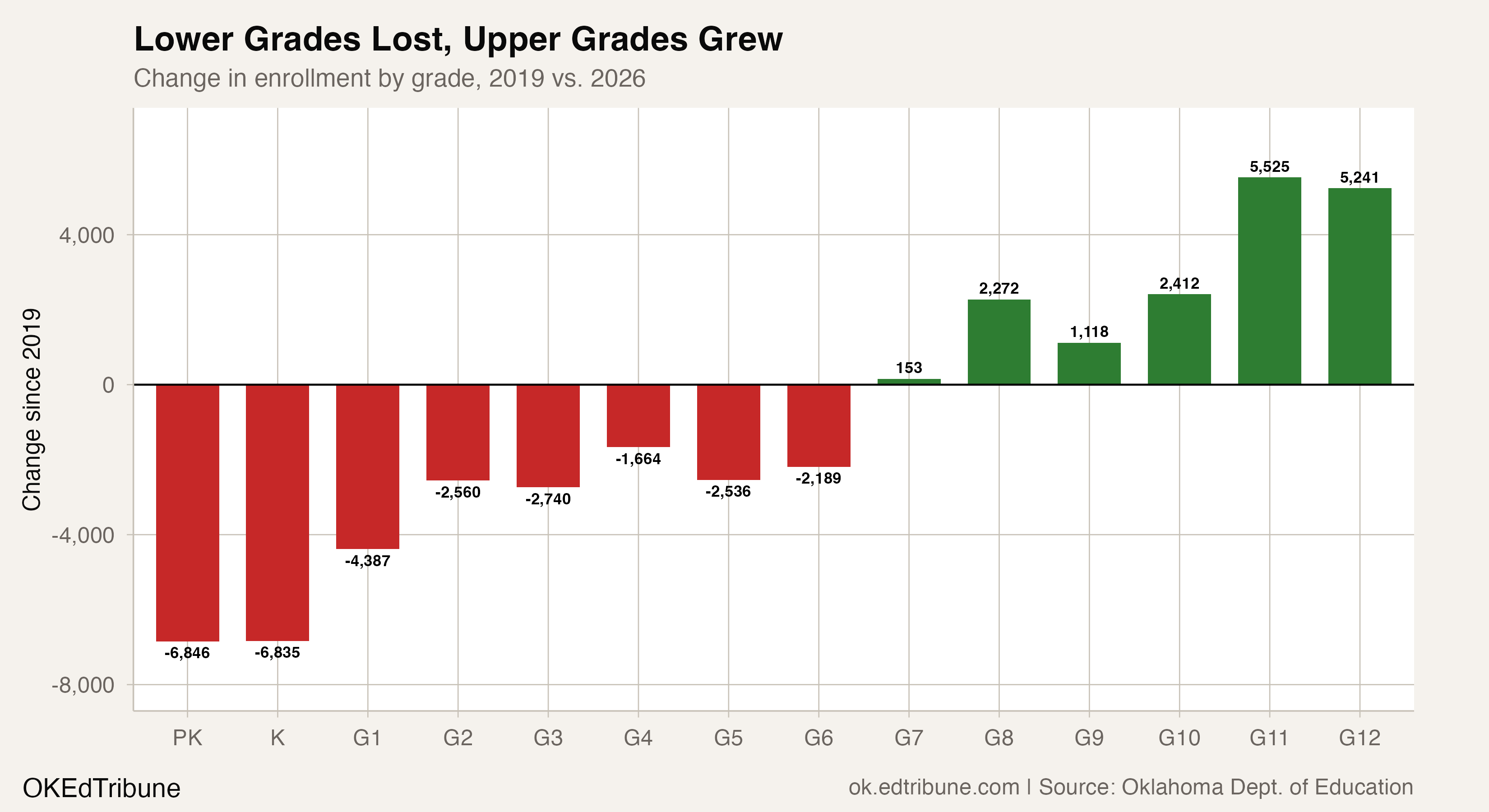
Combined PK and kindergarten enrollment has fallen from 94,390 to 80,709 since 2019, a loss of 13,681 students (14.5%). Combined 11th and 12th grade enrollment has risen from 90,479 to 101,245, a gain of 10,766 (11.9%). The system is top-heavy. Within three to four years, as the current upper-grade bulge graduates, the smaller lower-grade cohorts will move into high school, and the current statewide decline will accelerate.
What the recovery rate hides
The 26.4% recovery rate does not vary as much by district size as one might expect. Among the smallest quintile of districts (median enrollment of 143 in 2019), 30.1% have recovered. Among the largest quintile (median 2,265), 33.0% have recovered. The middle quintiles fare worst, with the second quintile at just 19.4%.
This pattern suggests the non-recovery is not simply a big-city problem exported to the statewide number by Oklahoma City and Tulsa. Mid-sized districts, the ones too small to absorb losses through internal rebalancing and too large to benefit from a single new housing development, are bearing disproportionate pain. Ponca City↗ET (-584), Muskogee↗ET (-1,046), and Shawnee↗ET (-558) are characteristic of this group: communities where a few hundred fewer students translates directly into fewer sections, fewer teachers, and tighter budgets.
What the recovery failure means
COVID may not have been the primary cause. The pandemic may have just accelerated forces already in motion -- declining births, expanding school choice, outward migration from urban cores -- that would have eroded enrollment regardless.
The 96 districts that appeared to recover but then relapsed are the clearest evidence. Their brief enrollment gains were not a trend reversal. They were families returning from the pandemic's disruption, a one-time event that looked like a recovery and was not. Five years out, three in four Oklahoma districts are smaller than before the pandemic. The recovery narrative is over. What remains is the structural decline it was masking.
Detailed code that reproduces the analysis and figures in this article is available exclusively to EdTribune subscribers.
Discussion
Sign in to join the discussion.
Loading comments...