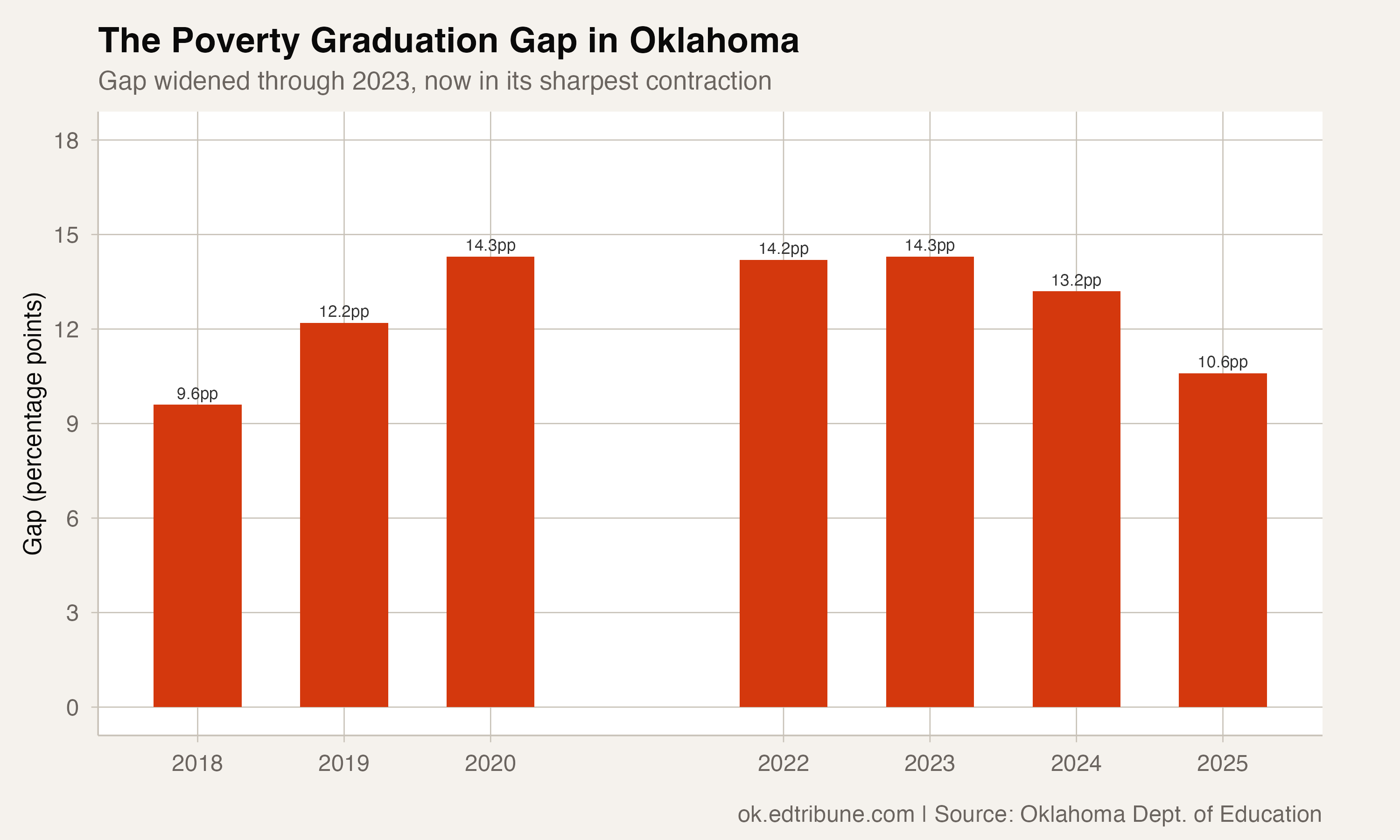
For five years, the graduation gap between Oklahoma students who are economically disadvantaged and their more affluent peers widened and then stuck. In 2018, students who are economically disadvantaged graduated 9.6 percentage points behind their non-disadvantaged classmates. The gap jumped to 14.3 points by 2020 and held near that level through 2023, a 50% increase that showed no sign of reversing.
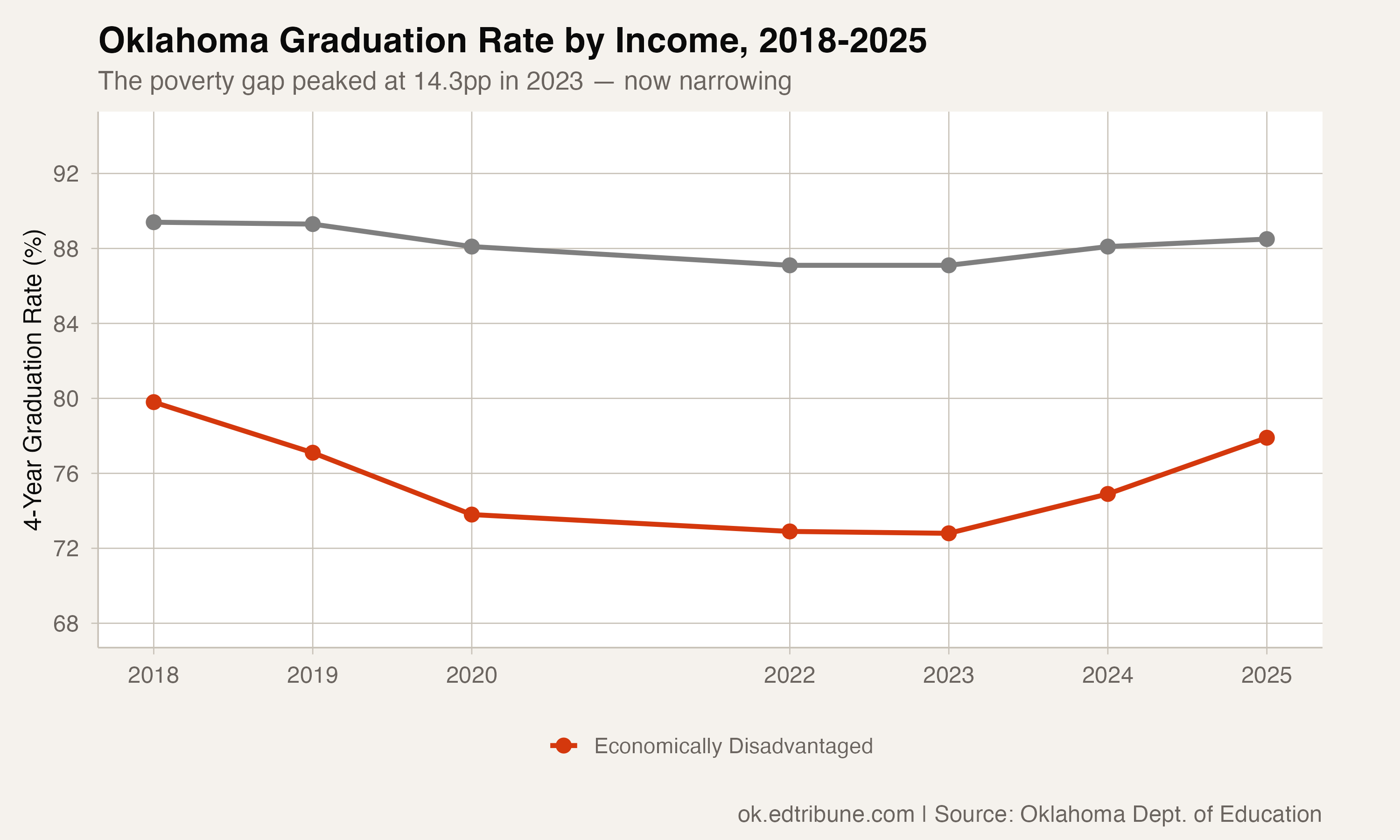
Then something shifted. In 2024, the gap contracted to 13.2 points. In 2025, it fell to 10.6. Students who are economically disadvantaged gained 5.1 percentage points in two years, from 72.8% to 77.9%, while non-disadvantaged students held essentially flat around 88.5%.
This is the first sustained narrowing of the graduation gap by income in seven years of Oklahoma data.
The shape of the gap
The trajectory tells a specific story. Non-disadvantaged students started high and slipped slightly, from 89.4% in 2018 to 87.1% in 2023. Students who are economically disadvantaged fell further, from 79.8% to 72.8% over the same period. The gap widened because that group's rate declined faster than the non-disadvantaged rate.
From 2018 to 2023, non-disadvantaged students lost 2.3 points while students who are economically disadvantaged lost 7 points. That uneven decline created the 14.3-point peak.
The reversal runs in the other direction. Students who are economically disadvantaged are now recovering fastest, gaining 5.1 points in two years. Non-disadvantaged students gained 1.4 points over the same period.
District variation
The statewide gap of 10.6 points hides wide district-level variation. In Choctaw-Nicoma Park, students who are economically disadvantaged graduated at 72.1% while the district overall hit 87.2%, a 15.1-point gap. Perry, Collinsville, and North Rock Creek all had gaps exceeding 11 points.
In some districts, the pattern flips. In Healdton, students who are economically disadvantaged graduated at 92.3% compared to the district's overall 83.7%. In Hulbert, Gore, and Mounds, students who are economically disadvantaged also outperformed the district average. These reversals tend to occur in small, rural districts where students who are economically disadvantaged may make up a majority of the student body, making the "disadvantaged" label less of a distinguishing marker.
What drove the recovery
The data does not isolate a single cause, but the timing is suggestive. Oklahoma expanded social-emotional learning programs and attendance interventions beginning in the 2023-24 school year. Several large districts implemented credit recovery and dropout prevention programs that served many students who are economically disadvantaged. Federal pandemic relief funds, which flowed heavily toward high-poverty schools, were deployed most intensively in the 2023 and 2024 school years.
Whether the gains persist as pandemic funding expires will be the test. Education equity gaps tend to close during periods of targeted investment and reopen when funding shifts. Oklahoma's 10.6-point gap by income, while improved, remains wider than it was in 2018.
The students behind the numbers
At 77.9%, Oklahoma graduates roughly three in four of its students who are economically disadvantaged on time. That means one in four does not, and in a state where over 60% of public school students qualify as economically disadvantaged, the scale is large.
The progress is real: this is the fastest two-year improvement for students who are economically disadvantaged in the data. The gap is closing because that group is gaining ground, while non-disadvantaged students hold steady. That distinction matters.
At the current pace, the gap by income returns to its 2018 level of 9.6 points within two years. But federal pandemic relief funds run out in 2025, and Oklahoma ranked 49th in per-pupil spending before the pandemic money arrived. The credit recovery programs, the attendance interventions, and the added counselors have to be paid for with state dollars now. If the money disappears, the gains probably do too.
The OKEdTribune is a data-driven publication covering K-12 education in Oklahoma. Subscribe at ok.edtribune.comET for weekly updates.
Detailed code that reproduces the analysis and figures in this article is available exclusively to EdTribune subscribers.
Discussion
Sign in to join the discussion.
Loading comments...