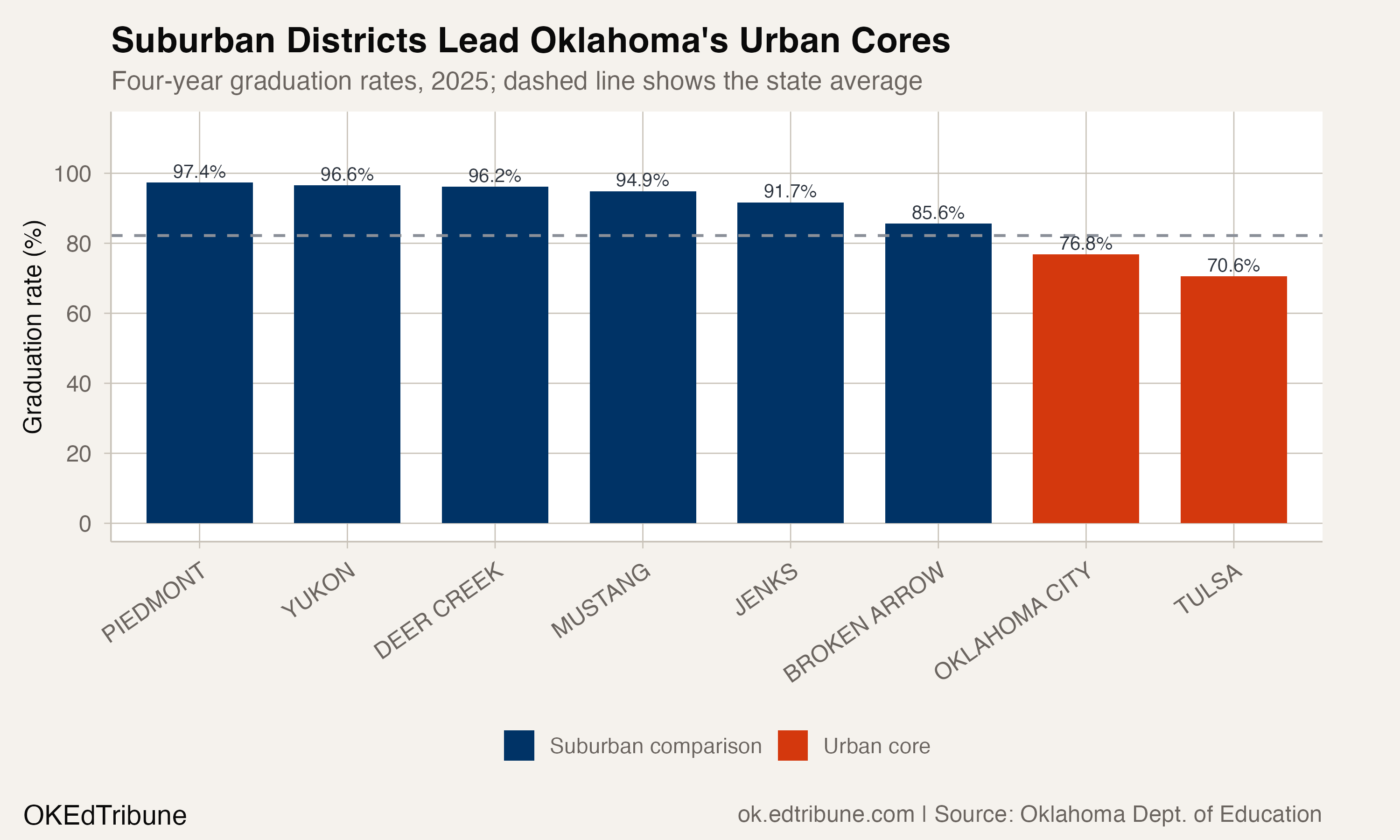
Piedmont↗ET posted a 97.4% graduation rate in 2025. Yukon↗ET posted 96.6%. Deer Creek↗ET posted 96.2%. Mustang posted 94.9%. Jenks posted 91.7%.
Those five districts were 14.9 to 26.8 percentage points above Oklahoma City Public Schools or Tulsa Public Schools in the same state graduation-rate file.
Oklahoma City graduated 76.8%. Tulsa graduated 70.6%.
The consistency of the gap
The suburban-urban graduation gap in Oklahoma is not a single-year phenomenon. In each available year from 2018 through 2025, Piedmont, Deer Creek, Yukon, Mustang, and Jenks stayed above the state average. Oklahoma City and Tulsa did not.
Oklahoma City's lowest point in the data was 68.9% in 2020. Tulsa's was 66.1% in 2024. The two urban districts improved in 2025, but neither reached the statewide rate of 82.2%.
Among all Oklahoma districts with five or more years of data, 129 exceeded the state average in every available year. The list includes the five suburban comparison districts in this story; it does not include Oklahoma City or Tulsa.
What the gap represents
The immediate objection to suburban-urban comparisons is demographics. Districts do not serve interchangeable student populations, and the graduation data alone cannot isolate why two districts differ.
But the subgroup data does not erase the gap. Oklahoma City's economically disadvantaged students graduated at 76.1% in 2025. Its students who were not economically disadvantaged graduated at 82.8%. Deer Creek's all-student rate was still 96.2%, 13.4 points higher than OKC's non-economically disadvantaged subgroup.
Broken Arrow provides an intermediate case: 85.6%, 15 points above Tulsa and 3.4 points above the state average. That does not prove demographics are irrelevant. It does show that Tulsa's gap is not simply the gap between a large district and everyone else.
The donut effect
Oklahoma's enrollment data tells a parallel story. From 2016 to 2026, Oklahoma City's enrollment fell 31.8% and Tulsa's fell 20.6%. Over the same span, Piedmont grew 50.6%, Deer Creek grew 45.1%, Mustang grew 24.4%, Yukon grew 12.5%, Jenks grew 6.0%, and Broken Arrow grew 4.8%.
Suggestive context: the enrollment pattern is consistent with a metro-area sorting story, but the package data does not prove why families moved or which specific students left each district. What the data can support is narrower and still stark: the high-graduation districts around Oklahoma's urban cores are also the districts that held or gained enrollment, while the two urban cores remained far below the suburban ring on graduation rates.
That makes the 2025 gap harder to dismiss as a one-year fluctuation. The suburban comparison districts are not just ahead. They have been above the state average every year in the graduation file, while Oklahoma City and Tulsa are still trying to climb back toward it.
The OKEdTribune is a data-driven publication covering K-12 education in Oklahoma. Subscribe at ok.edtribune.comET for weekly updates.
Detailed code that reproduces the analysis and figures in this article is available exclusively to EdTribune subscribers.
Discussion
Sign in to join the discussion.
Loading comments...