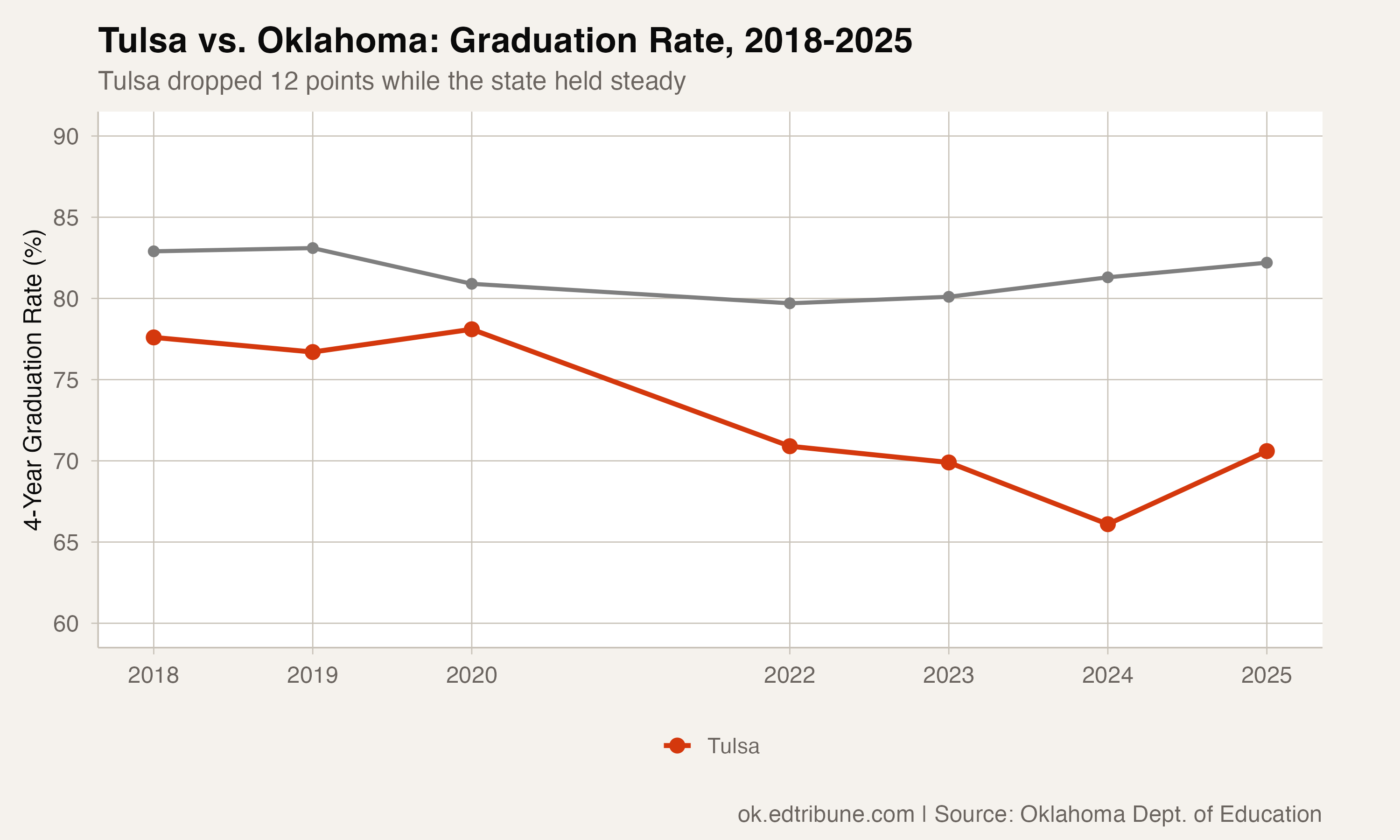
Tulsa Public Schools↗ET graduated 77.6% of its students in 2018. By 2024, the rate had fallen to 66.1% -- a collapse that opened the widest gap between a major district and the state average in seven years of data. Even after a partial recovery to 70.6% in 2025, Tulsa sits 11.6 points below the statewide rate and trails every large-district peer in the state.
The scale of the decline is difficult to attribute to any single cause. Chronic absenteeism runs at roughly 45% in Tulsa. The district has cycled through leadership changes. And the subgroup data suggests the collapse hit every demographic, not just one vulnerable population.
Every subgroup is below 75%
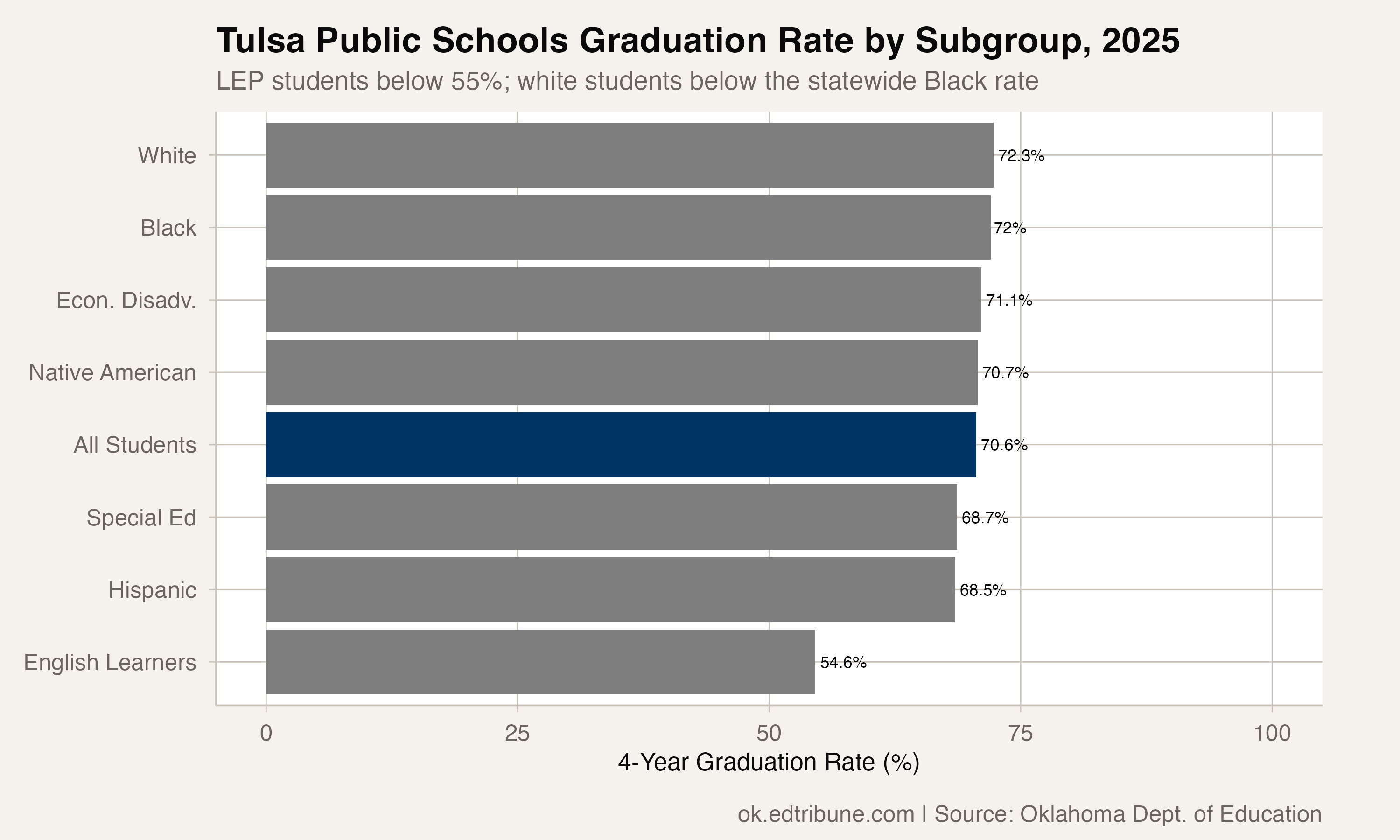
In most districts, at least one demographic clears the state average. In Tulsa, no subgroup does. English learners graduated at 54.6%, down from 71.1% in 2018 -- the steepest subgroup decline in the district. Hispanic students came in at 68.5%. Students in special education at 68.7%. The overall rate of 70.6% sits in the middle of a cluster where no subgroup breaks away from the pack.
The most striking number: white students in Tulsa graduated at 72.3%. That is lower than the statewide Black graduation rate of 78.2%. It is lower than every racial subgroup at the state level except English learners and students in special education. Whatever is happening in Tulsa is not confined to traditionally underperforming groups.
The peer comparison
Among Oklahoma's largest districts, the ranking is not close. Edmond graduates 91.5%. Moore, 88.7%. Broken Arrow, 85.6%. Norman, 84.1%. Putnam City, 81.9%. Lawton, which had its own dramatic collapse and recovery, is at 80.7%. Oklahoma City, with its own set of challenges, manages 76.8%.
Tulsa is last by 6.2 points.
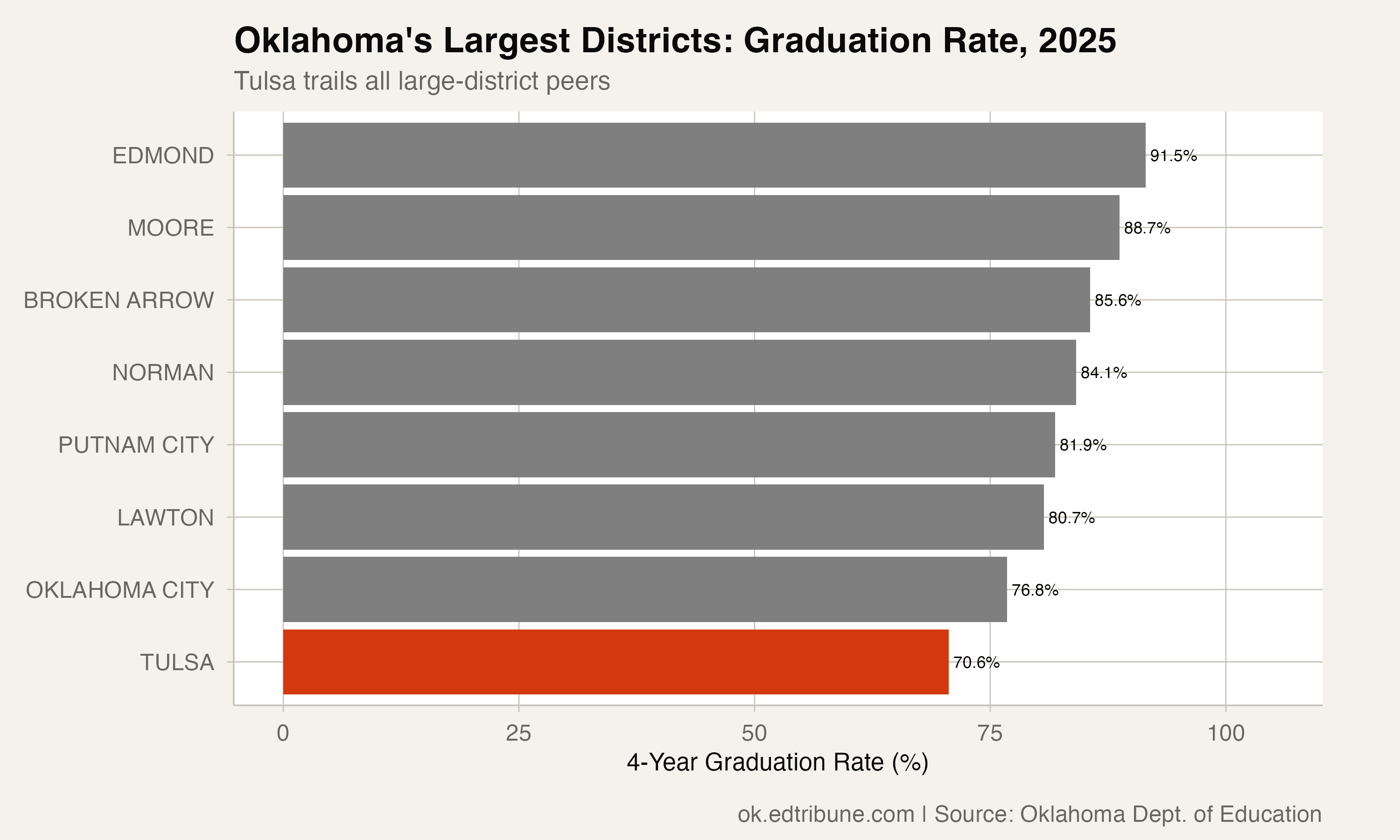
This is not a comparison between suburban affluence and urban poverty. Oklahoma City serves a similar demographic profile to Tulsa and graduates six points more of its students. Lawton, a military town with significant transient enrollment, manages ten points more. The gap between Tulsa and its peers has grown in nearly every year of the data.
The English learner decline
The trajectory of Tulsa's English learner graduation rate deserves particular attention. In 2018, LEP students in Tulsa graduated at 71.1% -- not far below the district average. By 2024, the rate had dropped to 44.7%. The 2025 figure of 54.6% represents a bounce, but it is still 16.5 points below where English learners stood seven years ago.
That kind of decline in a specific subgroup usually signals a structural problem: a change in how students are classified, a staffing shortage in bilingual programs, a breakdown in the support systems that keep students on track to graduate. Whatever produced the English learner collapse in Tulsa appears to be partially, but not fully, reversed.
What recovery looks like
The 4.5-point gain from 2024 to 2025 is the largest single-year improvement Tulsa has posted in the data. If the district sustains that pace, it would return to its 2018 level by 2027. But COVID recovery data across the country shows that the first years of rebound tend to be the largest, with gains tapering as districts run into harder problems.
Tulsa is still 6.1 points below its 2019 rate. The gap to the state average, which was 6.4 points in 2019, is now 11.6 points. The state improved during the same period that Tulsa declined, meaning Tulsa has to run just to stand still.
For a district that serves roughly 30,000 students in the state's second-largest city, the graduation rate is not an abstract metric. It is roughly 900 additional students per year who do not earn a diploma compared to where the district was seven years ago. That number accumulates.
The OKEdTribune is a data-driven publication covering K-12 education in Oklahoma. Subscribe at ok.edtribune.comET for weekly updates.
Detailed code that reproduces the analysis and figures in this article is available exclusively to EdTribune subscribers.
Discussion
Sign in to join the discussion.
Loading comments...