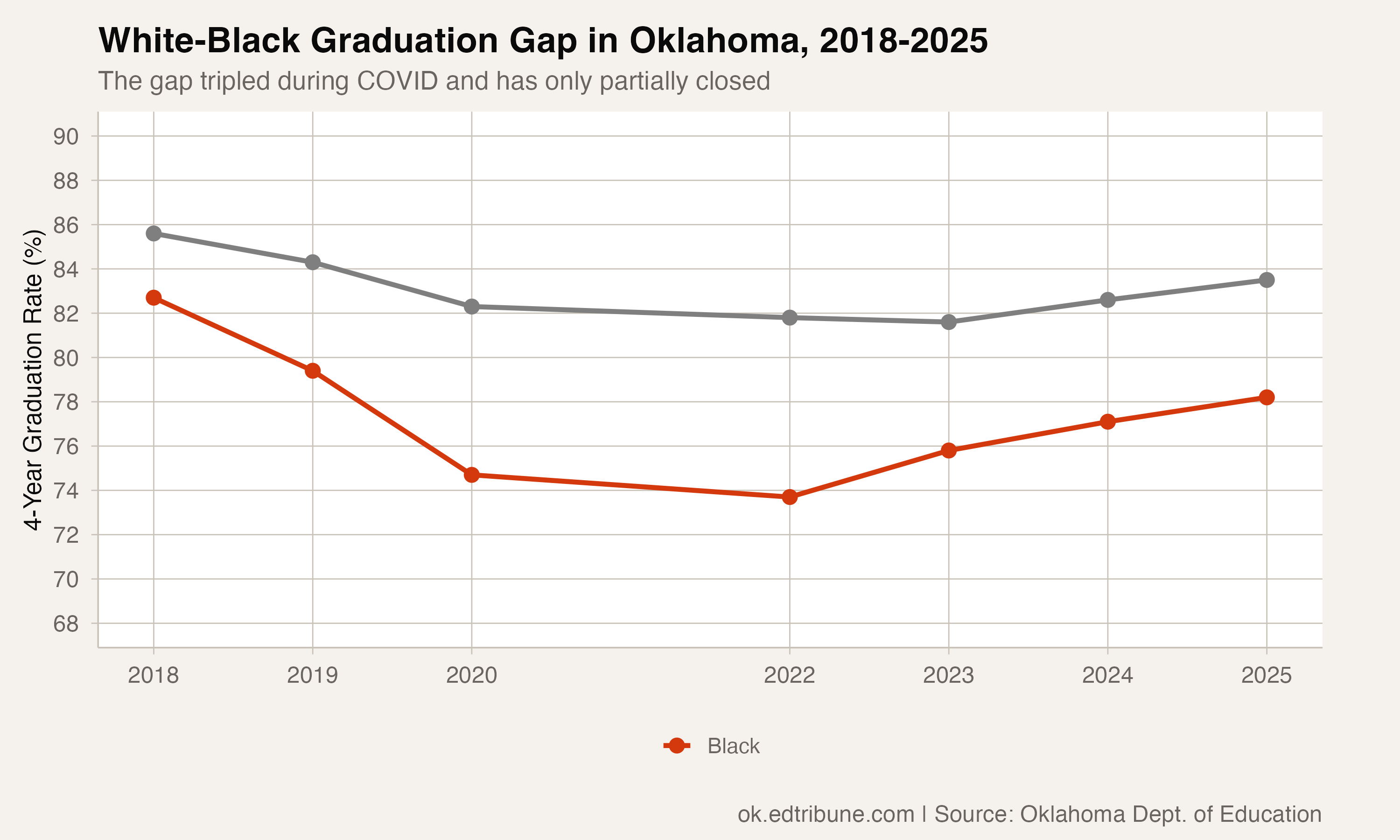
In 2018, Black students in Oklahoma graduated at 82.7%, nearly matching white students at 85.6%. The white-Black graduation gap was 2.9 percentage points, narrow enough to suggest the state was approaching equity on this measure.
COVID erased that progress. By 2022, the Black graduation rate had fallen to 73.7%, a loss of 9 percentage points. White students also declined, but less sharply, to 81.8%. The gap tripled from 2.9 points to 8.1 points in four years.
Three years of recovery have brought the Black rate back to 78.2% and narrowed the gap to 5.3 points. The progress is real but incomplete. Black students have recovered roughly half of what they lost, and they remain 4.5 points below where they were seven years ago.
The uneven recovery
The comparison to 2018 tells the story. White students graduated at 85.6% then and 83.5% now, a 2.1-point decline. Black students graduated at 82.7% then and 78.2% now, a 4.5-point decline. Both groups fell; Black students fell harder and have recovered less.
The pandemic did not create the gap. But it turned a near-parity situation into a meaningful disparity. In 2018, a Black student and a white student in Oklahoma had roughly the same chance of graduating on time. In 2025, the white student has a 5.3-point advantage.
Where the gap is widest
At the district level, the Black graduation rate varies widely. The lowest district figures sit in virtual charter schools: Insight Virtual Charter School of Oklahoma reports a Black graduation rate of 31.0%, and Epic Charter Virtual School reports 44.5%. At the other extreme, ten districts report Black graduation rates above 90%, led by Deer Creek at 97.1%.
The concentration of low Black graduation rates in virtual charter schools and in Tulsa (where Black students graduated at 72.0% in 2025) is worth noting. Tulsa is not a district where Black students have always struggled: its Black graduation rate was 80.3% in 2018. The current 72.0% represents a decline, not a baseline.
The broader context
Oklahoma's Black graduation rate of 78.2% sits below the national rate for Black students, which the National Center for Education Statistics put at about 81% in recent years. The state's overall rate also trails the national average, which NCES reports at roughly 87%. Black students in Oklahoma face a compounded disadvantage: they attend schools in a state that graduates students below the national rate, and within that state, they are the lowest-performing racial subgroup measured here.
The recent gains are real. Black students improved by 1.1 points from 2024 to 2025, and the white-Black gap narrowed for the second year in a row. Even so, the gap remains nearly twice as wide as it was in 2018, and the path back to that level of near-parity depends on improvement holding steady in a subgroup whose year-to-year trajectory has been anything but smooth.
The OKEdTribune is a data-driven publication covering K-12 education in Oklahoma. Subscribe at ok.edtribune.comET for weekly updates.
Detailed code that reproduces the analysis and figures in this article is available exclusively to EdTribune subscribers.
Discussion
Sign in to join the discussion.
Loading comments...