In most states, Native American students graduate at rates 10 to 17 percentage points below the state average. The national narrative around Native American education outcomes is one of persistent, deep disadvantage.
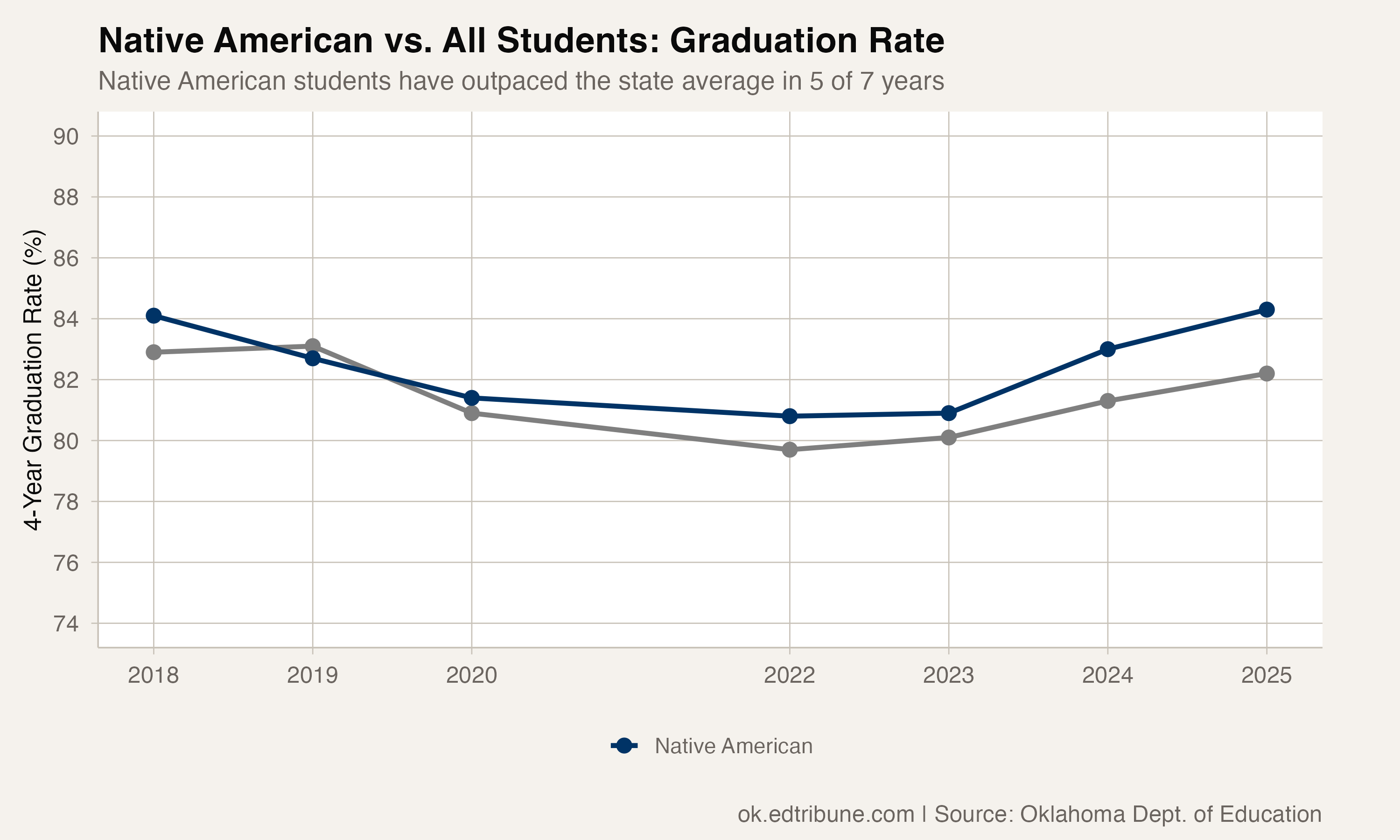
Oklahoma breaks that pattern. In 2025, Native American students graduated at 84.3% -- 2.1 points above the state average of 82.2%. This is not a one-year anomaly. Native American students have outperformed the statewide rate in six of the seven years of data.
The context
Oklahoma has the second-largest Native American population of any state. Thirty-nine federally recognized tribes are headquartered here. Unlike states where Native students are concentrated on isolated reservations with underfunded Bureau of Indian Education schools, Oklahoma's Native students attend public schools throughout the state, in districts large and small.
That structural difference matters. In states like South Dakota, Montana, or New Mexico, the graduation data for Native American students often reflects the outcomes of schools on reservations -- institutions that face distinct funding, staffing, and geographic challenges. Oklahoma's Native students are, in a sense, part of the broader public school system rather than a parallel one.
District-level outcomes
The district data reinforces the state-level finding. In 2025, multiple districts with significant Native American populations reported rates at or near 100%. Fort Gibson, where roughly a third of students are Native American, graduated 100% of its Native American students. Adair, Stilwell, and several eastern Oklahoma districts posted similarly strong numbers.
These districts tend to be in the eastern part of the state, within the Cherokee, Muscogee, and Choctaw Nations. Several tribal nations operate supplemental education programs -- tutoring, college readiness, wraparound services -- that complement what public schools provide.
Not universal
The Native American advantage is not universal across Oklahoma. Lawton's Native American graduation rate is 70.7% -- 13.6 points below the statewide Native American average. Tulsa's is also below the state level. The pattern holds strongly in smaller, eastern Oklahoma districts and less consistently in larger urban systems.
There is also a COVID story embedded in the data. The Native American rate dropped from 84.1% in 2018 to 80.8% in 2022 before recovering. The 3.3-point decline was comparable to the overall state decline of 3.2 points over the same period. By 2025, Native American students had fully recovered, reaching 84.3% -- their highest rate in the data.
What it tells us
The Oklahoma data is a reminder that population-level averages can obscure more than they reveal. The challenges facing Native American students in a remote Montana reservation school are different from those facing Native American students in a well-resourced eastern Oklahoma district with active tribal education support. Lumping them into a single national statistic misses the variation.
That said, the Oklahoma outcome is worth studying. Whatever combination of factors -- tribal education programs, school integration, community support, cultural continuity -- produces a consistent 2-point advantage for Native American students in the nation's second-most-Native state is relevant to any state seeking to close its own Native American graduation gap.
The OKEdTribune is a data-driven publication covering K-12 education in Oklahoma. Subscribe at ok.edtribune.comET for weekly updates.
Detailed code that reproduces the analysis and figures in this article is available exclusively to EdTribune subscribers.
Discussion
Sign in to join the discussion.
Loading comments...