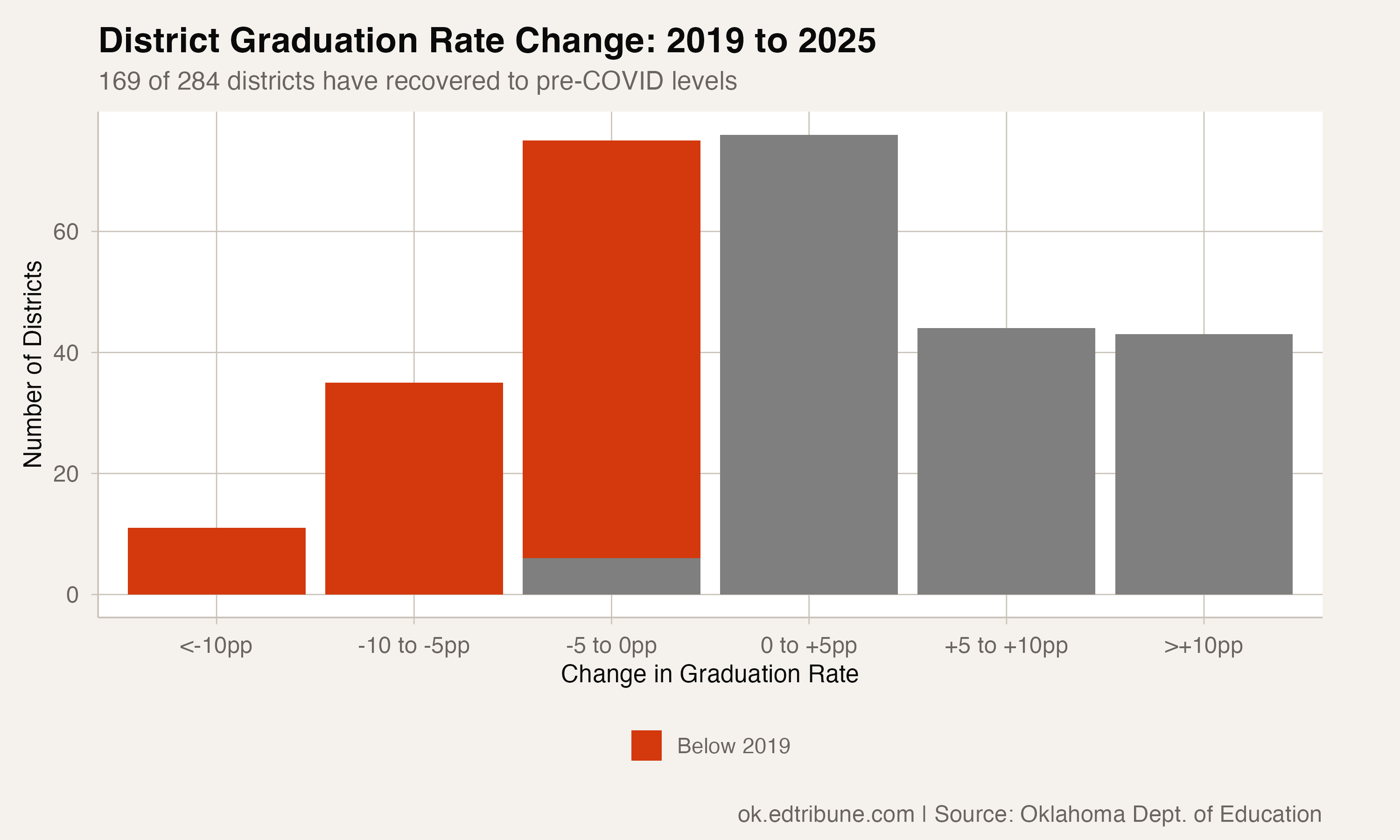
Five years after COVID disrupted education across Oklahoma, the graduation rate recovery remains unfinished. Of 284 districts with data in both 2019 and 2025, 169 have returned to or exceeded their pre-COVID graduation rate. That is 59.5%, a solid majority, but one that leaves 115 districts still below where they stood six years ago.
The mean change across all districts is positive: +2.8 percentage points. Oklahoma's graduation picture is, on average, better than it was in 2019. But averages conceal the districts that have not recovered and, in some cases, have fallen further behind.
The non-recoverers
The districts still below 2019 levels include some of Oklahoma's most consequential school systems. Tulsa↗ET remains 6.1 points below its 2019 rate. Ponca City↗ET has lost 11.2 points. Wellston↗ET, 17 points. Seiling↗ET, 21.4 points.
RELATED: Tulsa's Graduation Rate Fell 12 Points in Four Years. It Has Only Partly Recovered.ET
The list also includes mid-size towns like Davis↗ET (-15.3 points), Crescent↗ET (-13.5 points), and Rattan↗ET (-12 points). These are not tiny districts where a handful of students swings the rate. They are communities where meaningfully fewer students are graduating on time compared to six years ago.
The districts still below 2019 don't share an obvious profile. Some are urban, some rural. Some serve large shares of students who are economically disadvantaged, others do not. What they have in common is that whatever disrupted their graduation pipeline during COVID, whether absenteeism, staff turnover, family instability, or reduced engagement, has not fully resolved.
The recoverers
On the other side, the districts that have recovered tend to fall into two categories. Suburban districts like Deer Creek↗ET, Piedmont↗ET, and Yukon↗ET barely stumbled and are now well above their 2019 levels. And a set of small, rural districts that experienced sharp declines have bounced back completely. Fort Gibson↗ET's 52% in 2019 became 99.1% in 2025.
The geographic pattern is suggestive. Eastern Oklahoma, with its tribal education infrastructure, has recovered more completely than western Oklahoma. The I-44 corridor suburbs have recovered more completely than rural communities on either side.
The deceleration concern
The state's three-year recovery streak, from 79.7% in 2022 to 82.2% in 2025, has been real but decelerating. The gains went from +0.4 to +1.2 to +0.9 points per year. If that deceleration continues, the recovery could plateau before the state returns to its 2019 peak of 83.1%.
For the 115 non-recovered districts, the question is more acute. Some may simply need another year or two of the same trajectory. Others may have settled into a new, lower equilibrium from which additional improvement requires different interventions.
What five years tells us
For most Oklahoma districts, the COVID disruption to graduation rates looks temporary and resolvable. A majority have recovered. The state average sits within a point of its pre-pandemic level. The system took the shock and, slowly, worked its way back.
For four in ten districts, though, the disruption is entering its sixth year. At some point a graduation rate that has stayed below its pre-COVID level for half a decade stops reading as a pandemic effect and starts reading as the new baseline. The data can't say exactly when that line gets crossed. But it does raise a harder question for districts like Seiling and Ponca City: whether what they need now is a different approach, not just more time.
The OKEdTribune is a data-driven publication covering K-12 education in Oklahoma. Subscribe at ok.edtribune.comET for weekly updates.
Detailed code that reproduces the analysis and figures in this article is available exclusively to EdTribune subscribers.
Discussion
Sign in to join the discussion.
Loading comments...