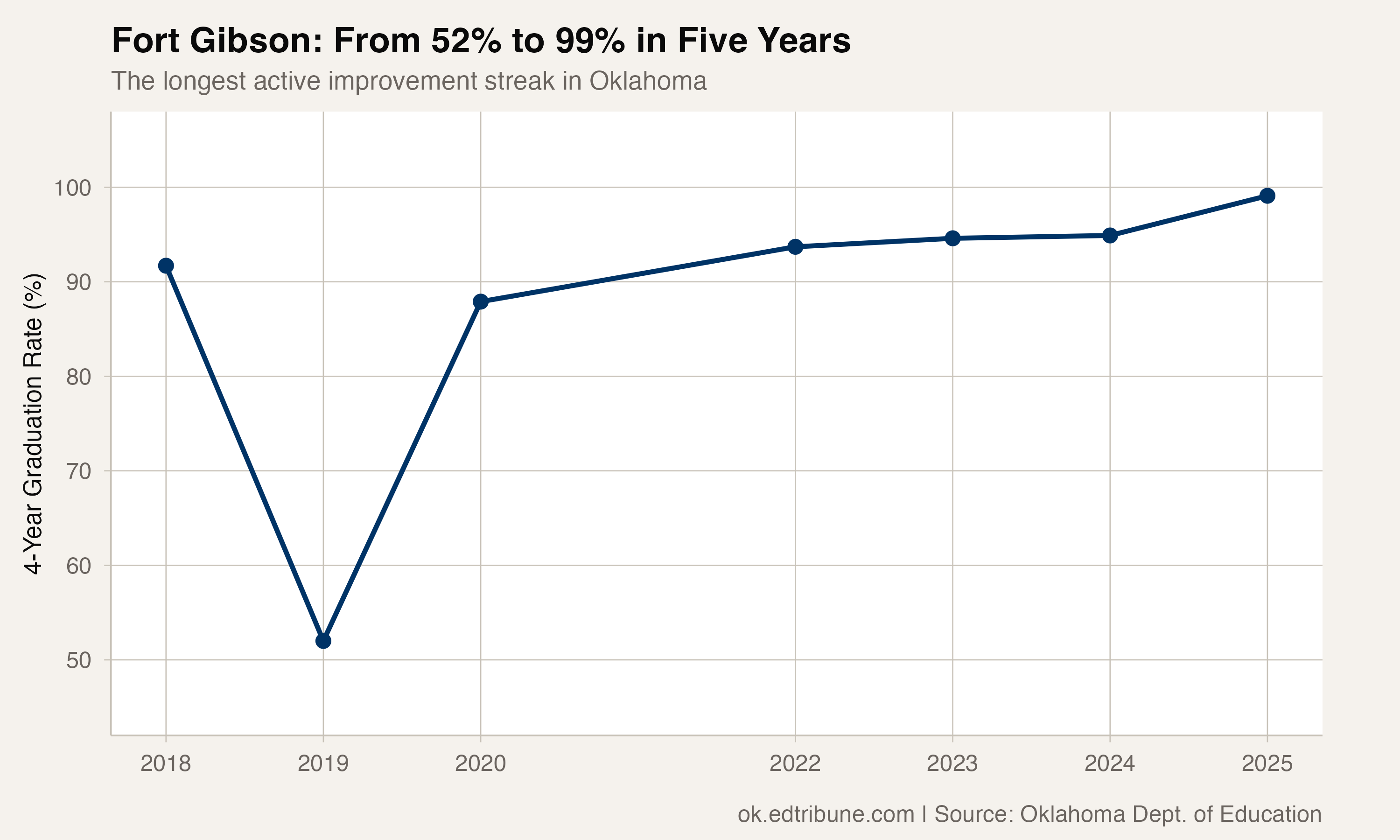
Fort Gibson↗ET is a small district east of Muskogee, tucked into the rolling hills where the Arkansas and Grand Rivers converge. It serves several hundred students per graduating class, a meaningful share of whom are Native American. In 2018, it graduated 91.7%.
Then something went wrong. In 2019, the rate plunged to 52%, a 40-point drop in a single year that is almost certainly anomalous. Whether a reporting error, a cohort classification problem, or a genuine disruption in the district, the data shows 52%.
What happened next is the story. Fort Gibson posted five consecutive years of improvement: 87.9% in 2020, 93.7% in 2022, 94.6% in 2023, 94.9% in 2024, and 99.1% in 2025. It is the longest active improvement streak in Oklahoma.
The subgroup numbers
The 2025 subgroup data is striking. Economically disadvantaged students graduated at 100%. Native American students graduated at 100%. White students graduated at 97.7%. Each of those groups reached its highest level anywhere in the seven years of data the state publishes.
This is a small district, and small cohorts produce volatile numbers. A single student either graduating or not can swing the rate by a point or more. But the consistency of the five-year streak, and the convergence of every subgroup toward near-perfection, suggests something beyond favorable math.
The 2019 question
Any honest reading of the Fort Gibson data must grapple with 2019. The district went from 91.7% in 2018 to 52% in 2019 and back to 87.9% in 2020. Drops of that magnitude in a single year, without a catastrophic event, typically indicate a reporting or classification issue: students counted in the cohort who should not have been, or a change in how graduates were categorized.
The data does not explain the anomaly, and without it, Fort Gibson's trajectory would look like a steady climb from the high 80s to 99%. The turnaround narrative is powerful, but it may be partly an artifact of measuring from an artificial low point.
What is not artifactual is the endpoint. Whatever happened in 2019, the district is now at 99.1% with equity gaps effectively eliminated. That outcome is real.
Context in eastern Oklahoma
Fort Gibson sits in a region with strong tribal education support. The Cherokee Nation, whose jurisdictional boundaries include Fort Gibson, operates supplemental education programs that provide tutoring, college readiness assistance, and wraparound services. Several nearby districts in the same region report strong Native American graduation rates too: Adair↗ET at 100%, Stilwell↗ET at 96.4%, and Vian↗ET at 85.7% in 2025.
Whether the tribal support system is the mechanism, or whether it is one of several contributing factors, the eastern Oklahoma corridor stands out as a region where small, diverse districts are producing graduation rates that rival or exceed wealthy suburban systems. Fort Gibson is the most extreme example of that pattern.
The OKEdTribune is a data-driven publication covering K-12 education in Oklahoma. Subscribe at ok.edtribune.comET for weekly updates.
Detailed code that reproduces the analysis and figures in this article is available exclusively to EdTribune subscribers.
Discussion
Sign in to join the discussion.
Loading comments...