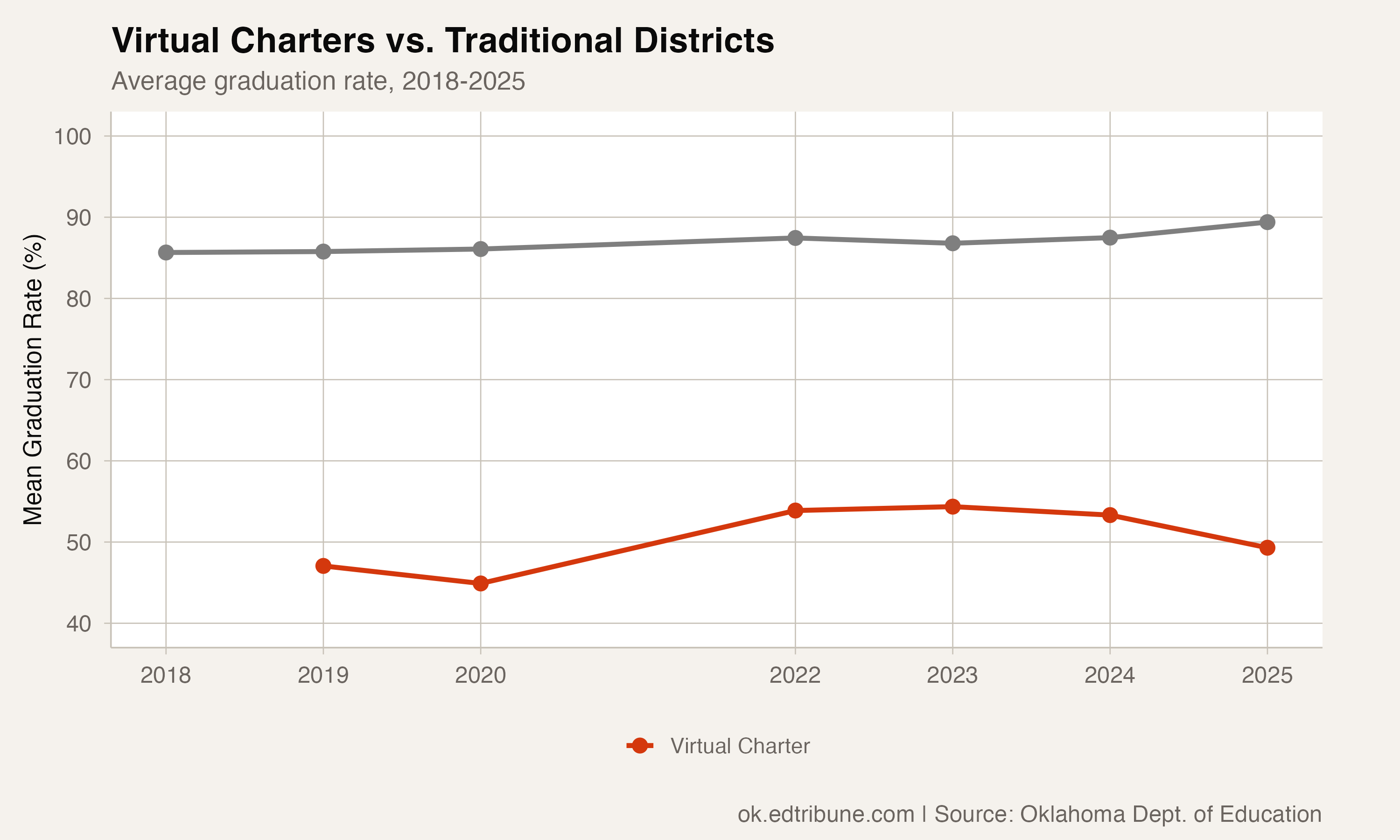
Oklahoma's traditional school districts graduated 89.4% of their seniors on time in 2025, the highest rate in the seven years of state data. The state's five virtual charter schools averaged 49.3%. That is a forty-point gap, and four of the five lowest-graduation-rate districts in Oklahoma are not failing urban schools or underfunded rural districts. They are virtual charters.
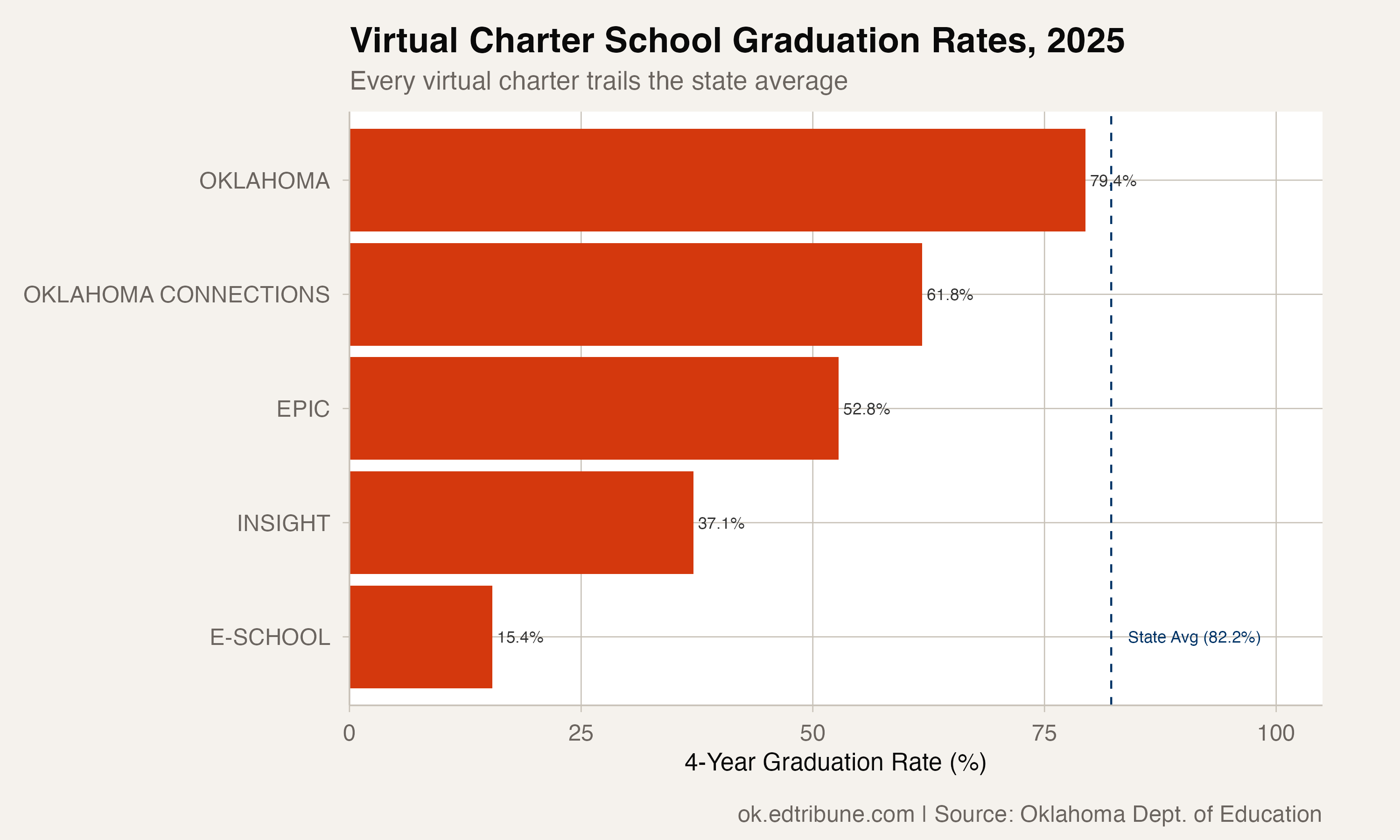
The numbers are stark. E-School Virtual Charter Academy posted a 15.4% four-year graduation rate in 2025, roughly one in six students finishing on time. Insight Virtual Charter School graduated 37.1%. Epic Charter Virtual School, the successor to what was once the state's largest school system before a fraud scandal, graduated 52.8%. Oklahoma Connections Academy, 61.8%. Oklahoma Virtual Charter Academy, the sector's relative success story, managed 79.4%.
The gap is widening as traditional districts climb
The size of the gap is one piece. The direction is the other. In 2022, virtual charters averaged 53.9%. By 2025, the average had fallen to 49.3%. Traditional districts moved the opposite way, from 87.4% to 89.4%. The sector that was supposed to expand access to education is delivering worse outcomes year after year while the schools it was meant to compete with keep improving.
Inside Epic's numbers
Epic Charter Schools collapsed in a spectacular fashion. Its co-founders, Ben Harris and David Chaney, were arrested on fraud charges in 2022. The school system that once enrolled 59,000 students has splintered into separate entities, and the numbers coming out of the surviving ones are grim.
At Epic Charter Virtual School in 2025, students who are Black graduated at 44.5%. Students who are English learners graduated at 40.1%. Students who are economically disadvantaged graduated at 48.5%. Students who are Hispanic graduated at 48.3%. Students who are white, the largest demographic, graduated at 55.7%. None of those groups cleared 60%.
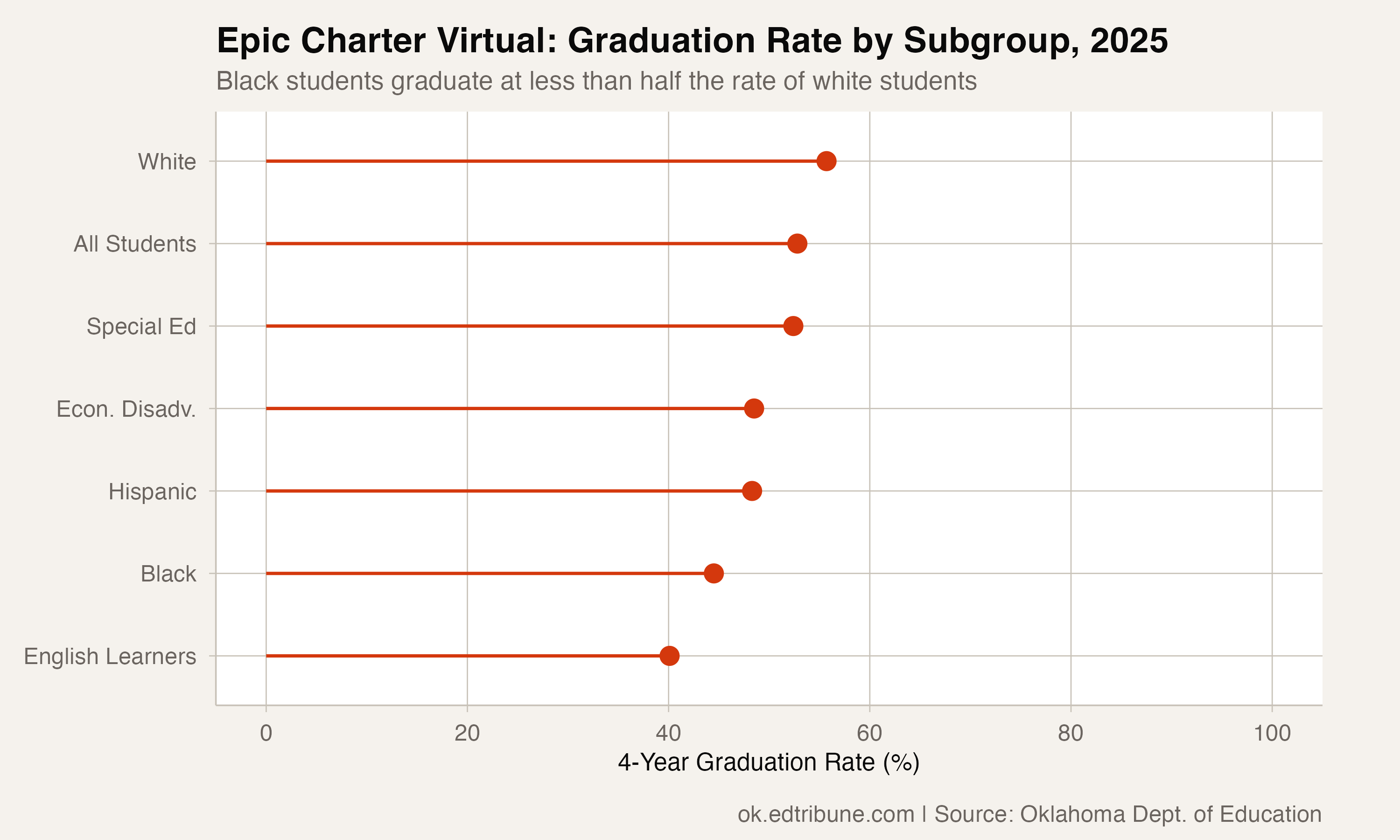
These are not the outcomes of a system working for its most vulnerable students.
E-School: 15.4%
E-School Virtual Charter Academy's 15.4% rate deserves its own moment. Among students who are economically disadvantaged enrolled there, 10.9% graduated on time. For students who are white, who statewide are typically the highest-performing demographic, the rate was 16.3%.
A school that graduates roughly one in six of its general population, and one in ten of its students who are low-income, is not a school in crisis. It is a school that has already failed.
What the first traditional district looks like
The first non-virtual school to appear on the list is Gore, at 67.7%. That is a genuinely struggling traditional district. But it is 52 points above E-School and roughly 18 points above the virtual charter average. The worst traditional district in Oklahoma outperforms the average virtual charter by a wide margin.
The median traditional district graduates 90.4% of its students. The median virtual charter graduates 52.8%.
The accountability question
Oklahoma's school accountability system gave these schools passing grades even as fewer than half their students earned diplomas. The state assigned letter grades to schools based on a formula that weighted academic growth and other factors alongside graduation rates. A virtual charter could receive a "C" or "B" while graduating a minority of its cohort.
That disconnect, between what the data shows and what the accountability system signals to parents, is at the heart of the virtual charter question. Families choose these schools believing they offer a viable alternative. The graduation data suggests that for many students, particularly students who are Black and students who are English learners, the alternative is considerably worse than what they left behind.
A sector problem, not a single-school problem
It would be convenient to blame Epic and move on. Epic's scandal was real, its fraud was documented, and its post-scandal graduation numbers are abysmal. But the problem runs through every virtual charter in the state. Insight, which was never part of the Epic organization, graduates 37.1%. Oklahoma Connections Academy, run by national operator Pearson, manages 61.8%. These are different organizations with different leadership, serving different student populations, and all of them fall well short of the traditional sector.
The data does not tell us why. Virtual schools often attract students who have already disengaged from traditional education, students who may have been on track to not graduate regardless of where they enrolled. But that explanation, even if partly true, does not explain a sector-wide average of 49.3%, or the fact that the average is declining while the traditional sector improves.
What the data does tell us is that Oklahoma's virtual charter sector, collectively, is the weakest link in the state's graduation rate chain. Since 2022, traditional districts have climbed two full points to 89.4% while virtual charters have lost more than four. The two sectors are moving in opposite directions.
The OKEdTribune is a data-driven publication covering K-12 education in Oklahoma. Subscribe at ok.edtribune.comET for weekly updates.
Detailed code that reproduces the analysis and figures in this article is available exclusively to EdTribune subscribers.
Discussion
Sign in to join the discussion.
Loading comments...