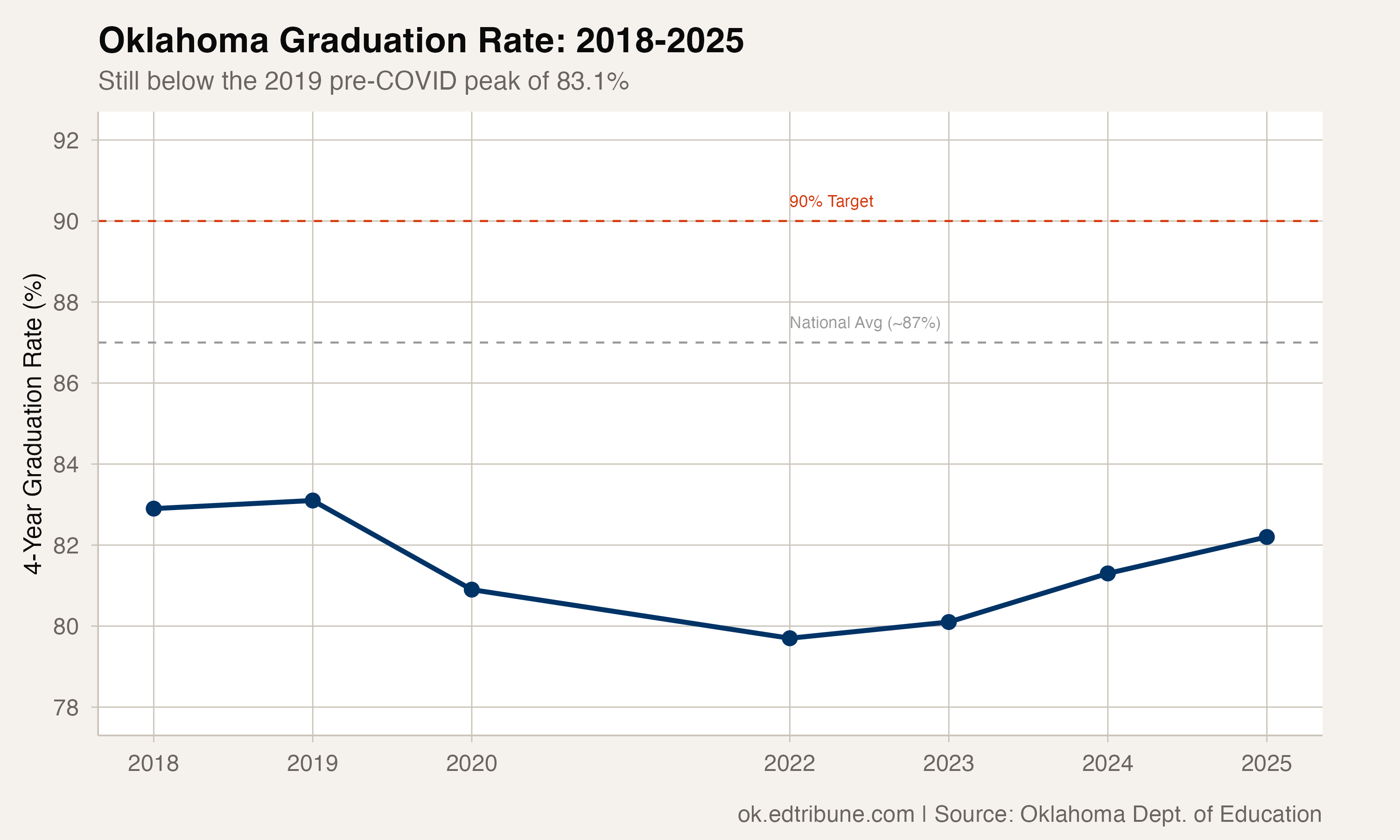
Three years of steady improvement have pushed Oklahoma's four-year graduation rate to 82.2% for the class of 2025. In any other context, that would be good news. But 82.2% is still nine-tenths of a percentage point below where the state stood in 2019, before COVID shattered the trajectory.
The recovery has followed a familiar shape: a sharp drop, a slow climb, and a plateau that keeps the finish line just out of reach. Oklahoma cratered to 79.7% in 2022 -- the lowest rate in the data -- then gained 2.5 points over three years. The gains, though, are decelerating. The jump from 2022 to 2023 was a modest 0.4 points. The next year brought 1.2. Then 0.9.
At that pace, Oklahoma would not cross 90% -- the threshold the state's own strategic plan targets -- until 2035. The national average sits around 87%, leaving Oklahoma nearly five points behind.
The landscape beneath the average
The statewide rate obscures two very different Oklahomas. Among the 293 districts that reported graduation data in 2025, the median rate was 90.2% -- eight points higher than the statewide average. Sixty-seven districts graduated 95% or more of their students. Twelve graduated every single one.
At the other end, eight districts fell below 70%. Four of those are virtual charter schools, whose dismal outcomes drag down the statewide number.
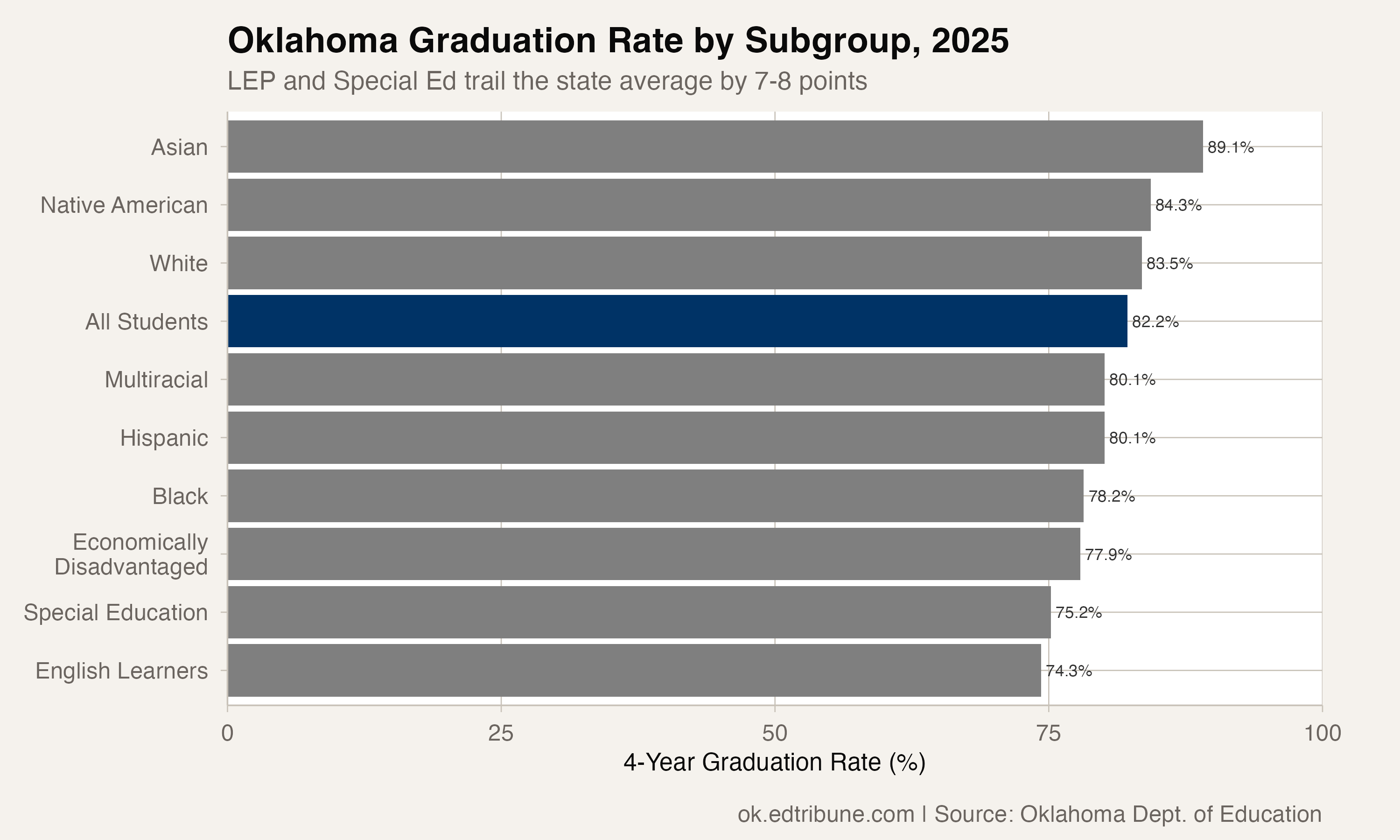
Asian students led all subgroups at 89.1%, the only group approaching the 90% target. Native American students graduated at 84.3% -- above the state average, bucking the national pattern where Native students typically trail by 10 to 17 points. White students (83.5%) and Hispanic students (80.1%) were close to the average. Black students (78.2%), economically disadvantaged students (77.9%), special education students (75.2%), and English learners (74.3%) brought up the rear.
A recovery that reaches about six in ten districts
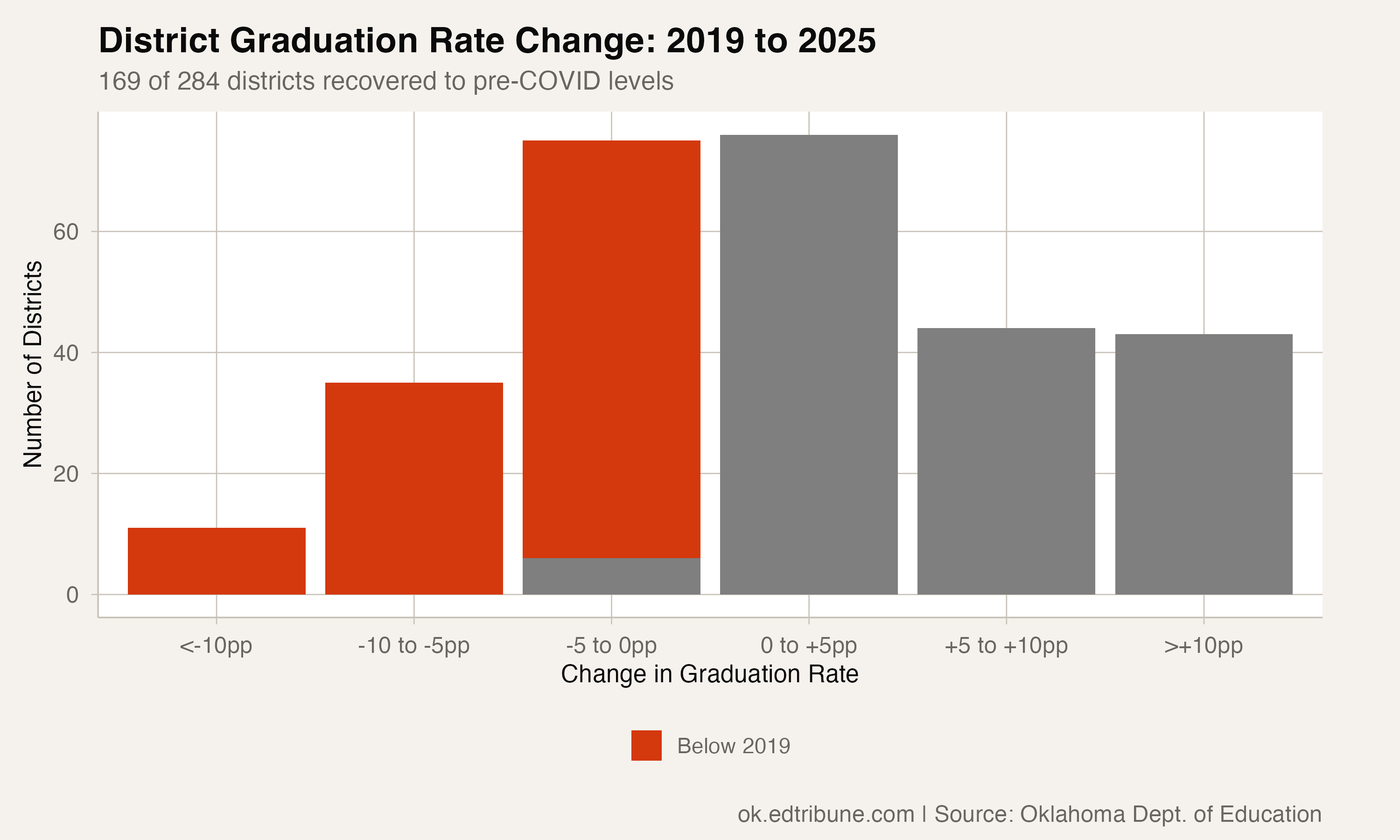
Of the 284 districts with data in both 2019 and 2025, 169 have recovered to or exceeded their pre-COVID graduation rate. That leaves 115 -- about four in ten -- still below where they were six years ago.
The non-recoverers include some of the state's most consequential districts. Tulsa Public Schools is 6.1 points below its 2019 level. Ponca City lost 11.2 points. Wellston lost 17. These are not small fluctuations in tiny cohorts.
The recoverers skew suburban and small-town. Deer Creek, Piedmont, and Yukon never really stumbled. The districts still underwater tend to be the ones serving more economically disadvantaged students, more English learners, more students whose lives were most disrupted by the pandemic and its aftermath.
The year-over-year picture
Looking just at 2024 to 2025, 169 districts improved, seven held flat, and 101 declined. The broad base of improvement is real -- a majority of districts are moving in the right direction. But the deceleration in year-over-year gains (from 1.2 points to 0.9 points at the state level) suggests the easiest recovery gains have already been captured.
The CORE curriculum question
A federal order adds uncertainty to the trajectory. The U.S. Department of Education directed Oklahoma to stop counting students who completed the alternate CORE curriculum -- which substitutes a CareerTech course for a math or science credit -- in the graduation rate. Roughly 6 to 7% of Oklahoma graduates follow this pathway. If the change takes full effect, it could shave several points off the statewide rate, potentially pushing it back below 80%.
The state legislature is working on a fix, but the calculation change may already be affecting 2025 figures. It adds a footnote of caution to any celebration of the three-year recovery streak.
What the data says about what comes next
Oklahoma's graduation rate earned a "D" on the state's own report card. The 90% target the state set for itself requires nearly eight more points of improvement -- a gap that, at the current pace, would take a decade to close.
The good news is structural: 151 of 293 districts already graduate more than 90% of their students. The state's problem is not a universal failure but a set of deep, concentrated challenges in urban districts, virtual charters, and pockets of rural Oklahoma where the recovery has not arrived.
A climbing statewide average, driven largely by districts that were already doing well, papers over a Tulsa at 70.6% and a virtual charter sector averaging 49.3%. Those two Oklahomas pull the same number in opposite directions, and the state's "D" grade will not change until the bottom catches the top.
The OKEdTribune is a data-driven publication covering K-12 education in Oklahoma. Subscribe at ok.edtribune.comET for weekly updates.
Detailed code that reproduces the analysis and figures in this article is available exclusively to EdTribune subscribers.
Discussion
Sign in to join the discussion.
Loading comments...