Guymon↗ET sits in Oklahoma's Panhandle, where agriculture and meatpacking have shaped the town for decades. The Oklahoma Historical Society identifies Seaboard as the area's largest employer in the early 2000s and says agriculture drew a large Hispanic population to Guymon. A 2015 KOSU report described Guymon Public Schools as about 70% Hispanic and said students spoke 27 languages; a 2018 KGOU story reported 37 languages in the district. The district's current website still highlights 12 languages.
That is the context for a school system that looks like a hard case on paper: rural, multilingual, and serving many students who enter school needing English-language support.
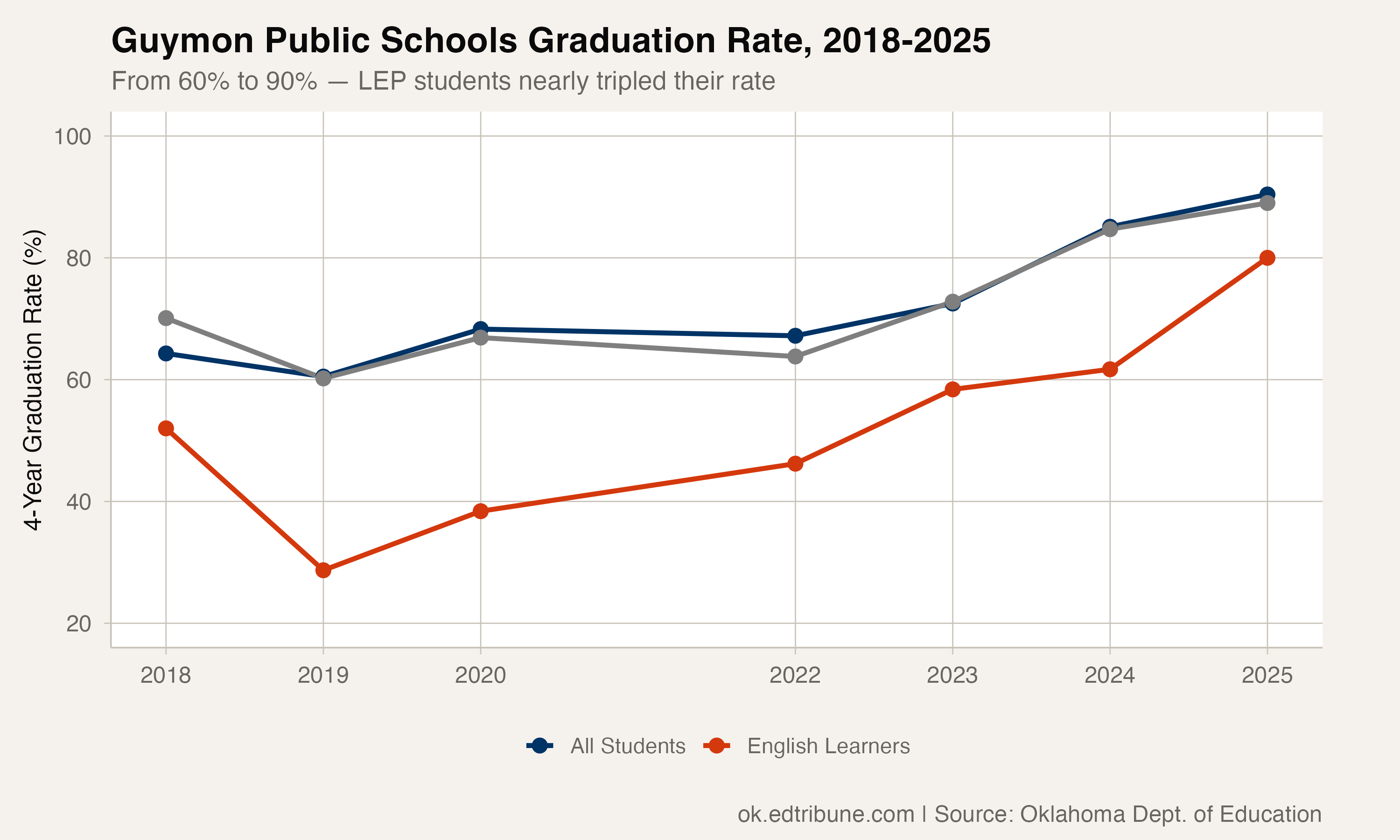
In 2019, Guymon graduated 60.5% of its students. The English learner rate was 28.7%. By any standard measure, the district was failing its students.
Six years later, Guymon's overall graduation rate is 90.4%. Hispanic students graduate at 89%. And English learners -- the group furthest behind in 2019 -- graduate at 80%, nearly tripling their rate.
The scale of the turnaround
A 29.9-percentage-point gain in six years, in a 3,009-student district built around language transition, is one of the largest improvements in Oklahoma. Among districts enrolling at least 3,000 students in 2025, only Oklahoma Virtual Charter Academy posted a larger gain from 2019 to 2025. The trajectory has been consistent: each reported year from 2022 to 2025 brought improvement, with gains of 5.3, 12.6, and 5.3 points in consecutive years.
This is not a single-year bounce driven by a favorable cohort. It is a sustained upward move across multiple classes of students.
The English learner trajectory is the most striking. From 28.7% in 2019 to 80% in 2025 is a transformation that suggests a fundamental change in how the district serves students who arrive with limited English. When fewer than three in ten students finish on time, the problem is structural. When eight in ten do, something structural has changed.
What Guymon means for the state
Oklahoma's English learner population is growing. Statewide, LEP students graduate at 74.3% -- 7.9 points below the average and the lowest rate of any subgroup. Districts across the state are grappling with how to serve students who need language support while keeping them on track for a diploma.
Guymon offers an existence proof. A small, rural district in the most remote corner of the state managed to build a system that graduates 80% of its English learners. The statewide LEP rate trough was 65.4% in 2019. Guymon was well below even that floor, and now sits above the state average for all students.
The circumstances that produced Guymon's student body -- immigration tied to meatpacking and agriculture -- are documented local context, not a causal explanation the graduation data can prove. What matters is whether the district's approach can be studied and adapted.
The numbers do not tell us why
The data shows what happened but not how. The graduation rate data does not include information about specific programs, staffing changes, or instructional models. What it shows is a sustained pattern of improvement that spans multiple subgroups and multiple years -- the kind of pattern that typically reflects institutional rather than incidental change.
In a state where Tulsa, the largest district by 2025 enrollment, graduates 70.6% of its students, a rural Panhandle town graduating 90.4% of its multilingual students is the kind of outlier that deserves attention.
Detailed code that reproduces the analysis and figures in this article is available exclusively to EdTribune subscribers.
Discussion
Sign in to join the discussion.
Loading comments...