The last time Oklahoma lost this many students in a single year, schools were closed, parents were afraid to send children to classrooms, and a pandemic had upended American life. This time there is no pandemic.
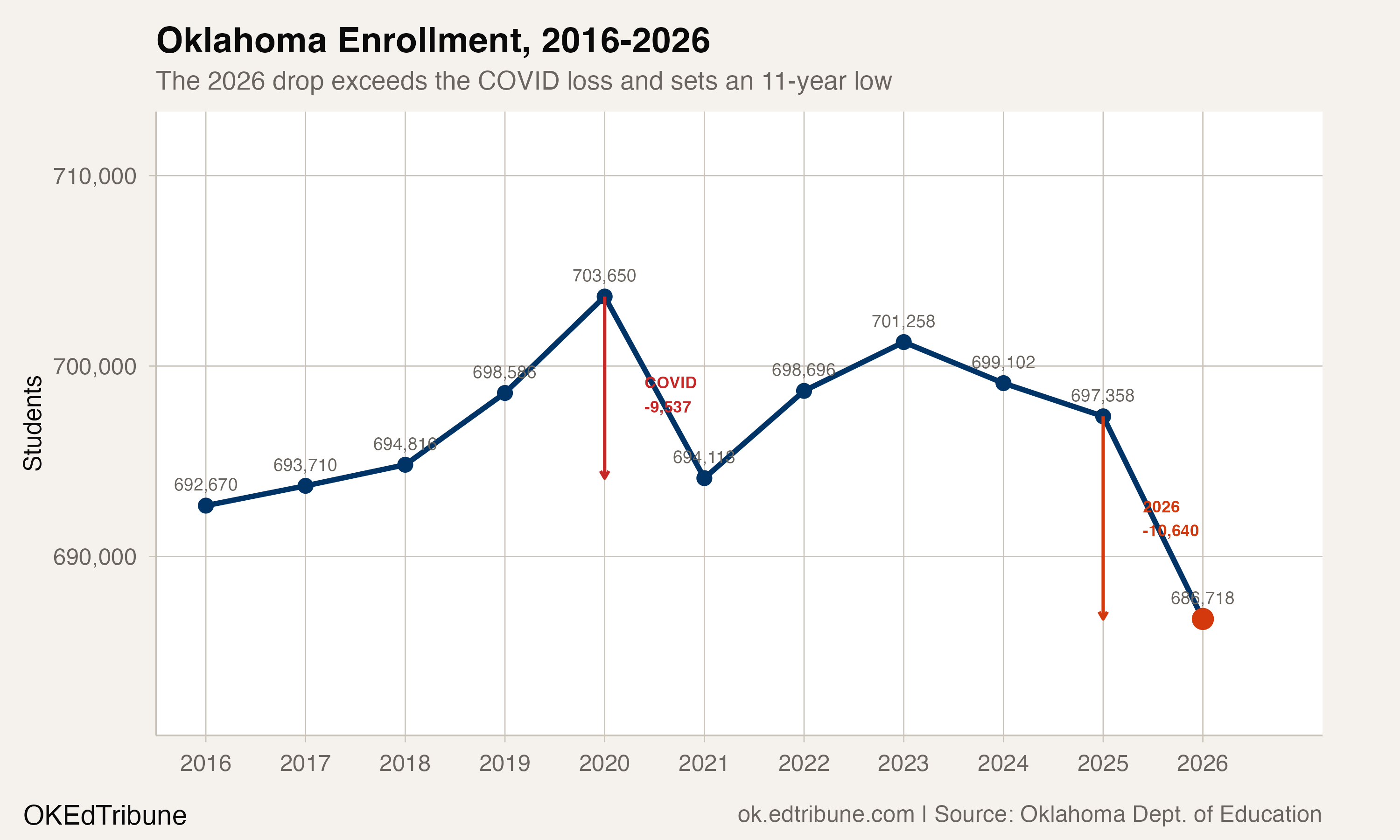
Oklahoma's public schools enrolled 686,718 students in the 2025-26 October count, a drop of 10,640 from the prior year, 1.5% of the student body. That loss exceeds the 9,537-student COVID drop of 2020-21 by more than 1,100 students, making it the largest single-year decline in the state's 11-year enrollment dataset. The state now sits 7,395 students below the COVID-era floor it hit in 2021, at the lowest enrollment recorded since at least 2015-16.
A false recovery
The trajectory since 2020 tells the story in two acts. After the COVID plunge, Oklahoma clawed back 7,145 students over two years, recovering 74.9% of the loss by 2022-23. That partial recovery peaked at 701,258 students. Then enrollment reversed again: small losses of 2,156 and 1,744 in the next two years, followed by the 10,640-student cliff in 2025-26. The three-year post-recovery slide has now erased 14,540 students, more than 1.5 times the original COVID loss.
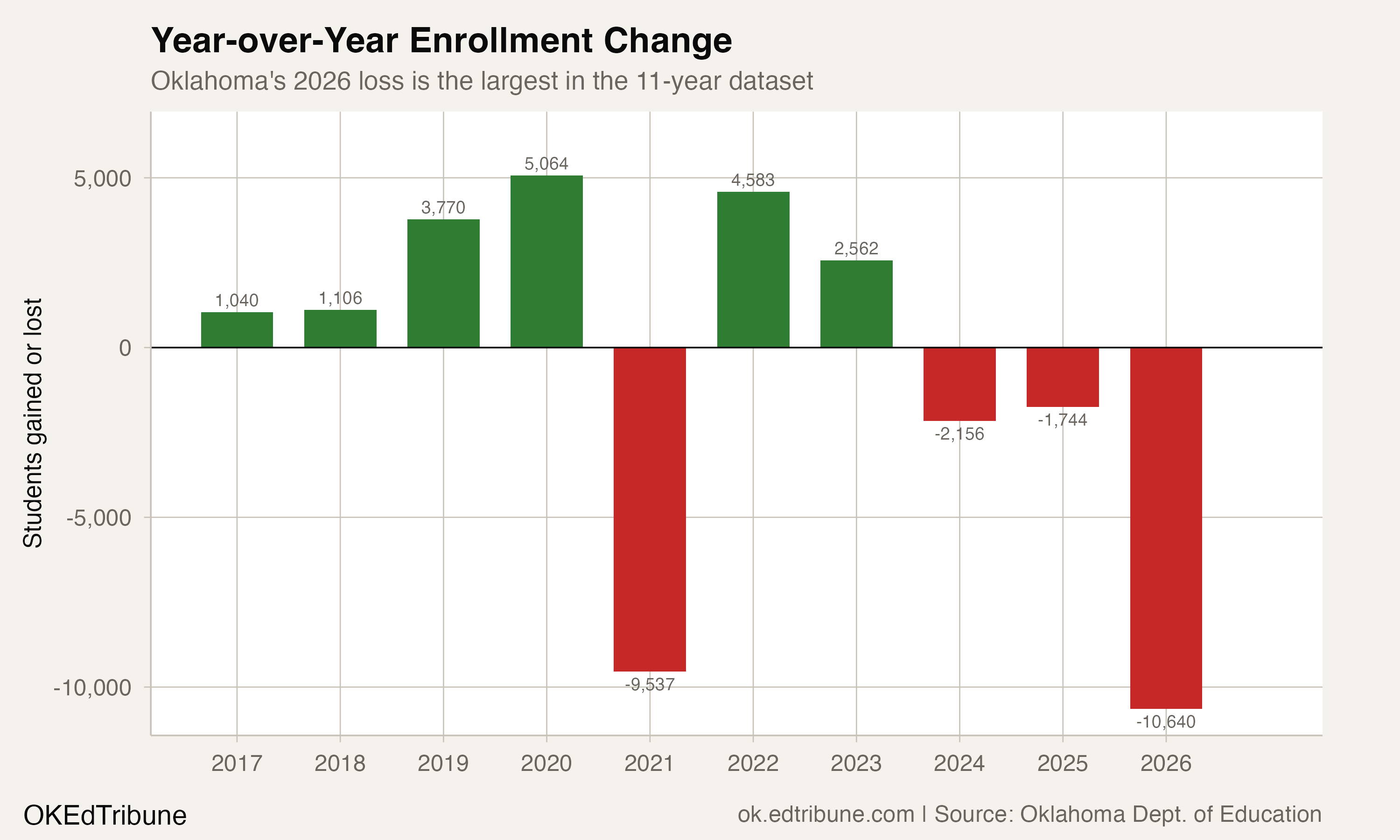
The pattern is not a gradual decline accelerating slowly. The state added students through 2019-20, lost them to COVID, got most back, and then fell off a ledge. Of 539 districts reporting in both years, 350 shrank in 2025-26. Only 181 grew. The losses are not concentrated in a handful of places: 183 districts, 35.3% of those with five or more years of data, are at their all-time enrollment low.
Where the students are leaving
Oklahoma City↗ET lost 1,646 students in a single year, dropping from 32,750 to 31,104. That is a 5.0% decline in one year for the state's second-largest district, part of a longer collapse that has seen OKC shed 14,473 students since 2015-16, a 31.8% loss. Tulsa↗ET lost 1,167, falling to 32,450. Tulsa overtook OKC as the state's largest district in 2021-22 and has held that position for five straight years as OKC's decline has been steeper.
The suburban metro districts felt it too. Moore↗ET lost 852 students (3.6%), Edmond↗ET lost 753 (2.9%), and Putnam City↗ET lost 714 (3.8%). The eight largest losing districts together shed 6,439 students, 61% of the statewide loss. Lawton↗ET, the state's largest district outside the two metros, lost 376.
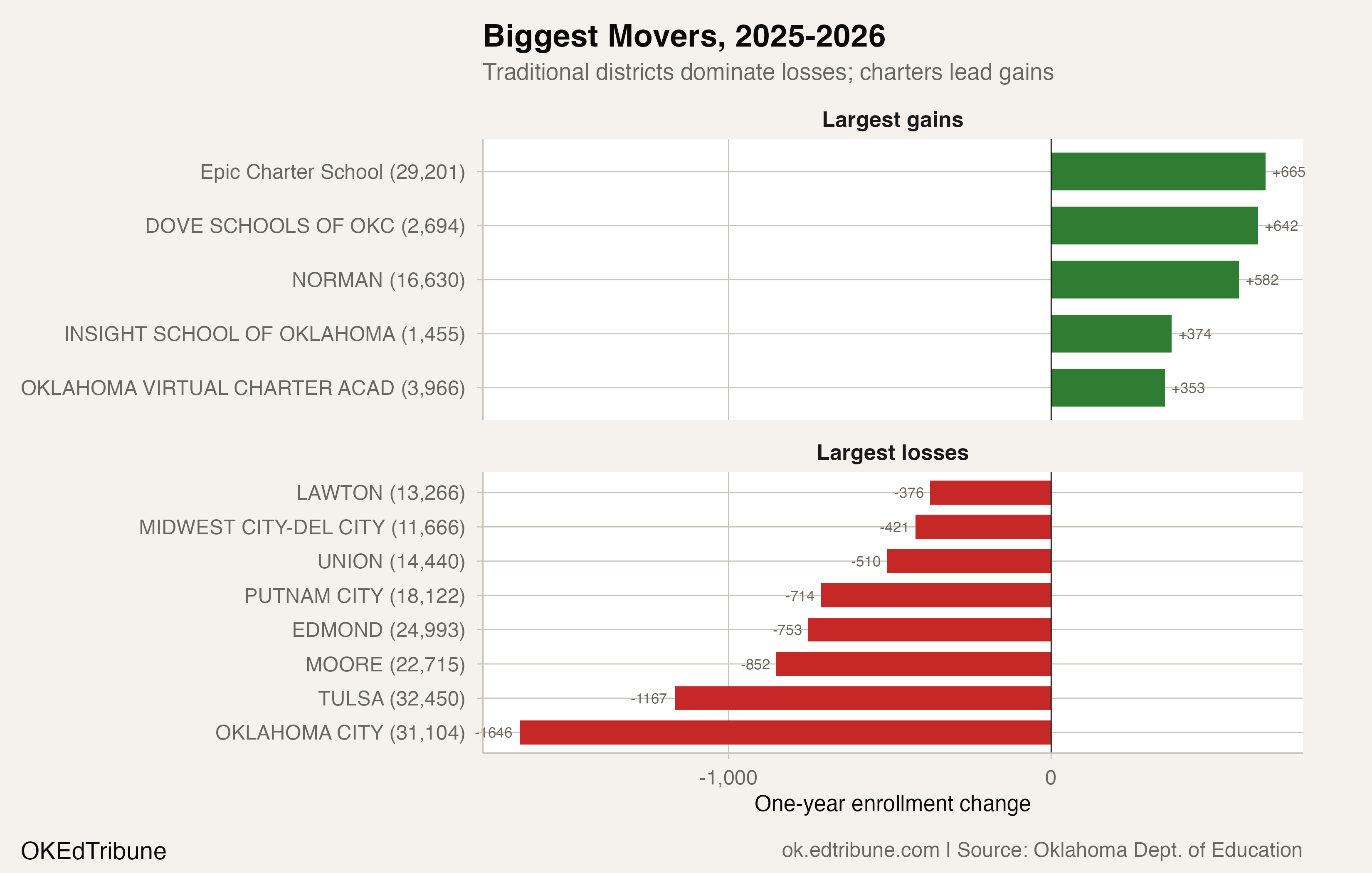
The exceptions tell their own story. Norman↗ET gained 582 students. Epic Charter School↗ET, which operates as a statewide virtual charter, added 665 students to reach 29,201. Four of the five largest gainers were charter or virtual schools. Dove Schools of OKC↗ET added 642 students, Insight School of Oklahoma↗ET added 374, and Oklahoma Virtual Charter Academy↗ET added 353.
Three forces, no single villain
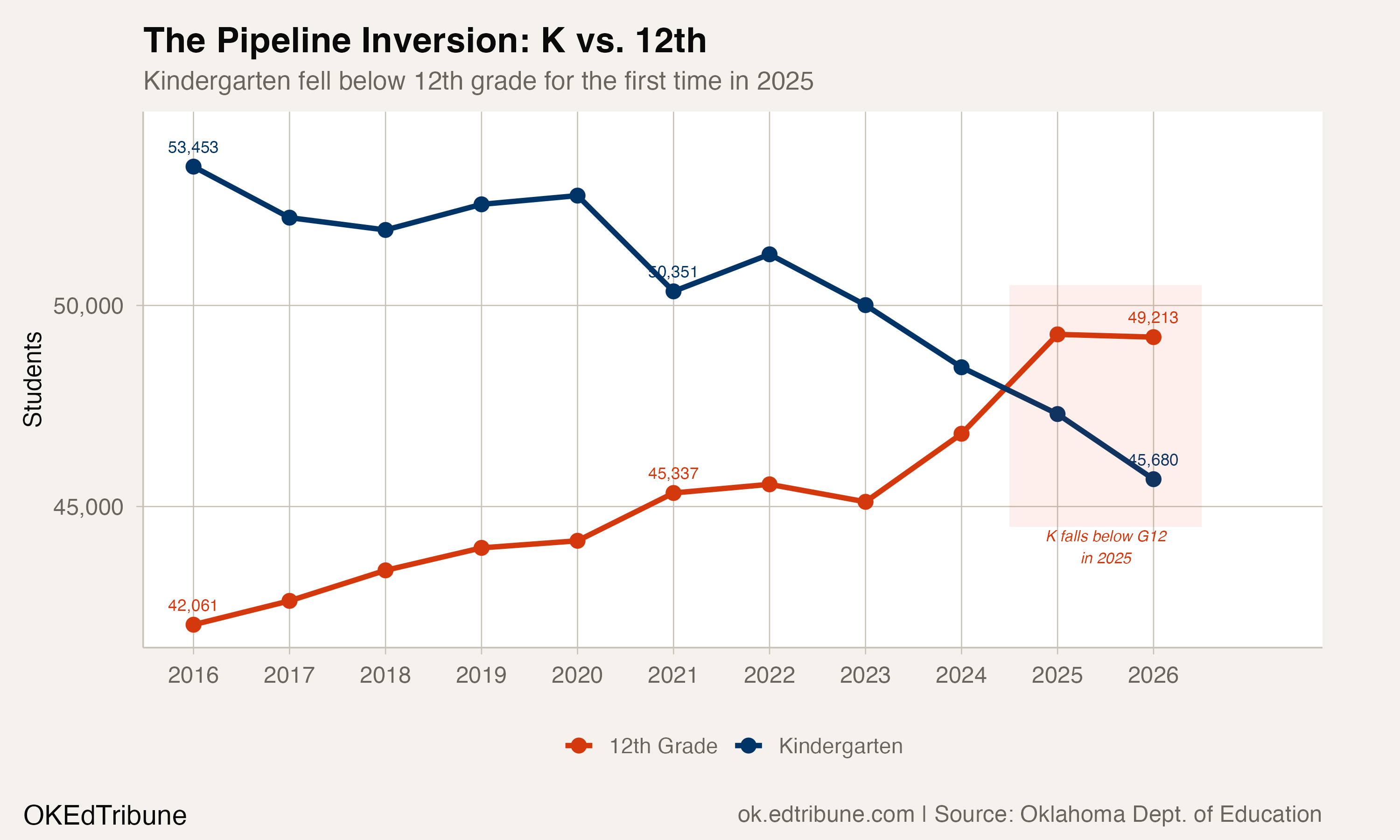
The most likely primary driver is demographics. Oklahoma's fertility rate fell nearly 12% between 2013 and 2023, and the national rate hit an all-time low of 1.6 births per woman in 2024, well below the 2.1 replacement level. Kindergarten enrollment in Oklahoma has fallen from 53,453 in 2015-16 to 45,680 in 2025-26, a 14.5% decline. Twelfth-grade enrollment over the same period rose 17.0%, from 42,061 to 49,213. In 2024-25, kindergarten dropped below 12th grade for the first time. The ratio now stands at 92.8 kindergartners for every 100 seniors, down from 127.1 a decade ago. Fewer children are entering the system than leaving it.
The state's Parental Choice Tax Credit, signed in 2023 and launched in 2024, provides $5,000 to $7,500 per child for private school tuition. Approximately 39,485 students received credits in 2025-26, but the direct enrollment impact is more modest than the headline number suggests: 3,762 of those students attended public school the prior semester, meaning the tax credit accounts for roughly a third of the 10,640-student loss at most. The rest were already in private schools or newly entering students who chose private from the start. The program's cap rose from $150 million to $250 million for the 2026 tax year.
A competing explanation is the continued growth of virtual and charter schools within the public system. Enrollment in identifiable virtual and charter entities reached approximately 57,000 students in 2025-26, or 8.3% of the state total. Epic Charter School alone enrolled 29,201 students, despite an ongoing criminal investigation in which co-founders Ben Harris and David Chaney face racketeering and embezzlement charges. Virtual charter growth does not reduce total public enrollment, but it does redistribute per-pupil funding away from brick-and-mortar districts, compounding the fiscal impact of the headcount decline.
What reporting says
"There were 10,000 fewer students enrolled in Oklahoma public schools this year compared to last year, a dip of 1.5%. Falling birth rates are the main culprit." -- Oklahoma Watch, Jan. 28, 2026
Oklahoma Watch's Jennifer Palmer reported that enrollment decreased in every grade except 4th, 7th, and 11th, with the steepest drops among the youngest students in pre-K through 3rd grade. That pattern aligns with the birth-rate explanation: the children not being born five and six years ago are now the kindergartners not enrolling.
"Nearly 70 percent of children using the Oklahoma Parental Choice Tax Credit program to leave public schools and enroll in private schools for the first time in the 2025-2026 school year are from low- and middle-income families." -- Oklahoma Council of Public Affairs, 2025
State Rep. John Waldron noted that "few private schools have opened up or expanded to take in kids from economically challenged regions," a constraint on how much the tax credit can grow.
The fiscal math
Only 28.5% of districts with comparable data have recovered to their pre-COVID enrollment levels. The other 71.5%, 369 districts, are funding operations on a smaller student base than they had six years ago. In a state that ranks 48th nationally in student outcomes and near the bottom in per-pupil spending, the loss of 10,640 funded seats translates directly into reduced state aid. Oklahoma's funding formula allocates dollars based on weighted average daily membership. Fewer students means less money, regardless of whether fixed costs like building maintenance, transportation routes, and administrative staff have changed.
The pipeline chart points to where this is headed. With 45,680 kindergartners and 49,213 seniors, each graduating class is being replaced by a smaller incoming one. Unless migration or policy reverses the pattern, the state will continue shedding students through at least the end of the decade as Oklahoma's smaller 2025-26 elementary cohorts advance through the system.
The children who will enter kindergarten in fall 2027 were born in 2022, one of Oklahoma's lowest birth years on record. The cliff was not a one-time adjustment. It was the first year the pipeline math caught up with the birth rate.
Detailed code that reproduces the analysis and figures in this article is available exclusively to EdTribune subscribers.
Discussion
Sign in to join the discussion.
Loading comments...