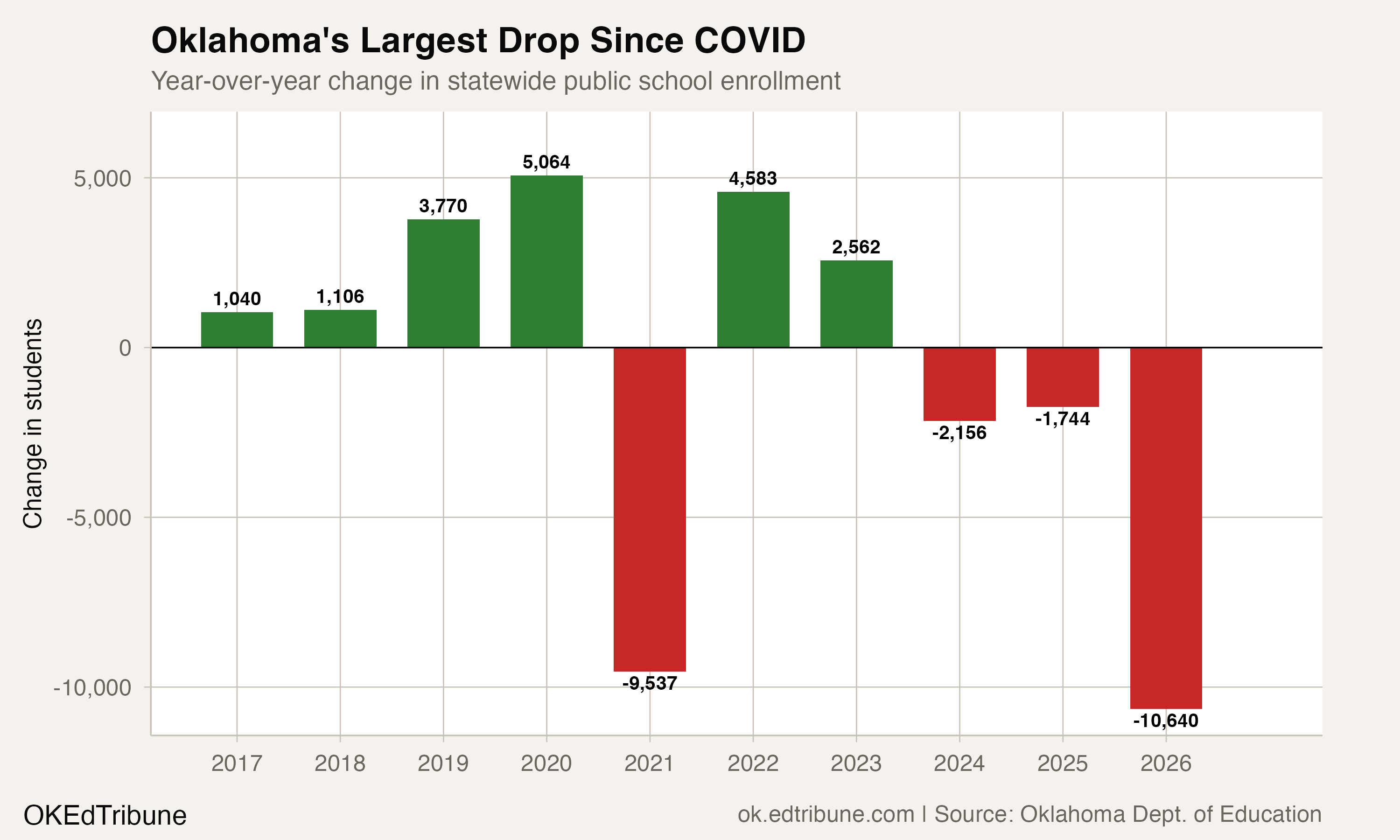
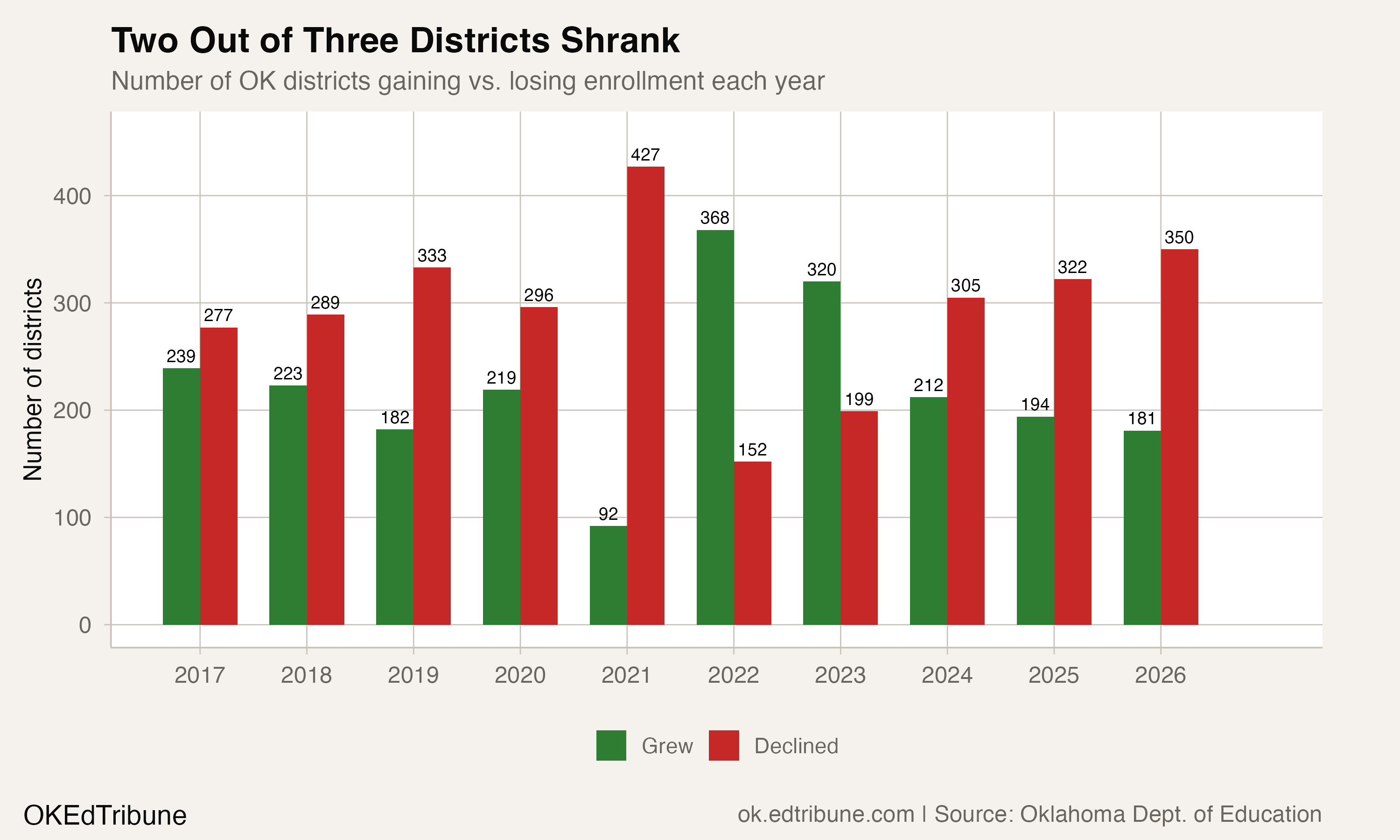
In 2019, 333 Oklahoma districts lost students. The state still grew by 3,770, because a handful of fast-expanding charter and virtual schools more than offset the losses. In 2025-26, 350 districts lost students, a nearly identical count. The state dropped by 10,640.
The difference: the districts still growing can no longer compensate.
The broadest decline outside the pandemic
Oklahoma's 2025-26 enrollment of 686,718 represents a 1.5% decline from the prior year, a single-year loss that exceeds even the COVID drop of 9,537 in 2020-21. But the pandemic was a shock concentrated in one year: 427 of 539 districts declined in 2021, a 4.6-to-1 ratio of losers to gainers. The system rebounded quickly, with 368 districts growing the following year.
The 2025-26 350-to-181 ratio, roughly 2-to-1, is less extreme. It is also harder to dismiss. The decline is neither a one-time shock nor a recovery dip. It is the third consecutive year of statewide losses, following drops of 2,156 in 2024 and 1,744 in 2025, and it arrived five times larger than either predecessor.
Districts holding 73% of Oklahoma's total enrollment shrank in 2025-26. Declining districts collectively lost 17,337 students. Growing districts added 6,719. The net: a deficit that accounts for nearly all of the statewide drop.
Losses run deep, not just wide
The top 10 losing districts account for 40.1% of total losses. Oklahoma City↗ET alone shed 1,646 students, a 5.0% decline. Tulsa↗ET lost 1,167 (3.5%). Moore↗ET, Edmond↗ET, and Putnam City↗ET lost 852, 753, and 714 respectively. Six of the eight largest traditional districts in the state are on the list.
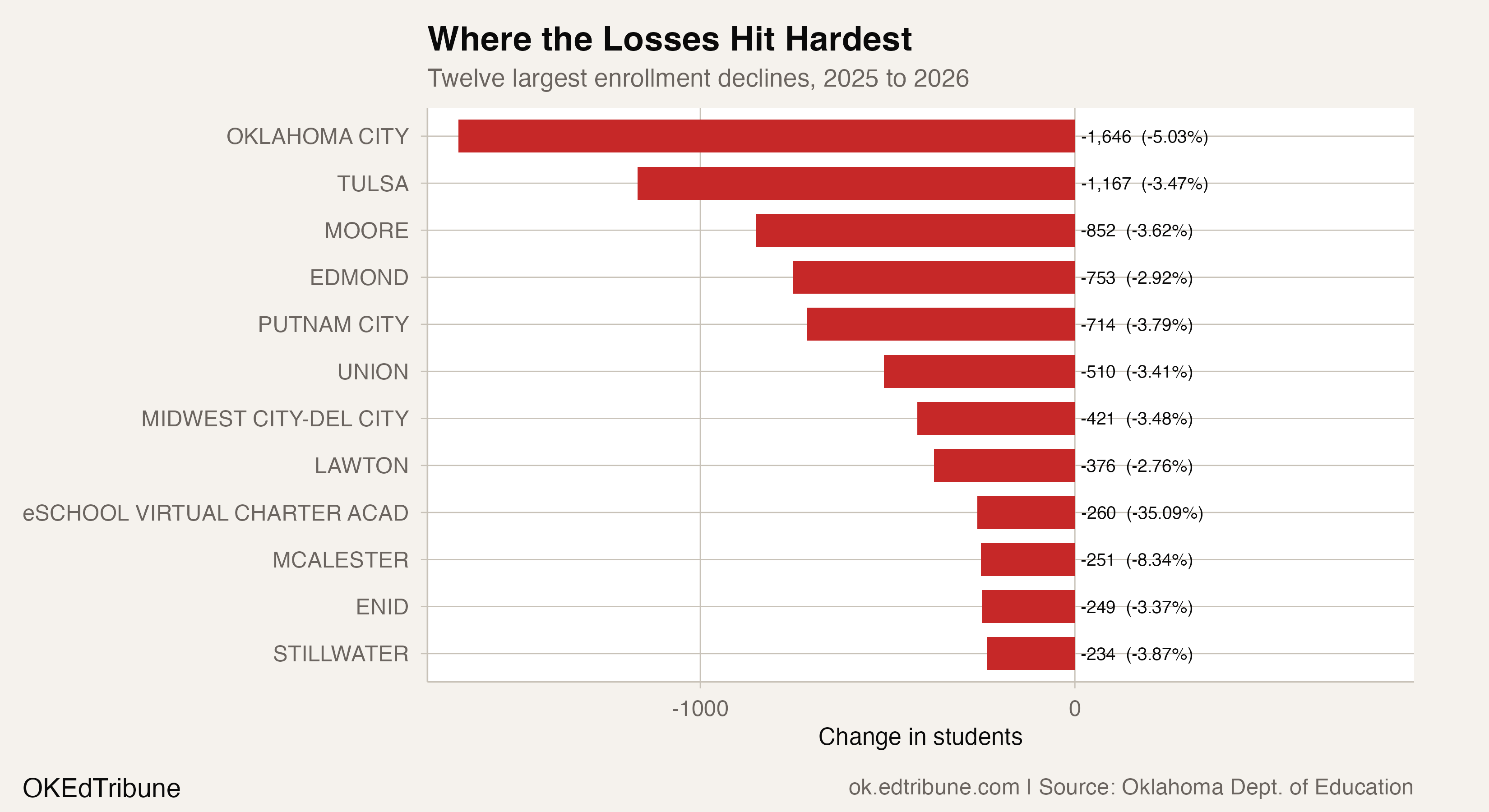
But here is the finding that distinguishes 2026 from prior years: the other half of the losses, 49.6%, came from 330 districts, most of them small. That distribution matters. When losses concentrate in a few large urban systems, policymakers can point to city-specific factors. When 185 districts with fewer than 500 students each collectively lose 3,167, the explanation has to be structural.
Across all size categories, a majority of districts shrank. Among the 13 districts enrolling 10,000 or more students, 10 declined (76.9%). Among the 309 districts under 500 students, 185 declined (59.9%). The median percentage decline was steepest at the extremes: -2.9% for the largest districts, -2.4% for the smallest.
Who is still growing
The gainers list tells its own story. Epic Charter School↗ET added 665 students. Dove Schools of OKC↗ET gained 642. Insight School of Oklahoma↗ET, a virtual charter, grew by 374. Oklahoma Virtual Charter Academy↗ET added 353.
Of the top 10 gainers, eight are charter or virtual entities.
Among traditional districts, Norman↗ET stands out. It added 582 students, a 3.6% gain, the only traditional district in the top five gainers. Bixby↗ET gained 158, Piedmont↗ET 90, and Deer Creek↗ET a modest 9. Suburban growth pockets remain, but they are narrowing.
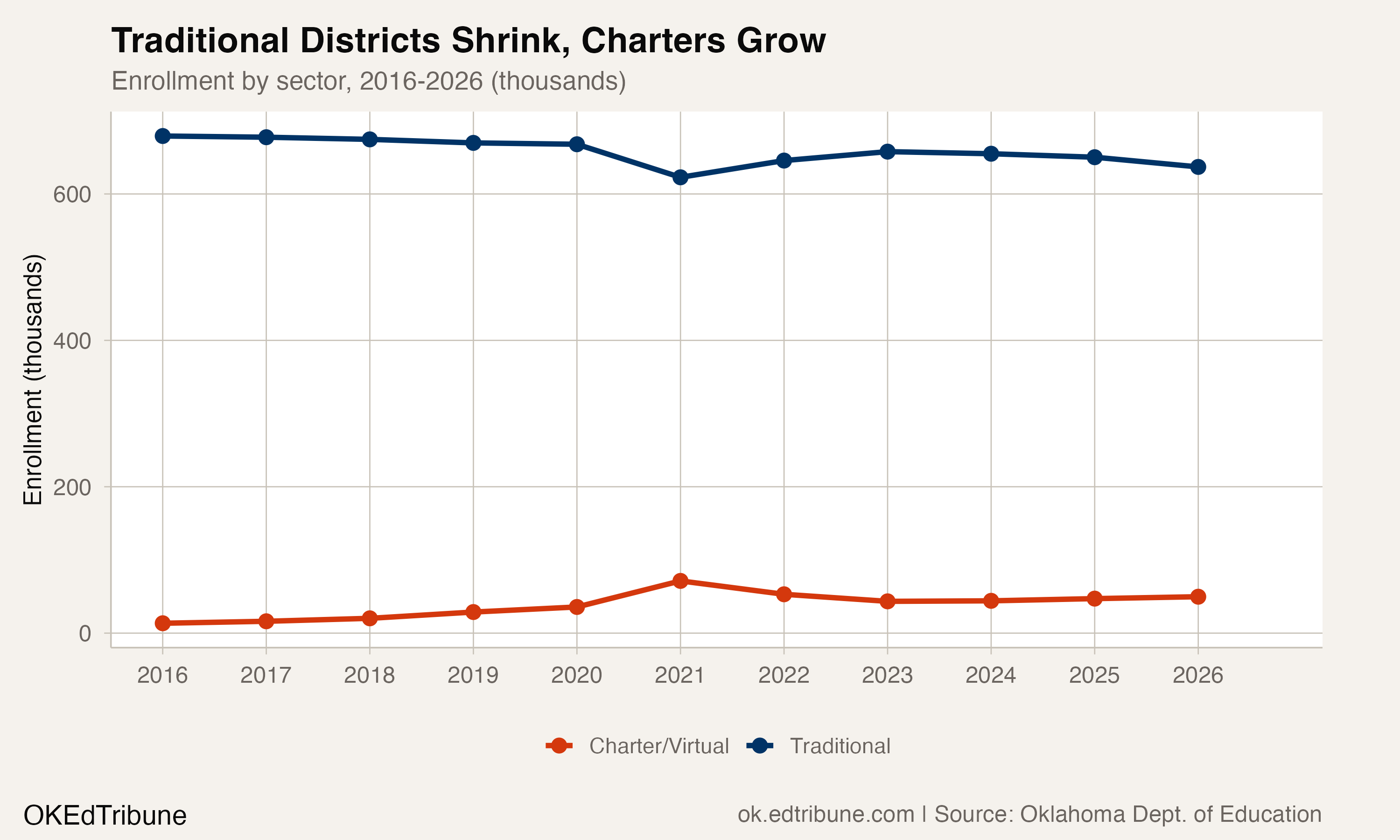
The sector split is stark. Charter and virtual entities gained a net 2,607 students; traditional districts lost 13,225. That divergence is not new. Traditional enrollment fell from 667,904 in 2020 to 636,960 in 2026, a net loss of 30,944 students (4.6%), with partial recoveries in 2022 and 2023 before resuming decline. Charter and virtual enrollment over the same period rose from 35,746 to 49,758, a gain of 14,012 (39.2%).
Birth rates, school choice, and the limits of explanation
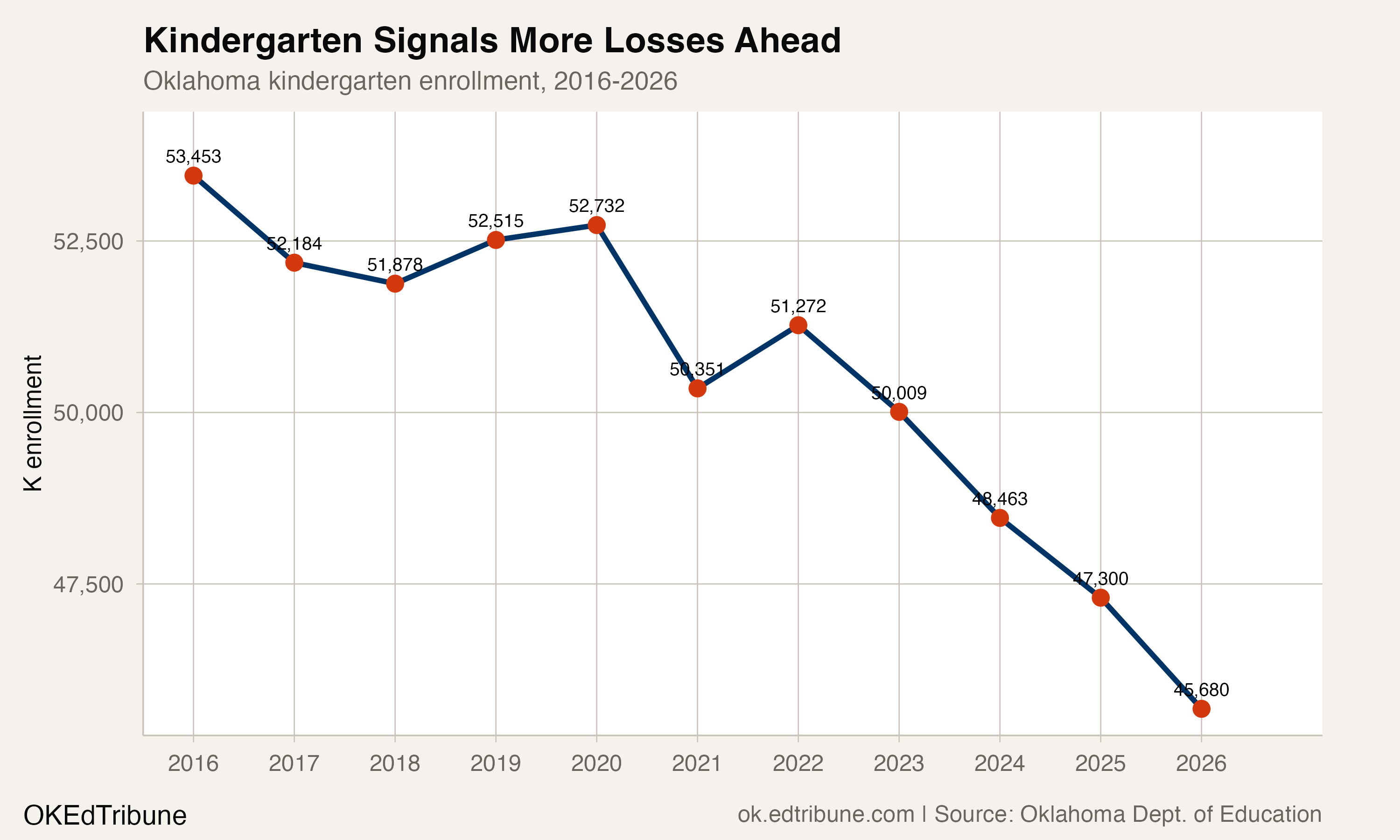
Oklahoma's fertility rate fell 12.2% between 2011 and 2023, according to the March of Dimes, the second-largest drop in a 17-state regional comparison. Fewer births a decade ago means fewer kindergartners now: Oklahoma's kindergarten class has fallen from 52,732 in 2020 to 45,680 in 2026, a 13.4% decline. That pipeline pressure will propagate upward through the grade structure for years.
The state's Parental Choice Tax Credit, enacted in 2023 and launched in 2024, provides refundable credits of $5,000 to $7,500 per child for private school tuition and $1,000 for homeschool expenses. In its first full year, the program served 39,485 students, though only 3,762 of those, fewer than 10%, had been enrolled in public school the prior semester, according to Oklahoma Tax Commission data reported by Oklahoma Watch. The program's funding cap rises from $150 million in 2024 to $250 million in 2026, so its pull on public enrollment may strengthen.
Neither explanation is complete on its own. Birth rate decline is the most plausible driver of the broad-based losses affecting small rural districts. School choice policy more directly affects metro-area systems where private school options are concentrated. The two forces overlap in the aggregate number but likely operate through different channels at different scales.
One significant unknown: Oklahoma does not require families to register or notify the state when they choose homeschooling, and no comprehensive count of private school students exists. The gap between the 10,640-student statewide decline and the 3,762 students who demonstrably switched to the tax credit program leaves roughly 6,900 students unaccounted for by school choice alone.
121 districts have declined three straight years
Beyond the single-year count, 121 districts have now lost enrollment in each of the past three years, from 2024 through 2026. That is nearly one in four Oklahoma districts locked in a multi-year contraction with no reversal in sight.
"I see what's coming... if it doesn't go through, we can hang in here, and we can be like a lot of other schools that have slowly dwindled." — David Morris, Paoli superintendent, on a proposed annexation with Whitebead Public Schools, KGOU, May 2025
More than 100 Oklahoma schools have been absorbed by neighboring districts since the state began tracking annexations in 1976. The current enrollment trajectory suggests more will follow. At 309 districts with fewer than 500 students, Oklahoma's district structure is a product of an era when the state's school-age population was larger. At statehood, the state had nearly 6,000 districts. It had 539 in 2025-26, and 185 of those lost students that year while already below 500.
What to watch next
The kindergarten class of 2026 is 7,052 students smaller than the class of 2020. Those students do not reappear. Each year's kindergarten cohort becomes the next year's first graders, and no grade above kindergarten can grow faster than the cohort that feeds into it. The pipeline is contracting.
For the 185 districts under 500 students that shrank in 2025-26, that contraction is not abstract budget math. It is the difference between fielding a basketball team and not, between keeping a music teacher and sharing one with a district 30 miles away. Paoli's superintendent is already talking about annexation. He will not be the last.
Detailed code that reproduces the analysis and figures in this article is available exclusively to EdTribune subscribers.
Discussion
Sign in to join the discussion.
Loading comments...