If Oklahoma's seven virtual charter schools were a single district, it would be the state's third-largest. At 37,249 students in 2025-26, the virtual sector enrolls more students than Edmond↗ET (24,993), Moore↗ET (22,715), Broken Arrow↗ET (19,765), or any of the state's other 530-plus traditional districts. Only Tulsa↗ET (32,450) and Oklahoma City↗ET (31,104) are larger, and neither by much.
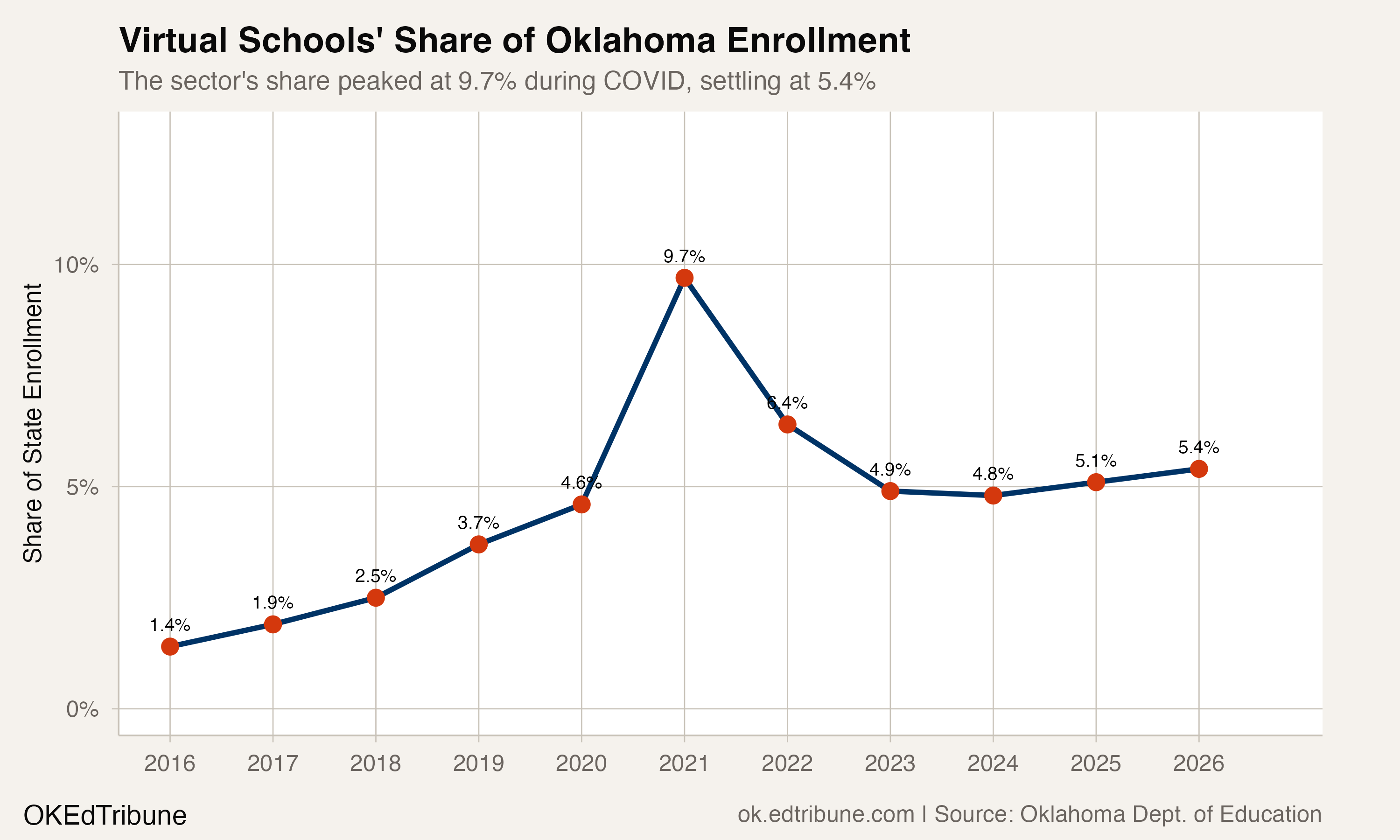
A decade ago the sector barely existed. Four virtual schools served 9,901 students in 2015-16, just 1.4% of the state. By 2025-26 that figure had nearly quadrupled, surviving a pandemic-driven spike that briefly pushed virtual enrollment past 67,000 and a criminal scandal that sent the sector's dominant operator into freefall.
A sector shaped by one school's rise and fall
The story of virtual education in Oklahoma is, in large part, the story of Epic Charter Schools↗ET. In 2015-16, Epic enrolled 6,037 students across a single entity. By 2020-21, it had exploded to 59,445 across two campuses, accounting for 88.7% of all virtual enrollment and 8.6% of the entire state.
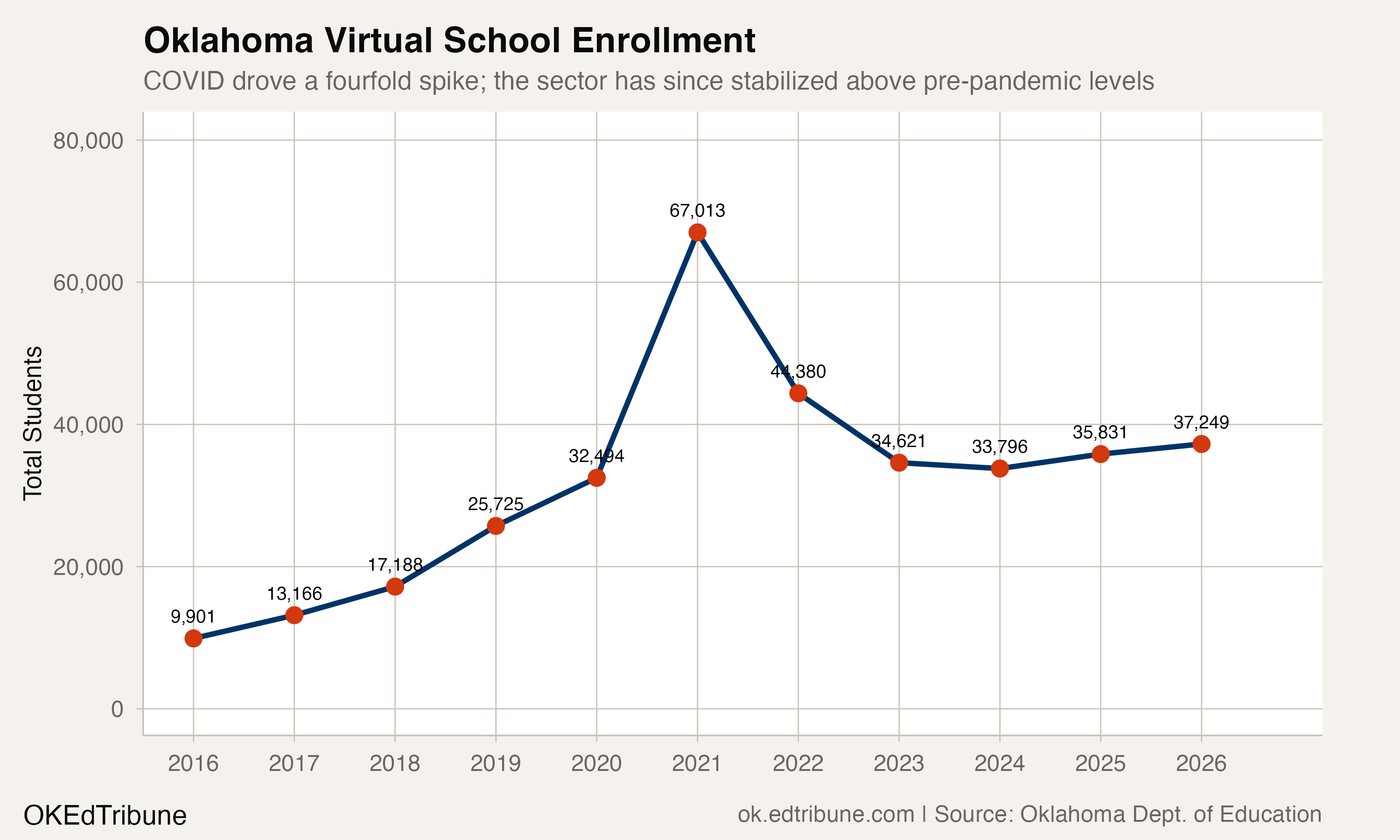
The collapse was nearly as swift. Epic's co-founders, Ben Harris and David Chaney, face multiple felony charges, including racketeering, embezzlement, and obtaining money by false pretenses, following a multi-year investigation by the Oklahoma State Bureau of Investigation. The preliminary hearing resumed in February 2026 after a nearly two-year delay. In June 2025, Epic cut 357 jobs including 83 teachers and 274 administrative staff, phasing out its learning center model entirely.
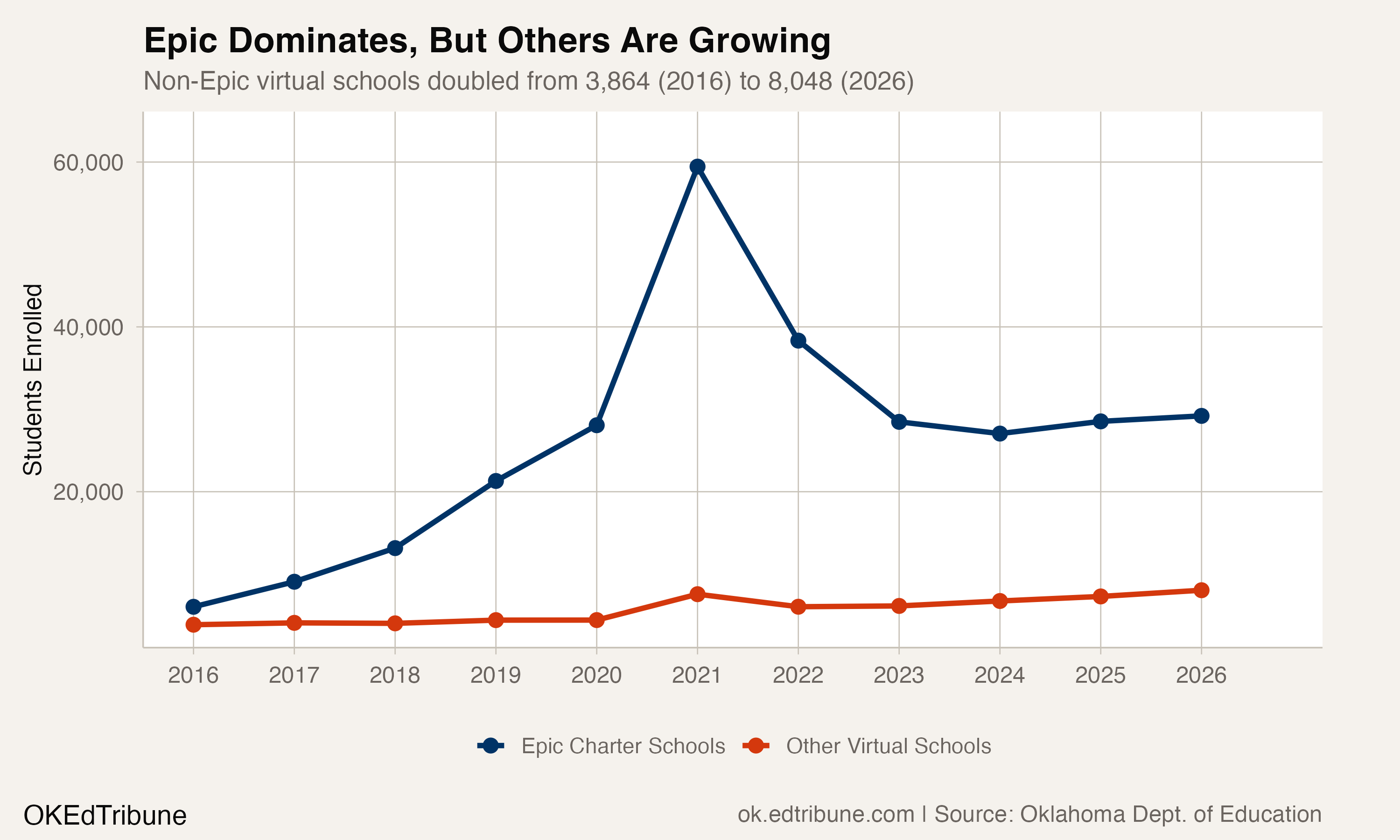
Epic's enrollment cratered from 59,445 in 2020-21 to 27,054 in 2023-24 before partially rebounding to 29,201 in 2025-26. It remains the state's third-largest enrollment entity by a wide margin. But its share of the virtual sector has fallen from 88.7% at the 2021 peak to 78.4%.
The rest of the sector is quietly doubling
While Epic dominated headlines, the six other virtual schools collectively grew from 3,864 students in 2015-16 to 8,048 in 2025-26, a 108.3% increase over 10 years. Oklahoma Virtual Charter Academy↗ET (3,966 students), Oklahoma Connections Academy↗ET (1,508), and Insight School of Oklahoma↗ET (1,455) anchor the non-Epic tier. Three smaller operators, eSCHOOL Virtual Charter Academy (481), Dove Virtual Academy (338), and Virtual Preparatory Charter Academy of Oklahoma (300), round out the sector.
The non-Epic tier has grown in six of the last seven years, including through Epic's post-scandal contraction. That steady growth suggests the demand for virtual schooling extends well beyond one operator's marketing machine.
Nearly 1 in 10 high schoolers
The grade-level distribution reveals where virtual schools have their deepest foothold. In grades 9 through 11, virtual schools account for 9.1% to 9.5% of all students. In elementary grades, that figure drops to 2.7% to 3.7%.
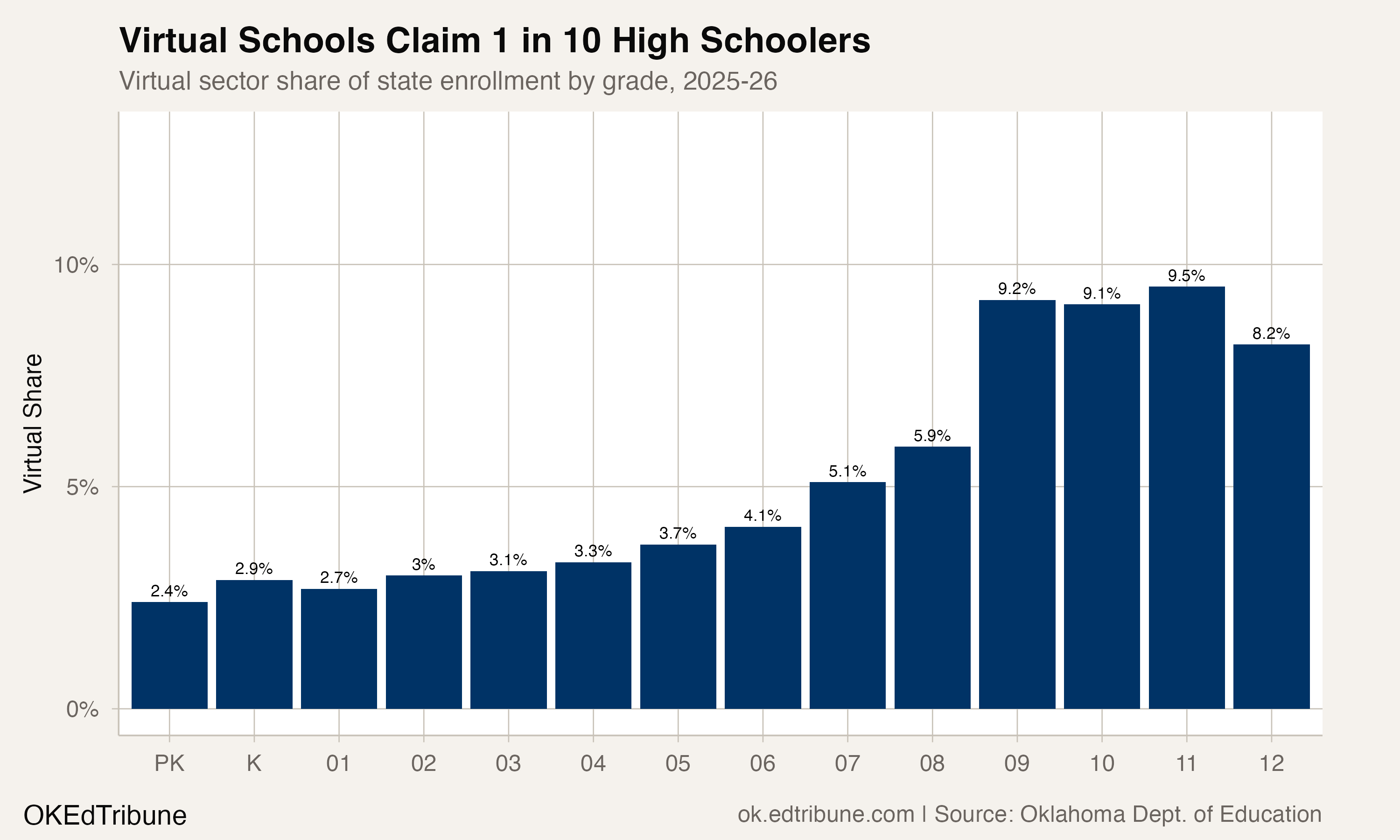
The high school skew has practical consequences. In 11th grade, virtual schools claim 4,931 of 52,032 students statewide. That is roughly one out of every 11 juniors in Oklahoma taking their courses through a screen rather than in a building. By contrast, fewer than one in 30 first-graders are enrolled virtually.
The pattern likely reflects a mix of factors: older students who may be working, parenting, or recovering credits; families who tried and left traditional high schools; and the flexibility that virtual models offer students who do not fit conventional schedules. The data cannot distinguish between students choosing virtual schools proactively and those pushed out of brick-and-mortar options.
What the research shows so far
Academic outcomes for virtual charter students in Oklahoma are, on average, substantially worse than for their peers in traditional schools. A peer-reviewed study published in the Oklahoma Education Journal tracked over 800,000 test scores and found that students attending virtual charters scored 0.21 standard deviations lower in English language arts and 0.30 standard deviations lower in math, deficits the authors estimated at roughly two-thirds of a year's learning.
"Average annual achievement growth is 0.31 standard deviations in ELA and 0.42 standard deviations in math for students in Grades 3 to 8." -- Hamlin, Adams, & Adigun, Oklahoma Education Journal (2023)
The researchers cautioned that "we cannot say that fully virtual schooling causes learning loss," since the students who enroll virtually may differ from those who stay in traditional schools in ways the data cannot capture. A student dealing with chronic illness, bullying, or housing instability may choose virtual school precisely because their circumstances are already affecting their learning. The performance gap may partly reflect who enrolls, not just how the school performs.
The funding equation
Oklahoma's school funding formula sends per-pupil dollars wherever students enroll. When 37,249 students attend virtual schools, 37,249 per-pupil allocations follow them out of traditional district budgets. The state ranks 49th in per-pupil spending according to the National Education Association, which means the margin between a school staying open and closing is thinner than in most states.
Traditional districts have shed 33,300 students since 2015-16, a 4.9% decline. But the decline has not been steady. In 2021-22 and 2022-23, traditional districts clawed back 27,216 and 12,321 students respectively as families returned from the pandemic's virtual experiment. In 2025-26, traditional districts lost 12,058 students, the steepest single-year drop since the pandemic itself.
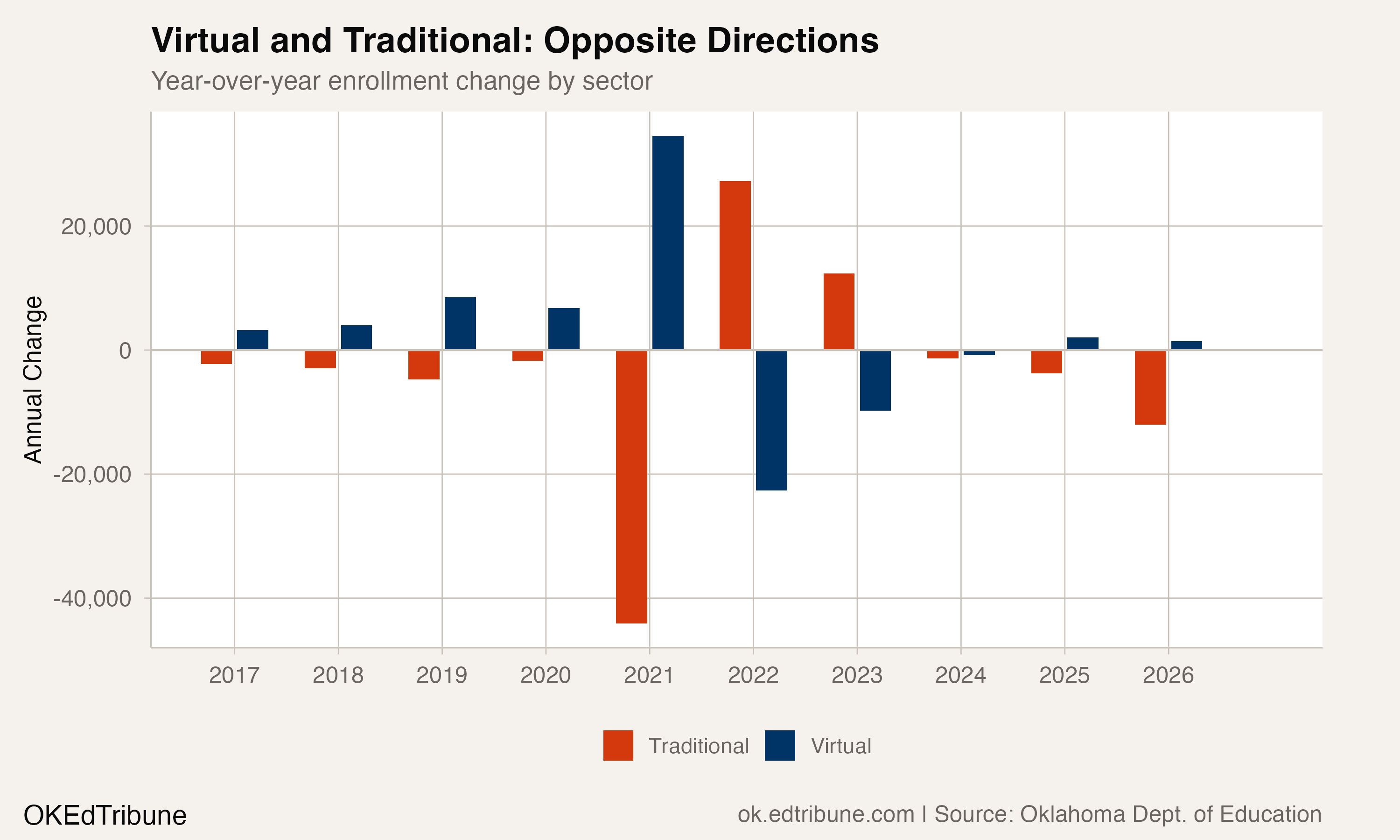
The virtual sector is not the only pressure on traditional enrollment. The Oklahoma Parental Choice Tax Credit, enacted in 2023, has approved 37,428 children for private school tax credits of $5,000 to $7,500 per student. Of those, 3,278 switched from public to private schools for the first time in 2025-26. Combined with the 37,249 students in virtual charters, roughly 74,000 Oklahoma students now participate in alternatives to traditional public schools through just these two programs.
The Statewide Charter School Board question
The Oklahoma Statewide Charter School Board, which assumed sole authority over virtual charter sponsorship on July 1, 2024, faces a straightforward challenge: how to oversee a sector that enrolls more students than all but two districts while the state's largest virtual operator is simultaneously fighting felony charges and restructuring its operations.
Robert Franklin, the board's chairman, has publicly acknowledged that the state could be approaching a saturation point for virtual schools. The Oklahoma Public Charter School Association disagrees. The data so far suggests the sector is still growing, adding 1,418 students in 2025-26 after a 2,035-student gain the year before.
37,249 families chose virtual. The research says those students are learning less. Oklahoma built one of the country's largest virtual sectors without building a system to check whether it works.
Detailed code that reproduces the analysis and figures in this article is available exclusively to EdTribune subscribers.
Discussion
Sign in to join the discussion.
Loading comments...