Deer Creek↗ET just asked voters for $153 million to build classrooms. Voters overwhelmingly approved the bond, and the district projects enrollment will reach 11,000 by 2034, up from 8,165 in 2025-26. Fifteen miles southeast, Oklahoma City↗ET has lost 14,473 students since 2016, a 31.8% decline that has hollowed out entire grade levels. The two districts share a metro area. They do not share a trajectory.
Across the OKC metro, enrollment has inverted. Four inner-ring districts lost a combined 19,694 students over the past decade, a 23.6% contraction. Seven outer-ring districts gained 8,469, a 9.2% expansion. The metro as a whole lost 11,225 students. The rest leaked out to virtual schools, private schools, or left the system entirely.
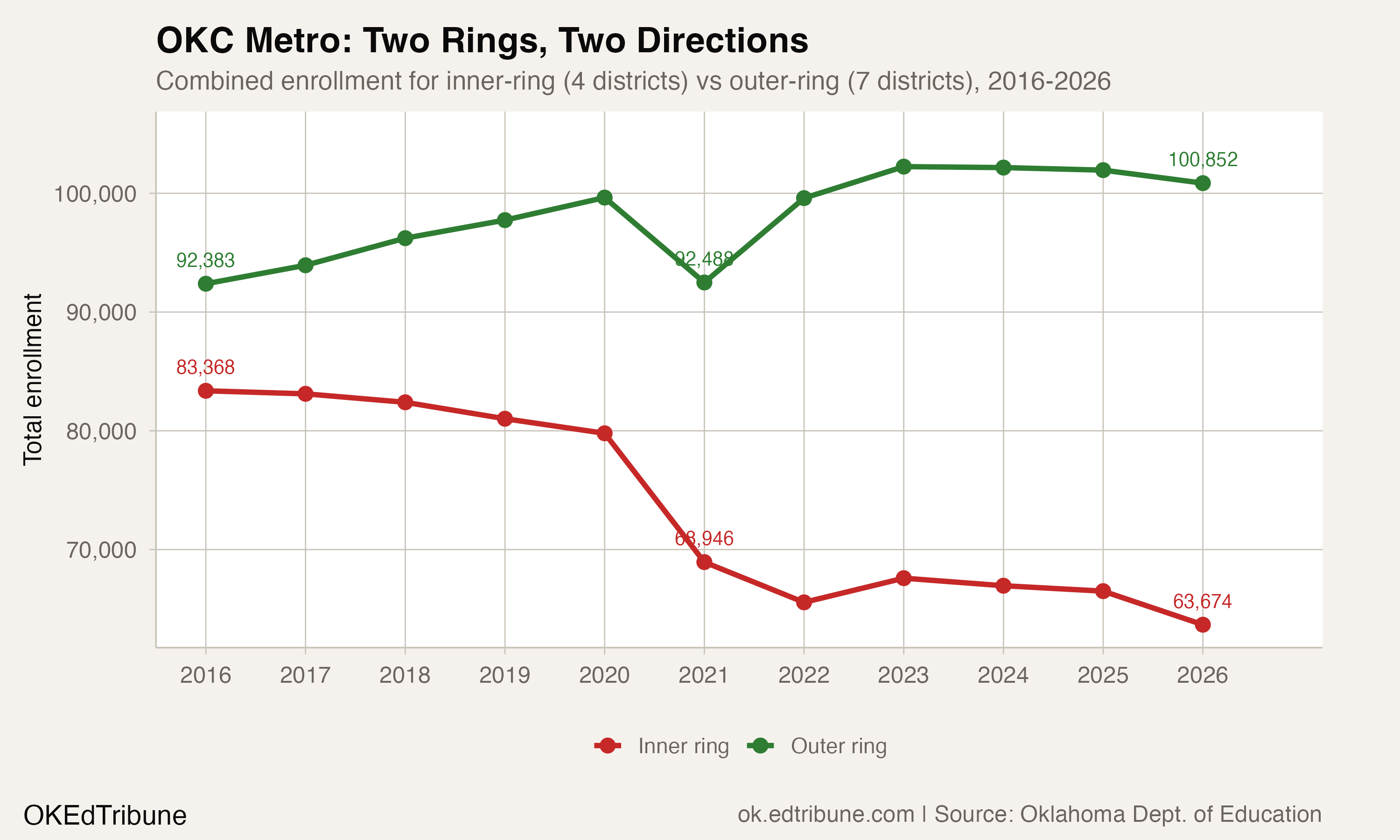
The gap between 83,000 and 64,000
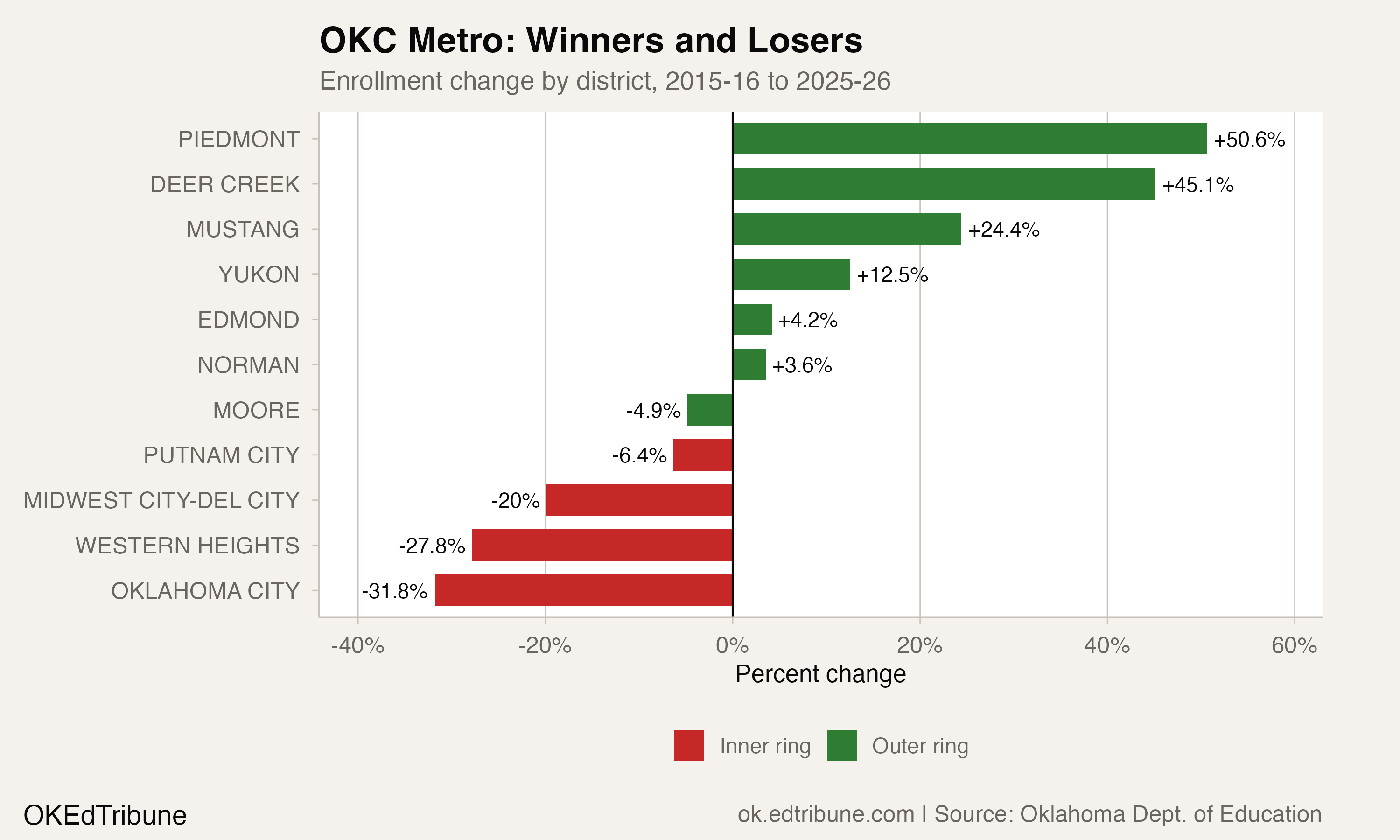
In 2015-16, the inner ring enrolled 83,368 students. By 2025-26 that number had fallen to 63,674. Oklahoma City accounts for the bulk of it: 14,473 of the inner ring's 19,694-student loss, or 73.5%. But the pattern is not unique to OKC. Western Heights↗ET, a small district on OKC's southwest side, lost 27.8% of its enrollment. Midwest City-Del City↗ET lost 20.0%. Even Putnam City↗ET, historically one of the metro's more stable suburban systems, shed 6.4%.
The outer ring tells the opposite story. Piedmont↗ET grew by 50.6%. Deer Creek grew by 45.1%. Mustang↗ET added 2,630 students, a 24.4% increase. Yukon↗ET grew 12.5%. Edmond↗ET and Norman↗ET added modest numbers, 4.2% and 3.6% respectively.
The net math is unfavorable. The outer ring's 8,469-student gain covers less than half of the inner ring's 19,694-student loss. The remaining 11,225 students left the metro's traditional public school system altogether. Some went to Epic Charter Schools↗ET, which grew from 6,037 students in 2016 to 29,201 in 2026 and now enrolls nearly as many students as OKC itself. Some went to private schools. Oklahoma's Parental Choice Tax Credit, which provides $5,000 to $7,500 per student in private school tuition support, received more than 31,000 applications on its first day of the 2025-26 application period alone.
The capital lost its crown
One consequence of OKC's decline: the state's capital city is no longer its largest school district.
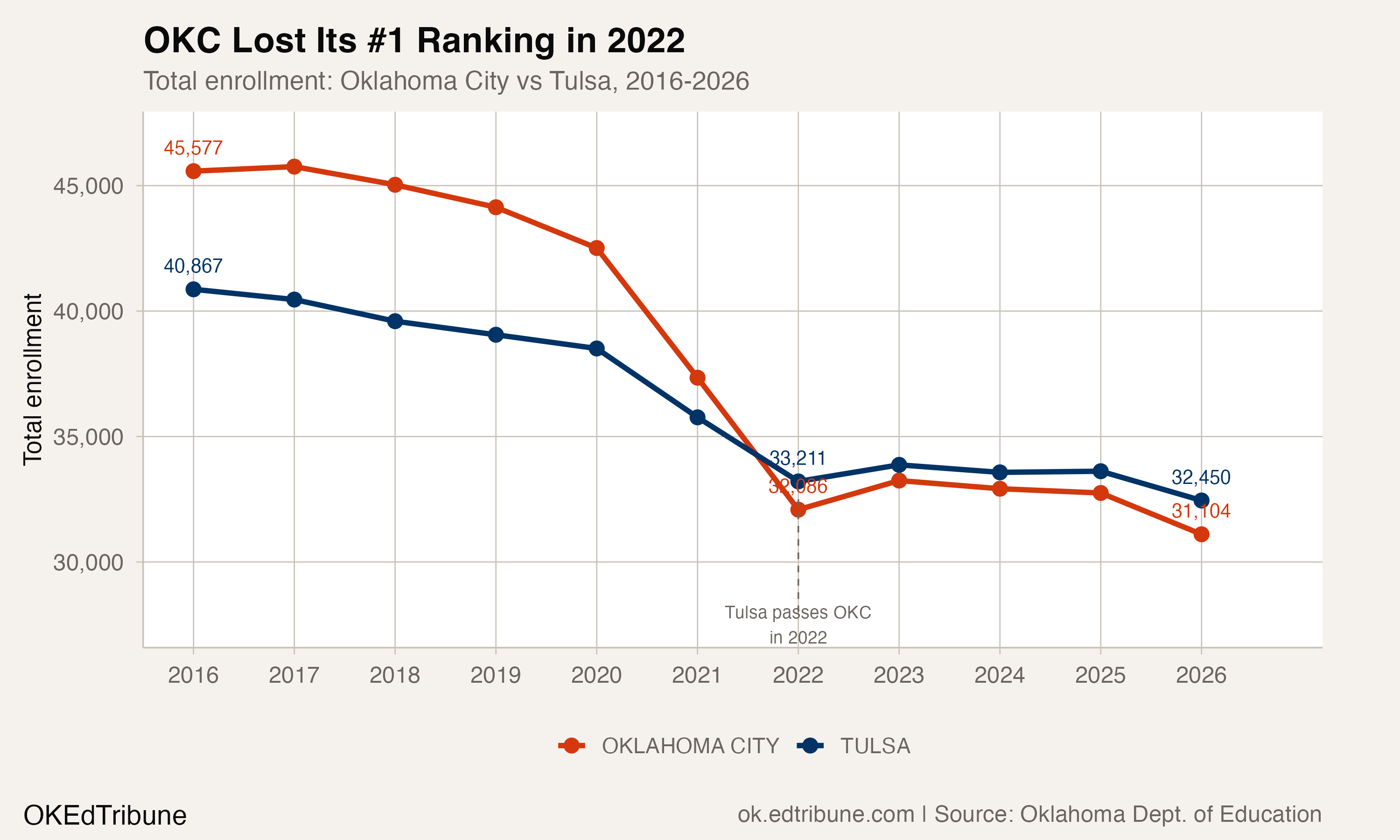
Tulsa↗ET passed Oklahoma City in enrollment in the 2021-22 school year and has held the lead since. In 2016, OKC enrolled 4,710 more students than Tulsa. By 2026, Tulsa leads by 1,346. Both districts are shrinking, but OKC is shrinking faster: it lost 31.8% of its enrollment over the decade compared to Tulsa's 20.6%.
Oklahoma City's losses are so large they distort the statewide picture. The state lost 5,952 students between 2016 and 2026, a 0.9% decline. OKC alone lost 14,473. Without OKC, the rest of Oklahoma's public schools grew by a combined 8,521 students over the same period.
Housing follows schools, schools follow housing
The suburban boom is not an accident. The western corridor of the OKC metro, home to Mustang, Yukon, and Piedmont, is projected to need 15,000 to 18,000 new housing units by 2030, a $2.5 to $3 billion investment. The southern corridor through Norman and Moore↗ET needs even more. Families are moving outward from the city core, drawn by lower land costs, newer construction, and school district reputations.
"These corridors succeed because they are underpinned by Oklahoma City's broader economic engine." -- HousingWire, 2025
The school district quality signal reinforces the cycle. Families choose Deer Creek or Piedmont in part because enrollment is growing, class sizes are manageable, and bond packages pass easily. That draws more families, which drives more growth, which funds more bonds. Meanwhile, inner-ring districts face the reverse: declining enrollment leads to funding cuts, which leads to program reductions, which accelerates the next round of departures.
This pattern has deep roots. A 2016 NonDoc analysis noted that 26 separate school districts surround OKC, and that suburban sprawl had been draining the district for decades. Before desegregation, OKCPS served more than 75,000 students. The current enrollment of 31,104 is less than half that peak.
The virtual school complication
Not all of OKC's losses went to the suburbs. The rise of virtual charter schools, particularly Epic Charter Schools, coincided precisely with OKC's sharpest enrollment drops. In 2020-21, the first full pandemic year, OKC lost 5,169 students in a single year. Epic's two entities gained a combined 31,377 students that same year, drawing from every district in the state.
Epic has since contracted. Its enrollment peaked near 60,000 in 2020-21, dropped to about 38,000 in 2021-22, and has stabilized around 29,000. But those students largely did not return to their original districts. OKC's brief recovery in 2022-23 (it gained 1,159 students) reversed the following year and has not resumed.
OKCPS officials have characterized the decline as expected. Rebecca Kaye, the district's chief of equity and accountability, noted that "parents are making choices to enroll in schools outside of urban districts across the country."
The outer ring's growth has stalled
The suburban boom may have peaked. After reaching a combined 102,243 students in 2022-23, the outer ring has shed 1,391 students over the past three years. Moore lost 1,917 students since 2023. Edmond lost 1,197. Even Mustang, which grew steadily through 2024, has plateaued. Only Norman, which added 844 students since 2023, is still meaningfully growing.
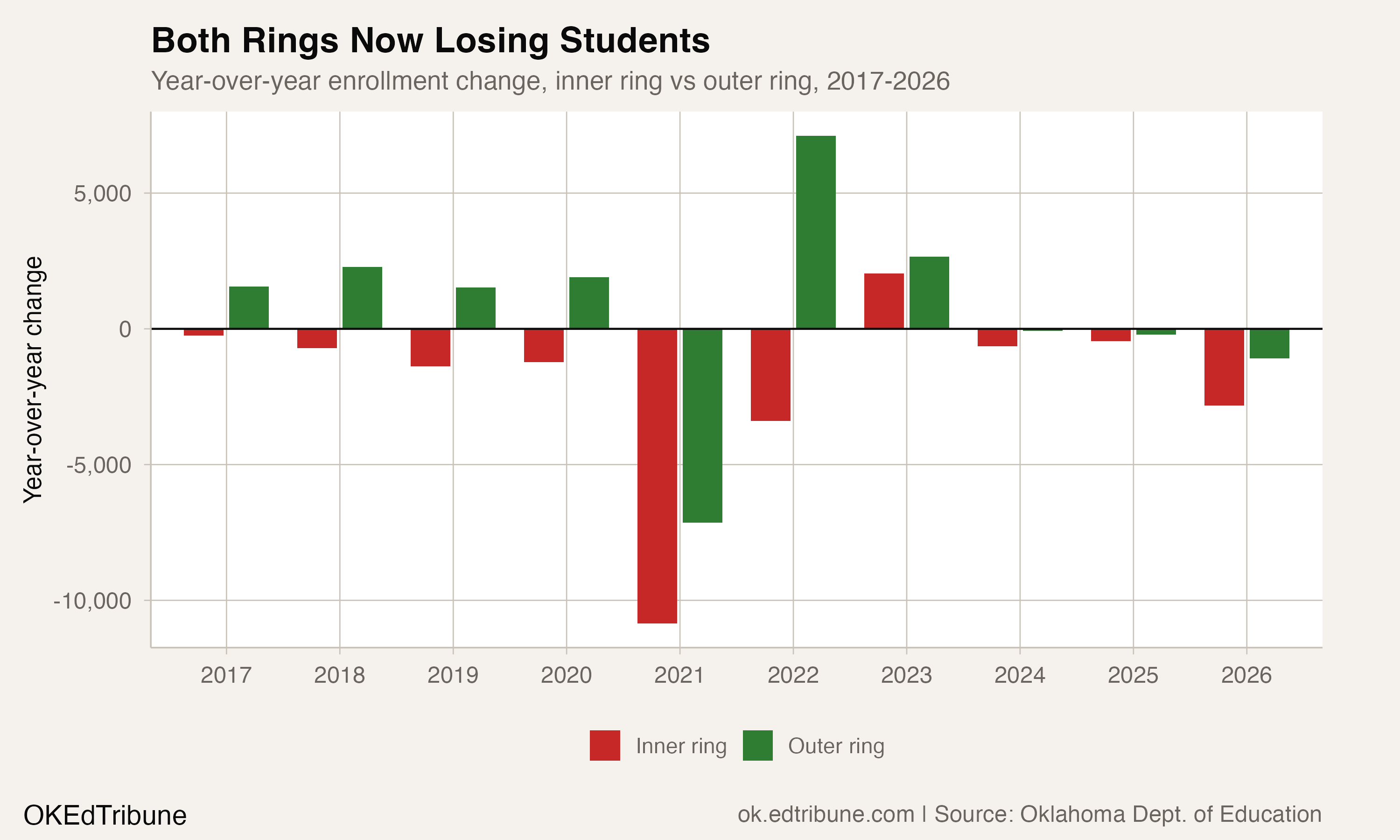
Both rings have now lost students for three consecutive years, but 2025-26 is by far the worst: the inner ring dropped by 2,827 and the outer ring by 1,095, dwarfing the modest simultaneous losses of 2023-24 and 2024-25. Statewide, Oklahoma lost 10,640 students in 2025-26, its largest single-year decline on record, driven by falling birth rates and expanded school choice.
What the kindergarten numbers say
The starkest measure of OKC's trajectory is not total enrollment. It is kindergarten.
Oklahoma City enrolled 4,129 kindergartners in 2015-16. In 2025-26, it enrolled 2,231, a 46.0% decline. Pre-K fell by a similar margin, from 3,119 to 1,672 (down 46.4%). First grade dropped 45.3%. Every grade from PK through sixth lost more than a quarter of its students; the early grades lost nearly half.
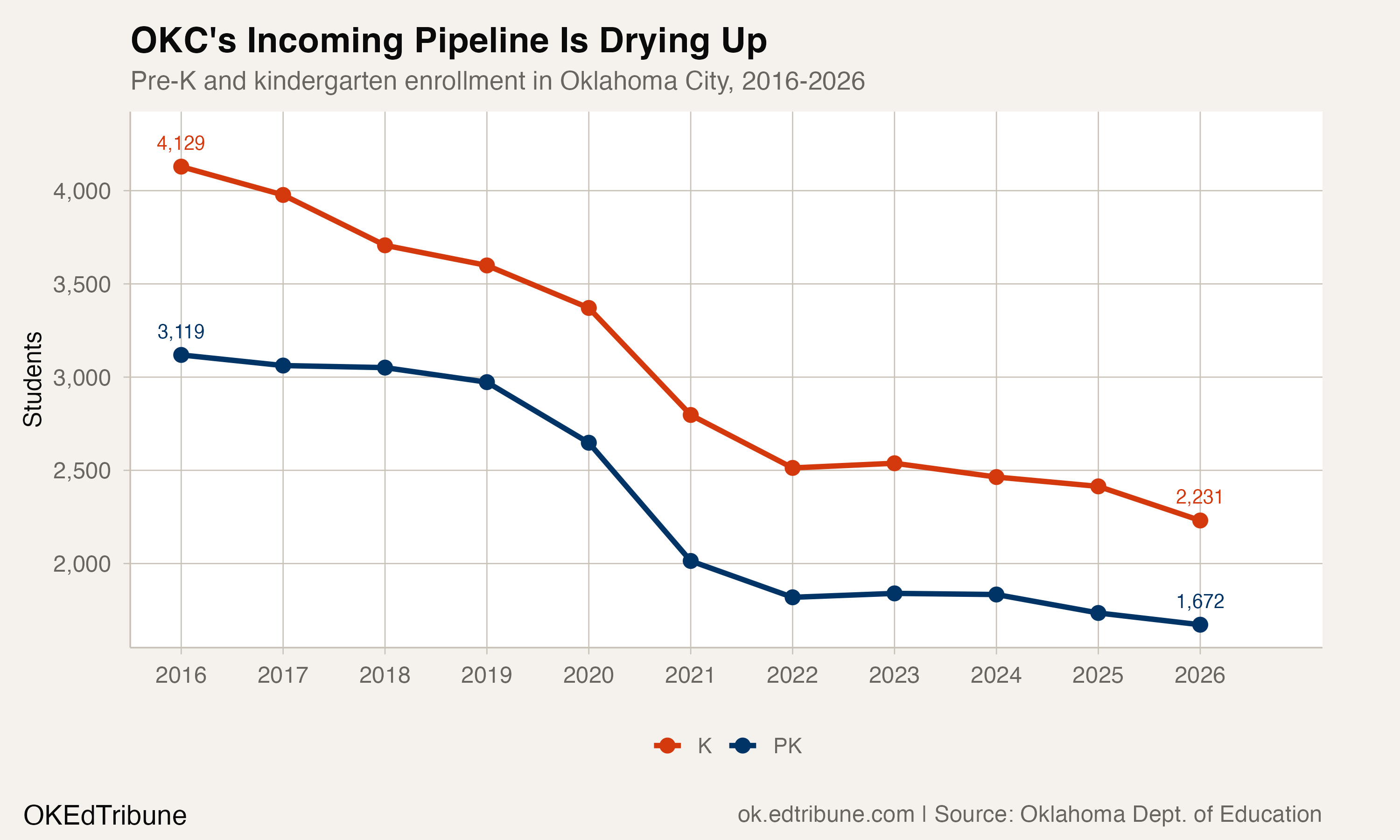
Across the inner ring, kindergarten enrollment fell from 7,096 to 4,431, a 37.6% decline. Even the outer ring's kindergarten numbers are softening: from a peak of 7,460 in 2020 to 6,287 in 2026, down 15.7%. Declining birth rates are part of this. But the inner ring's kindergarten losses outpace any demographic baseline, suggesting that families with young children are the most likely to move outward or exit the system entirely.
Western Heights: a cautionary case
Western Heights is the smallest of the inner-ring districts at 2,782 students, but its story illustrates how enrollment loss and institutional dysfunction compound each other. The district was placed on state probation in April 2021 after years of financial mismanagement. A state audit later found the district spent more than $1 million on legal fees over three years, much of it fighting the state's intervention. Former superintendent Mannix Barnes received $1.13 million in compensation from 2019 to 2022. The probation was not lifted until October 2025.
"School leaders have a responsibility to act in the best interests of students, families, and taxpayers." -- State Auditor Cindy Byrd, NonDoc, Dec. 2025
During the turmoil, Western Heights lost 27.8% of its students. The district's current superintendent, Brayden Savage, has described the administration he inherited as requiring "a complete structural rebuild."
Deer Creek's $153 million bet
Deer Creek's bond will build a 44-classroom expansion at the high school, a new performing arts center, and playground improvements at five elementary schools. The district projects enrollment of 11,000 by 2034, up from 8,165 in 2025-26. That projection assumes the suburban migration continues.
But the year-over-year data says the outer ring's growth engine is decelerating. Both rings lost students for three consecutive years. Moore, Edmond, and even Mustang have plateaued. If the state keeps shedding 10,000 students per year, the suburban ring will eventually feel the same arithmetic OKC already knows: 14,473 lost students at $3,300 per pupil is roughly $48 million in annual state funding. The buildings stay. The money leaves.
Detailed code that reproduces the analysis and figures in this article is available exclusively to EdTribune subscribers.
Discussion
Sign in to join the discussion.
Loading comments...