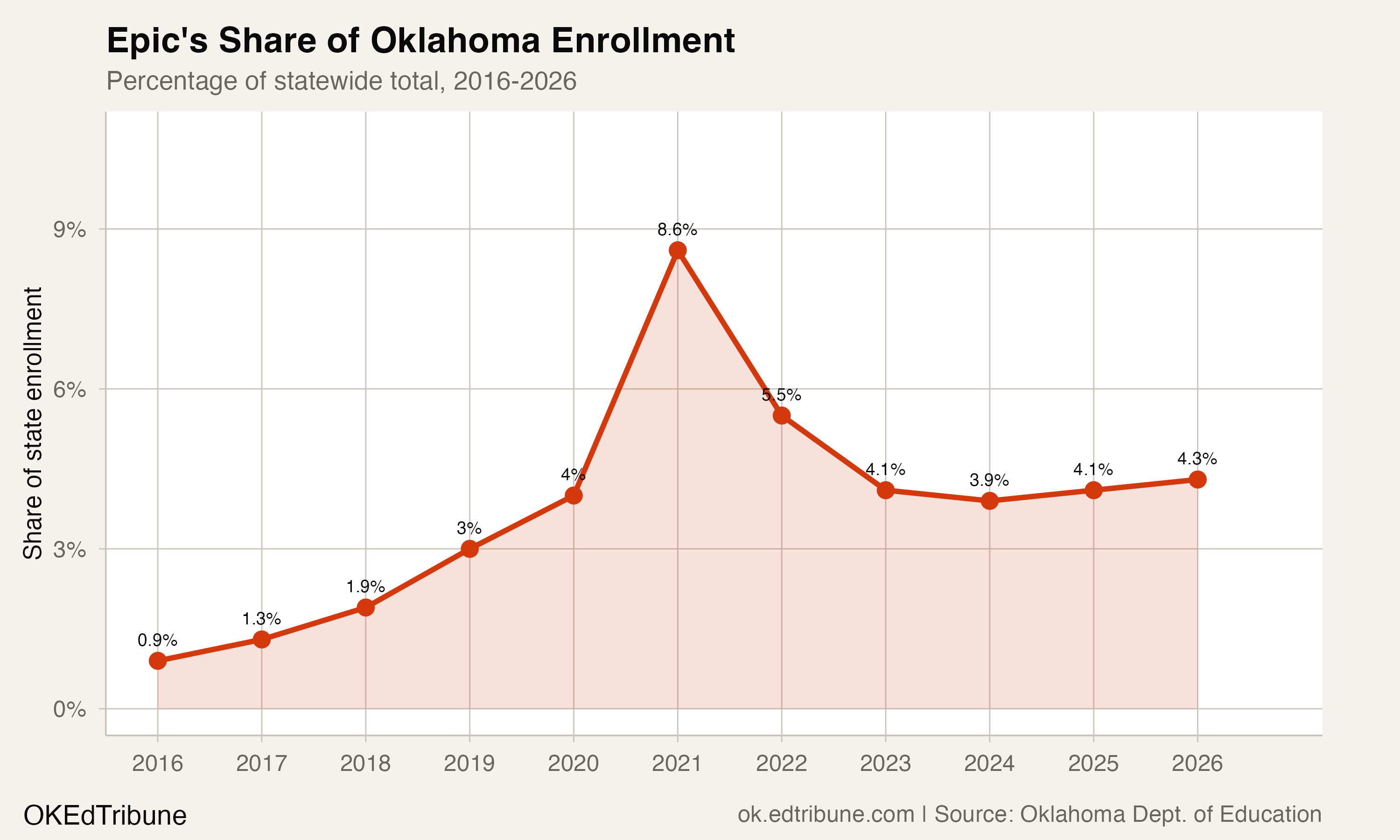
In 2016, Epic Charter Schools enrolled 6,037 students, less than 1% of Oklahoma's public school population. Five years later it enrolled 59,445, more than any other public school entity in the state. No single school entity in Oklahoma history had grown that fast, and none had ever overtaken both of the state's two largest districts in a single year.
Then it fell apart. Co-founders charged with racketeering. A forensic investigation. 500 employees terminated. Enrollment cut in half. In 2025-26, Epic Charter School↗ET enrolls 29,201 students, 4.3% of the state total. It remains Oklahoma's third-largest public school entity, larger than Edmond or Moore, but its trajectory looks nothing like it did four years ago.
From startup to state's largest in five years
Epic began as a single virtual charter school in 2011, offering a one-on-one online learning model. By 2016, it had expanded to 6,037 students. A second entity, Epic Blended Learning Charter, launched in 2017-18, and the two operations together reached 13,158 students by 2018, a 118% increase in two years.
The pre-pandemic growth was already extraordinary. Epic added 8,147 students in 2018-19 alone, reaching 21,305. COVID-19 turned that growth exponential. As families pulled children from in-person classrooms across Oklahoma, Epic added 6,763 students in 2019-20 and then 31,377 in 2020-21, more than doubling its enrollment in a single year.
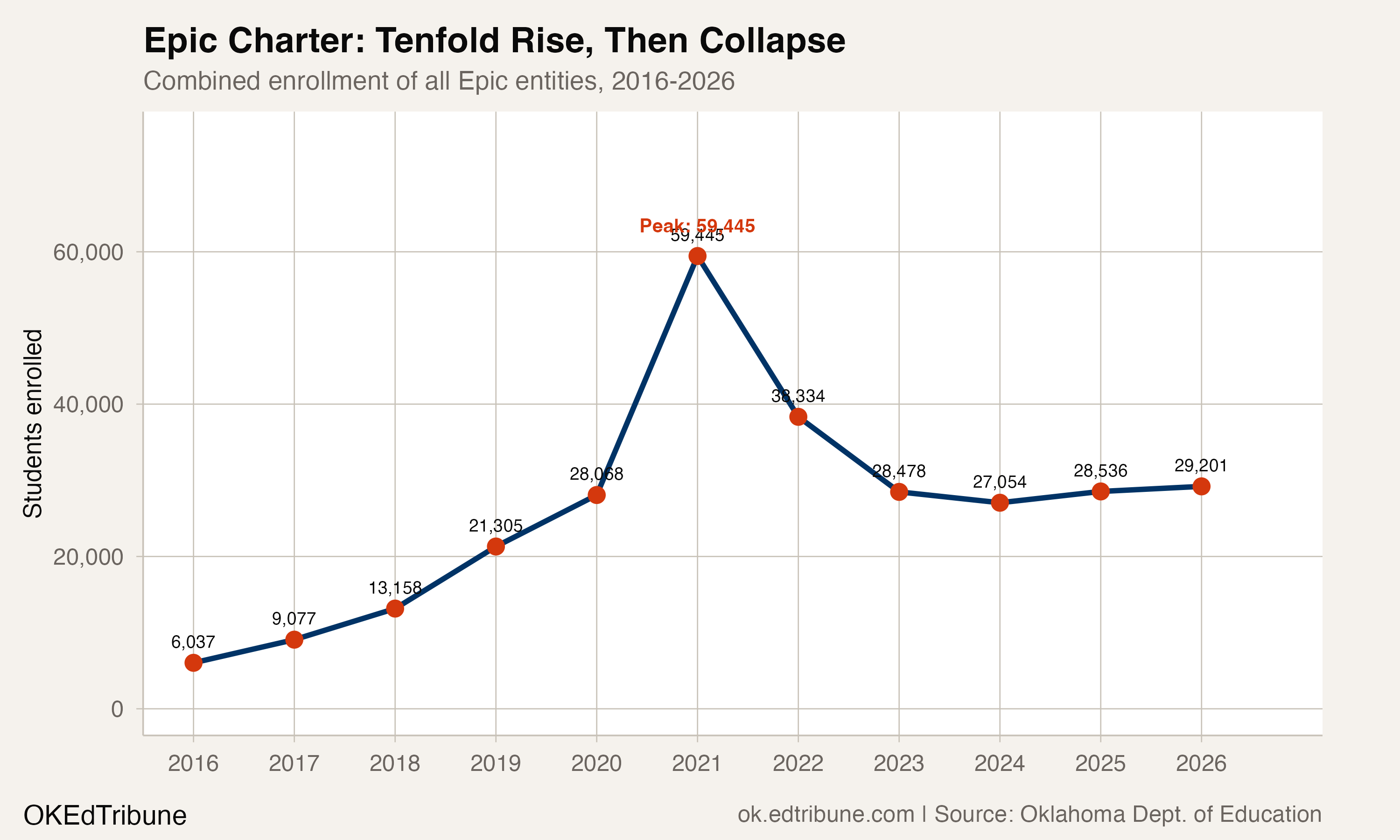
At its 2020-21 peak, Epic's combined enrollment of 59,445 made it the largest public school entity in Oklahoma. Tulsa↗ET fell to 35,765 that year. Oklahoma City↗ET fell to 37,344. Epic was larger than both by a wide margin, a virtual school system that had eclipsed two urban districts with decades of history and hundreds of physical buildings.
The 9.8-fold increase from 2016 to 2021 occurred across all grade levels. At the peak, 28,254 of Epic's students were in elementary grades (PK through fifth), 12,803 in middle school, and 18,388 in high school. Nearly half of its peak enrollment was elementary-age children, a population that would prove the least sticky when in-person schooling resumed.
The unraveling
The reversal was almost as fast as the rise. Epic lost 21,111 students between 2020-21 and 2021-22, a 35.5% decline in a single year. It lost another 9,856 the following year. By 2022-23, enrollment had fallen to 28,478, a 52.1% decline from the peak.
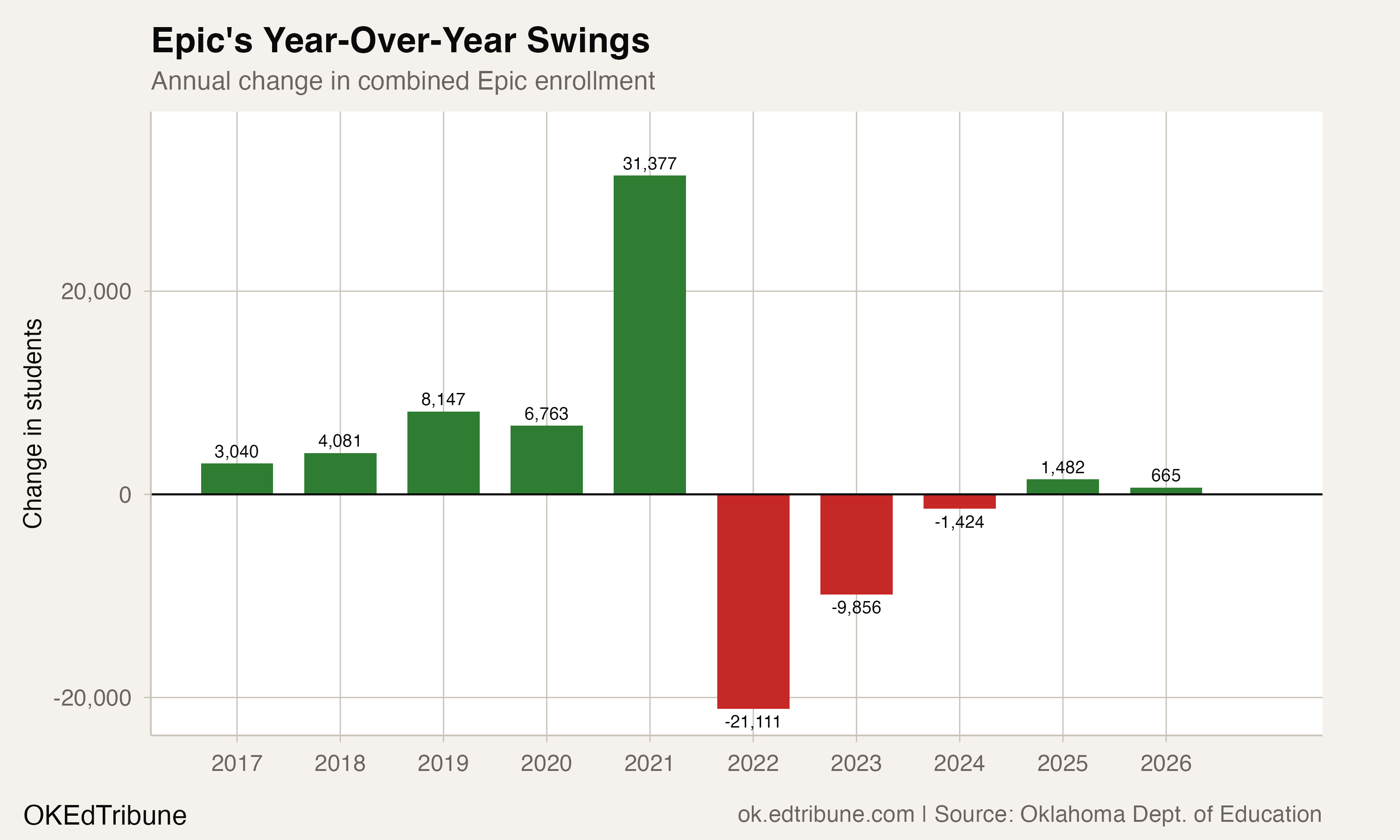
The initial decline was a return-to-school effect. Families who had enrolled in Epic as a pandemic alternative went back to their neighborhood schools when buildings reopened. Elementary enrollment took the hardest hit: Epic's PK-5 enrollment fell from 28,254 to 7,370 between 2021 and 2026, a 73.9% drop. High school enrollment, by contrast, fell only 18.2%, from 18,388 to 15,041. The students most likely to stay were those who had chosen virtual learning as a deliberate preference, not a pandemic refuge.
But the enrollment decline was compounded by a governance crisis that had been building for years. Epic's co-founders, Ben Harris and David Chaney, were charged in 2022 with 15 felonies each, including racketeering, embezzlement, and obtaining money by false pretenses. The Oklahoma State Bureau of Investigation had alleged that the co-founders used a student "Learning Fund" to commingle funds, make political donations, and pay personal expenses. Authorities estimated the scheme cost Oklahoma taxpayers $22 million.
Budget collapse and the 500 layoffs
Even after the co-founders were removed from operations and the school's accreditation was downgraded to probation, Epic's financial troubles deepened. In April 2025, the school's budget swung from a $3.1 million surplus to an $8.7 million projected deficit within two weeks. The finance chief attributed the error to a benefits cost that was "mistakenly counted twice." Superintendent Bart Banfield resigned in June 2025.
The financial crisis was rooted in enrollment projections that bore little resemblance to reality. Administrators had projected 33,000 students for 2024-25. Actual enrollment came in at 28,536, a gap of roughly 4,500 students. The school had hired and budgeted as if those students were coming.
"Operating without basic budgeting and oversight controls for leaders to make informed, responsible decisions" created unsustainable costs. — Statewide Charter School Board, Forensic Investigation Report, January 2026
The forensic investigation by Carr, Riggs & Ingram, released January 2026, found no embezzlement by the post-scandal leadership. It found something arguably worse for institutional credibility: a finance superintendent who maintained two budget versions (one public, one private), a reported carryover of $60.4 million that was actually $43.7 million, and a governing board that asked just six questions across all of the finance chief's budget presentations that year.
The result was 501 employees terminated between October 2024 and July 2025, including 357 teachers and administrators in a single June layoff. Minimum teacher salary was cut from $60,000 to $50,000 for those with student rosters under 28.
The school that stayed
After three years of losses, Epic stabilized. Enrollment ticked up slightly from 27,054 in 2023-24 to 28,536 in 2024-25 and 29,201 in 2025-26, a net gain of 723 students over three years. The hemorrhaging stopped, but the recovery has been minimal: Epic's 2025-26 enrollment is less than half its 2020-21 peak.
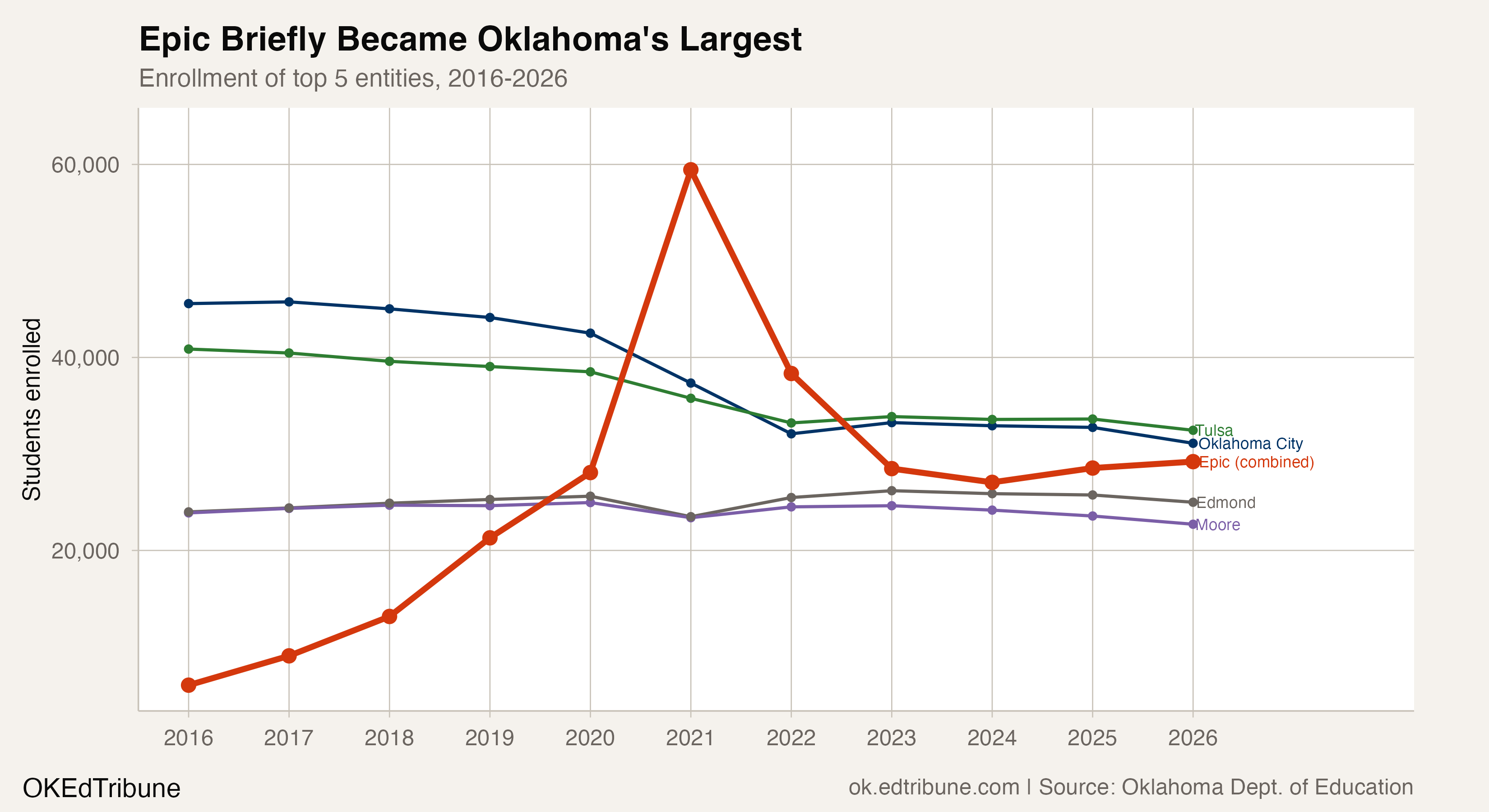
Epic remains the state's third-largest public school entity, behind Tulsa (32,450) and Oklahoma City (31,104). The gap between Epic and Oklahoma City has narrowed to 1,903 students. Before Epic's pandemic surge, Oklahoma City held 45,577 students in 2015-16 and had been the state's largest district since well before the data begins. Tulsa overtook OKC in 2021-22, a crossover driven partly by OKC's own enrollment losses and partly by the destabilizing effect of Epic's peak: when 59,445 students were enrolled in a virtual school drawing from every ZIP code in the state, every brick-and-mortar district felt the pull.
A different school at the bottom
The Epic that exists in 2025-26 is structurally different from the one that peaked in 2021. At the peak, 47.5% of Epic's students were in elementary grades. In 2025-26, 25.2% were. High school students now make up 51.5% of Epic's enrollment, up from 30.9% at the peak.
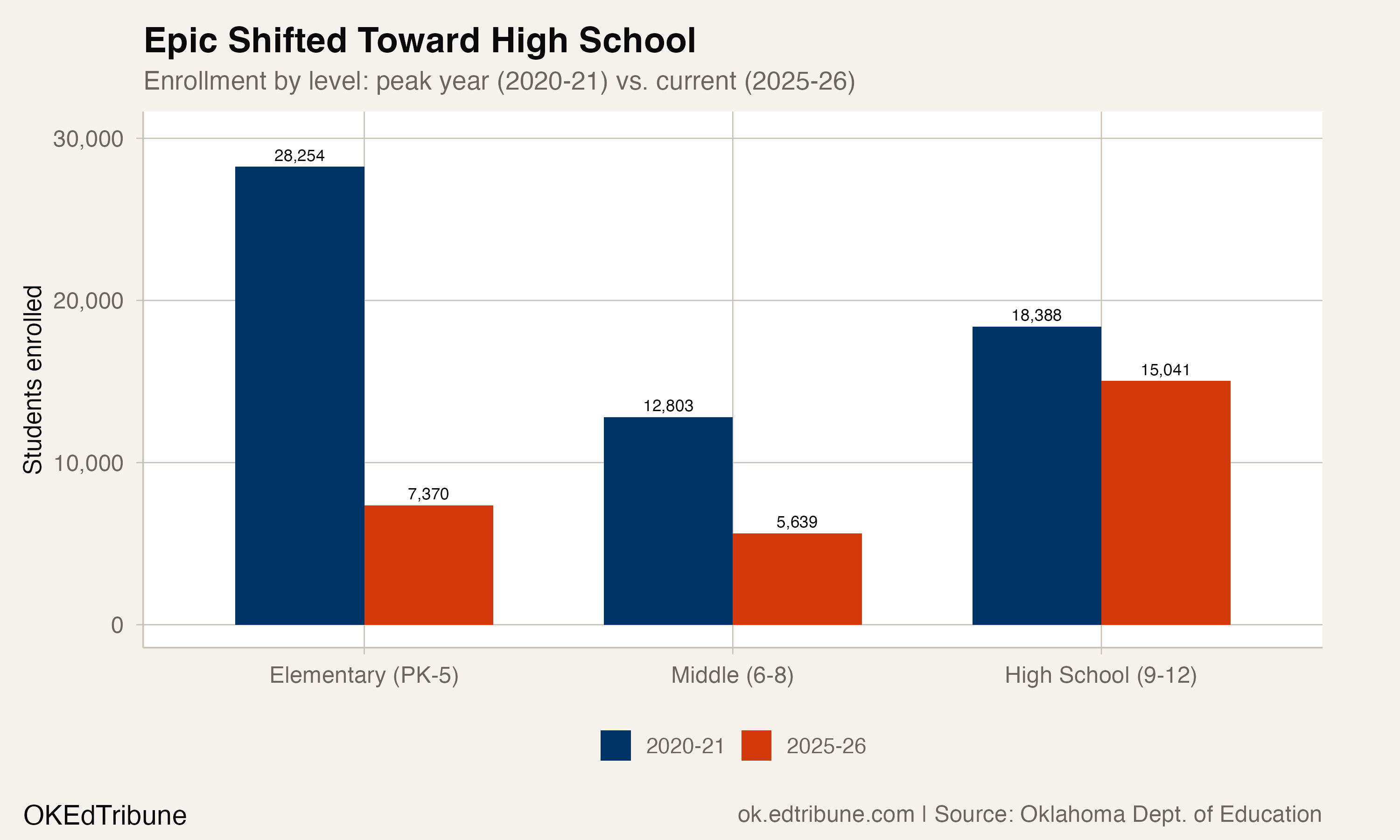
This shift has consequences. Epic now enrolls 15,041 high school students, 7.3% of all ninth through twelfth graders in Oklahoma. In a state that ranks 49th in per-pupil spending according to the National Education Association, that concentration of high schoolers in a single virtual entity shapes graduation pipelines, course access, and extracurricular availability for thousands of families.
The pandemic families who enrolled kindergartners at Epic in 2020-21 mostly left. The families that remain are more likely to have chosen virtual schooling deliberately. Whether that represents a stable floor or a temporary plateau depends in part on what happens in court.
What the broader landscape absorbed
Epic's enrollment swings were large enough to distort statewide numbers. Oklahoma's total public enrollment in 2020-21 was 694,113, down 9,537 from the prior year's peak of 703,650. Exclude Epic, and non-Epic enrollment that year was 634,668, a loss of 40,914 from the prior year's non-Epic total. Epic absorbed students that the statewide number suggested had simply vanished.
The broader charter and virtual sector grew even as Epic contracted. Non-Epic charter and virtual entities enrolled 6,593 students in 2016. By 2026, that figure is 27,935 across 27 entities, a 323.6% increase. OKC Charter Santa Fe South↗ET now enrolls 4,845. Oklahoma Virtual Charter Academy↗ET has 3,966. Dove Schools of OKC↗ET has 2,694. The sector that Epic helped pioneer has diversified well beyond a single operator.
The combined charter and virtual sector now enrolls 57,136 students, 8.3% of Oklahoma's 686,718 total. Even without Epic, the sector accounts for 4.1% of statewide enrollment. Virtual schooling survived Epic's scandal. It just scattered across more operators.
A criminal case still unresolved
The separate criminal prosecution of co-founders Harris and Chaney, which predates the budget collapse, entered its next phase in February 2026 after nearly two years of procedural delays. Both face 15 felony counts. A former Epic CFO testified in late February that the co-founders sought "retribution" against the state auditor who flagged the financial irregularities. Attorney General Gentner Drummond's office has said it remains "fully focused on presenting the facts and evidence."
The trial's outcome will not change Epic's enrollment trajectory. The 30,000 students who vanished from Epic between 2021 and 2023 are not coming back; they are enrolled elsewhere or have aged out. But the case will determine whether the institution that reshaped Oklahoma's competitive landscape did so through fraud or simply through the kind of aggressive growth that a lightly regulated charter environment allows.
For the 29,201 students who remain, that distinction matters less than whether the school's new leadership, now operating under tighter oversight from the Statewide Charter School Board, can run a budget without two versions.
Detailed code that reproduces the analysis and figures in this article is available exclusively to EdTribune subscribers.
Discussion
Sign in to join the discussion.
Loading comments...