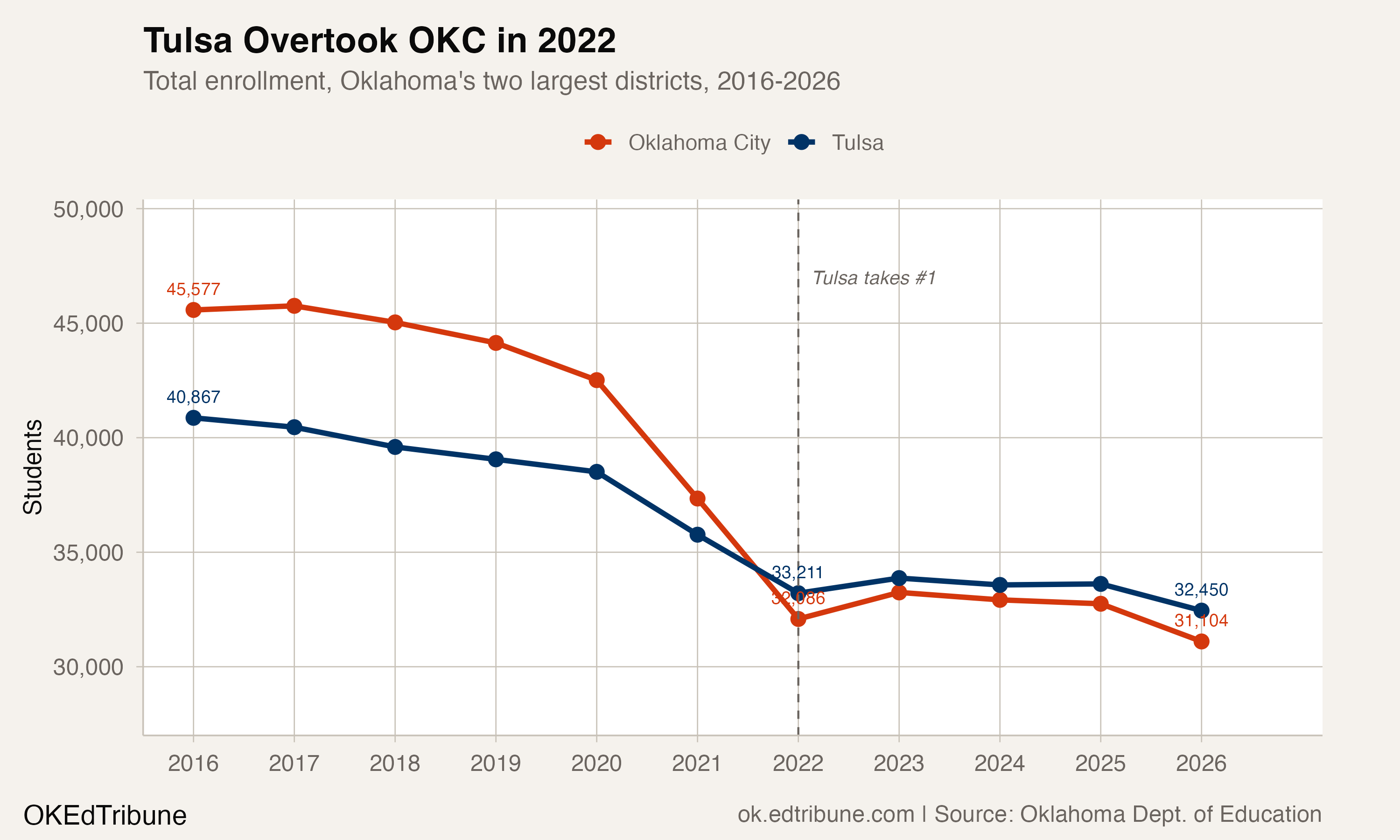
For decades, the question of Oklahoma's largest school district had an obvious answer. Oklahoma City enrolled 45,577 students in 2015-16, nearly 5,000 more than Tulsa. The gap seemed structural, built into the relative size of the two metros.
It is gone. Tulsa↗ET passed Oklahoma City↗ET in 2021-22 with 33,211 students to OKC's 32,086. By 2025-26, the gap has widened to 1,346 students: 32,450 in Tulsa, 31,104 in OKC. Both districts are at the lowest enrollment in the 11-year data window. The title of Oklahoma's largest district now belongs to a school system that has lost more than 8,400 students in a decade.
Two districts, two rates of collapse
Oklahoma City and Tulsa are both shrinking, but at very different speeds. OKC has lost 14,473 students since 2016, a 31.8% decline. Tulsa has lost 8,417, or 20.6%. The difference is not that Tulsa found a way to grow. It is that OKC fell faster.
The divergence is concentrated in two catastrophic years. Between 2019-20 and 2021-22, OKC shed 10,427 students, a 24.5% drop in just two years. Tulsa lost 5,298 over the same period, 13.8%. Those two years account for 72% of OKC's total decline and 63% of Tulsa's.
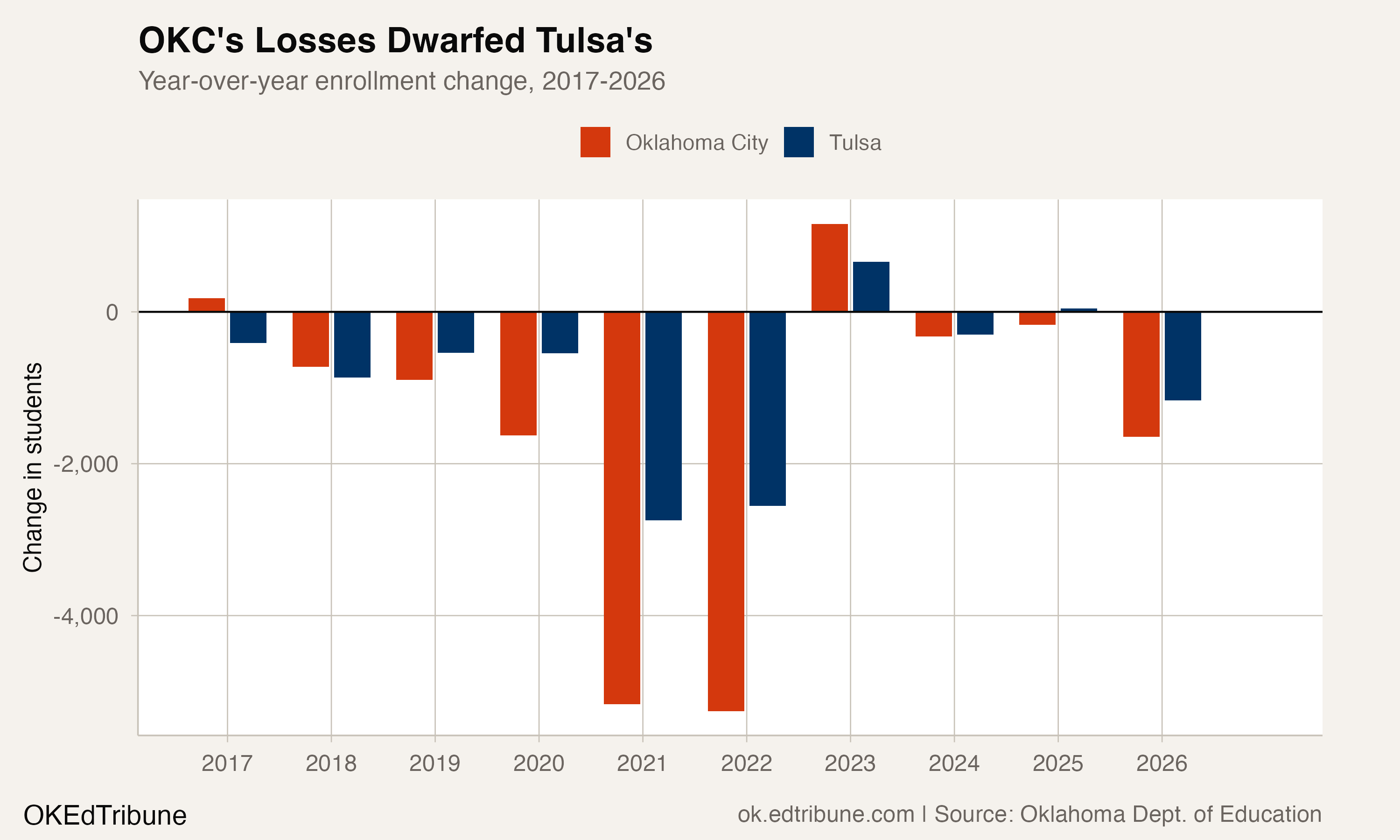
What happened in 2020-21 and 2021-22? The pandemic pushed families toward virtual options, and Epic Charter Schools↗ET was waiting. Epic's combined enrollment surged from 28,068 in 2019-20 to 59,445 in 2020-21, adding 31,377 students in a single year. OKC, as the state's largest urban district with the highest concentration of families seeking alternatives, bore a disproportionate share of that exodus.
Epic's enrollment has since contracted sharply. Its co-founders, Ben Harris and David Chaney, face felony charges including racketeering and embezzlement. A separate forensic audit commissioned by the Statewide Charter School Board found a $22.9 million budget shortfall resulting from financial mismanagement, though it found no evidence of embezzlement. Epic's enrollment fell to 29,201 by 2025-26, roughly half its peak. But the students who left OKC and Tulsa for Epic largely did not return. OKC recovered just 1,159 students in 2022-23, then resumed losing. Tulsa recovered 660, then flatlined.
The kindergarten signal
The pipeline data is where the long-term prognosis lives. OKC enrolled 4,129 kindergartners in 2015-16. In 2025-26, that number is 2,231, a 46.0% decline. Tulsa's kindergarten class fell from 3,566 to 2,523, a 29.2% drop. Both are severe, but OKC's is closer to a halving.
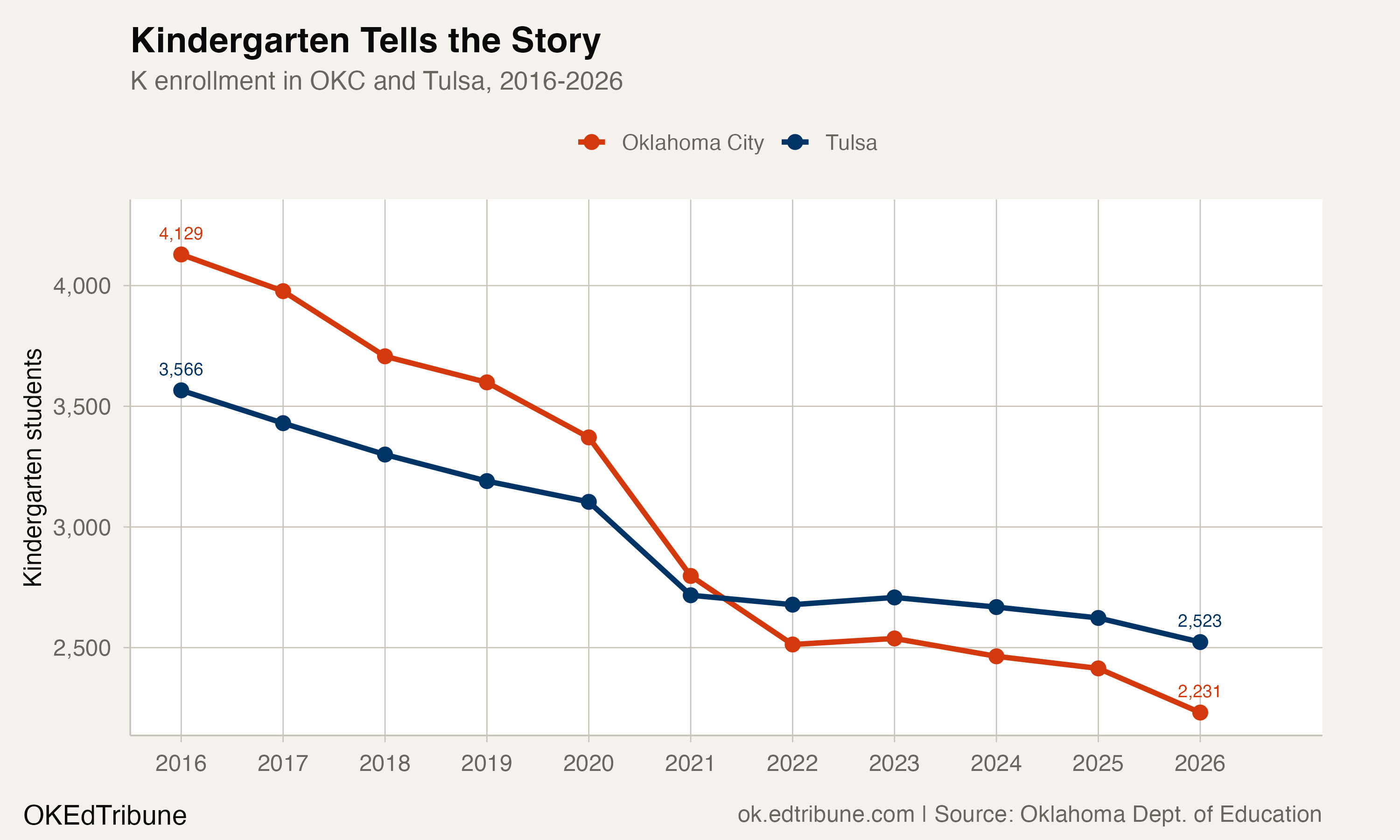
Pre-K tells a similar story. OKC's PK enrollment dropped from 3,119 to 1,672, down 46.4%. The early grades are the leading indicator: smaller kindergarten classes in 2026 become smaller third-grade classes in 2029 and smaller eighth-grade classes in 2034. The enrollment declines currently visible in upper grades reflect cohorts that entered school when the pipeline was still relatively full. The cohorts now entering are substantially smaller.
Oklahoma's fertility rate dropped 12.2% between 2011 and 2023. The births that produce kindergartners in 2026 happened in 2020 and 2021, at the trough of pandemic-era fertility. The pipeline will not widen soon.
A suburban donut around both cities
The enrollment OKC and Tulsa lost did not vanish from the state. Much of it moved outward. Deer Creek↗ET, on OKC's northern edge, grew 45.1% since 2016, adding 2,537 students. Mustang↗ET, to the southwest, grew 24.4%. On the Tulsa side, Bixby↗ET grew 41.1%, adding 2,486 students. Jenks↗ET added 700, up 6.0%.
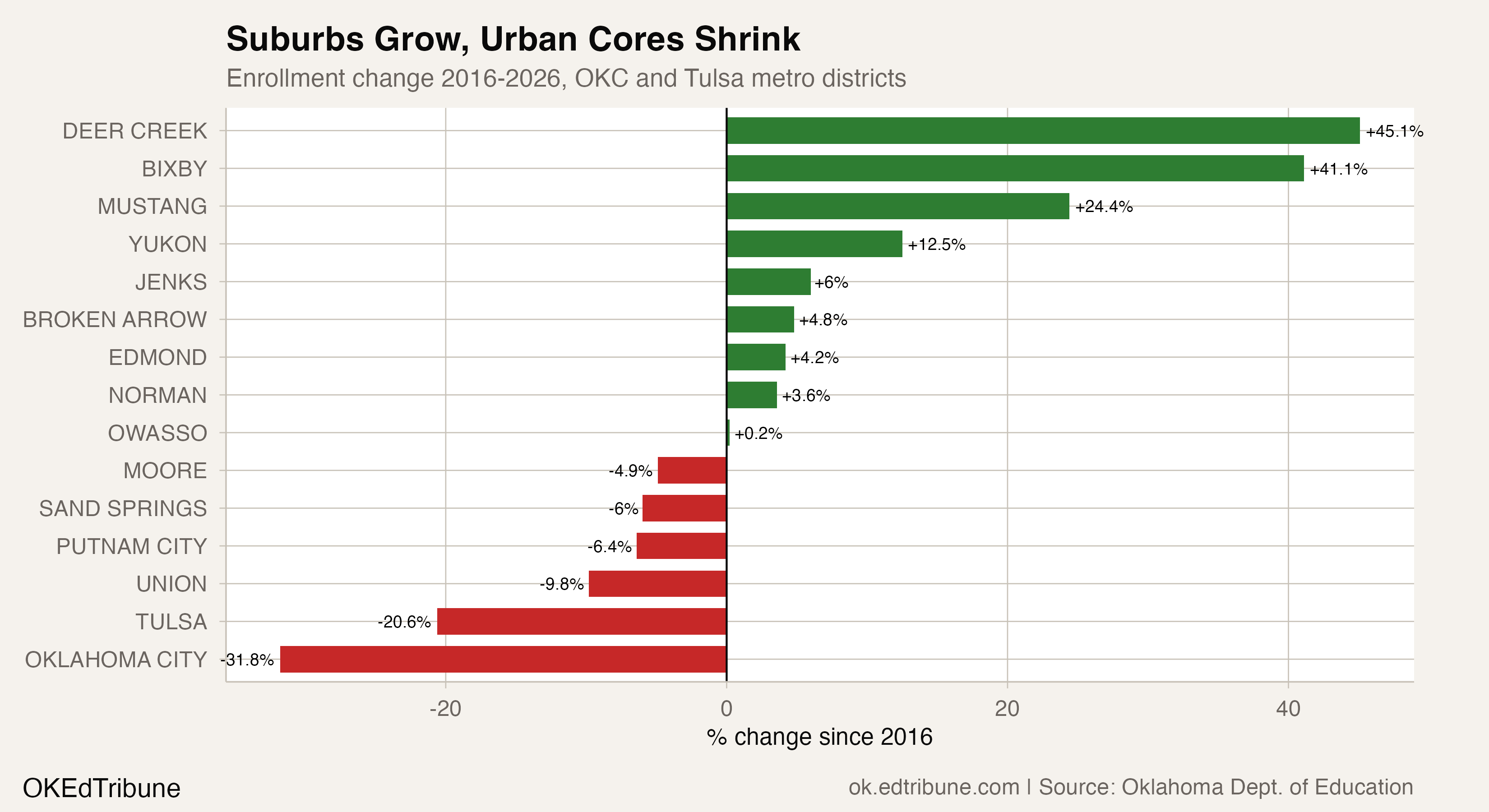
The pattern is a classic suburban donut: urban cores hollowing out while outer-ring districts absorb growth. But the inner suburbs are splitting. Putnam City↗ET, which borders OKC, lost 6.4%. Moore↗ET lost 4.9%. On the Tulsa side, Union↗ET lost 9.8%. These are not exurban districts at the metro fringe. They are established, mid-ring suburbs that have historically been stable, now caught in the same current pulling students from the urban core.
The school choice landscape adds another layer. Oklahoma's Parental Choice Tax Credit, launched in December 2023, provides $5,000 to $7,500 per child for private school tuition. According to the Oklahoma Council of Public Affairs, 36,860 students were approved for credits in 2025-26, with 2,999 currently enrolled in public school at the time of application. The program is capped at $250 million, and the Oklahoma Tax Commission reported it had awarded $248.5 million by November 2025. The tax credit's cumulative effect on urban districts, which have the highest density of private school alternatives, is not yet separable from the broader decline.
What shrinking means inside the building
The fiscal consequences of enrollment loss are immediate in Oklahoma, where per-pupil funding follows students. As OKCPS Deputy Superintendent Jason Brown told NonDoc in April 2024:
"We've been preparing — and our principals have been preparing — knowing that those ratios would increase year after year — getting us back to normal staffing ratios, and so next year we'll be back to normal, non-ESSER-inflated staffing ratios."
That preparation means larger classes. OKCPS kindergarten sections are rising from 22 to 26 students. Grades 1-2 are going from 22 to 28. Board member Jessica Cifuentes was blunt about the tradeoff:
"They're going to cut more teachers, and not only that, that's going to create more work for the teachers that are already there. That's not sustainable, and it saddens me that our students are going through this." — NonDoc, April 2024
Oklahoma ranks 49th nationally in per-pupil K-12 spending. When enrollment drops and per-pupil funding is already near the bottom, districts have almost no margin to absorb the loss without cutting staff.
A shrinking share of a shrinking state
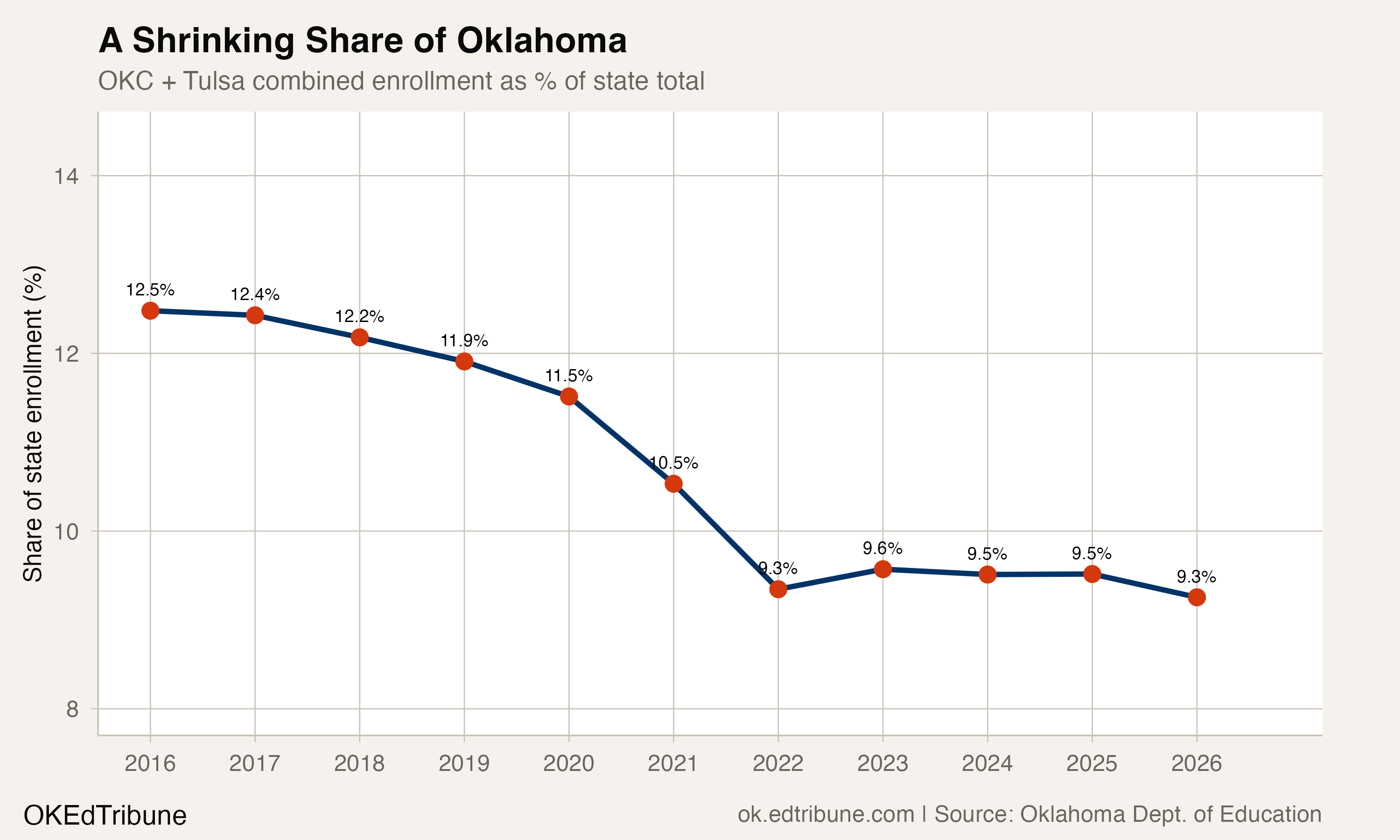
Together, OKC and Tulsa enrolled 12.5% of all Oklahoma public school students in 2016. In 2026, they account for 9.3%. The state's total enrollment has itself declined, from 703,650 at its 2019-20 peak to 686,718 in 2025-26. But the two largest districts are losing share faster than the state is losing students.
Epic Charter School, at 29,201 students, is now the state's third-largest district, fewer than 2,000 behind OKC. Edmond↗ET, at 24,993, is fourth. If OKC's decline continues at its 2025-26 rate, and Epic holds steady, Epic could pass OKC within two years.
The crossover was not a fluke. Tulsa has led OKC for five consecutive years, the gap is widening, and both districts are entering a decade of smaller incoming cohorts. Meanwhile, Epic Charter School sits at 29,201 students, fewer than 2,000 behind OKC. If current trends hold, Epic could pass OKC within two years, and Oklahoma's capital city would be home to the state's third-largest school district.
Detailed code that reproduces the analysis and figures in this article is available exclusively to EdTribune subscribers.
Discussion
Sign in to join the discussion.
Loading comments...