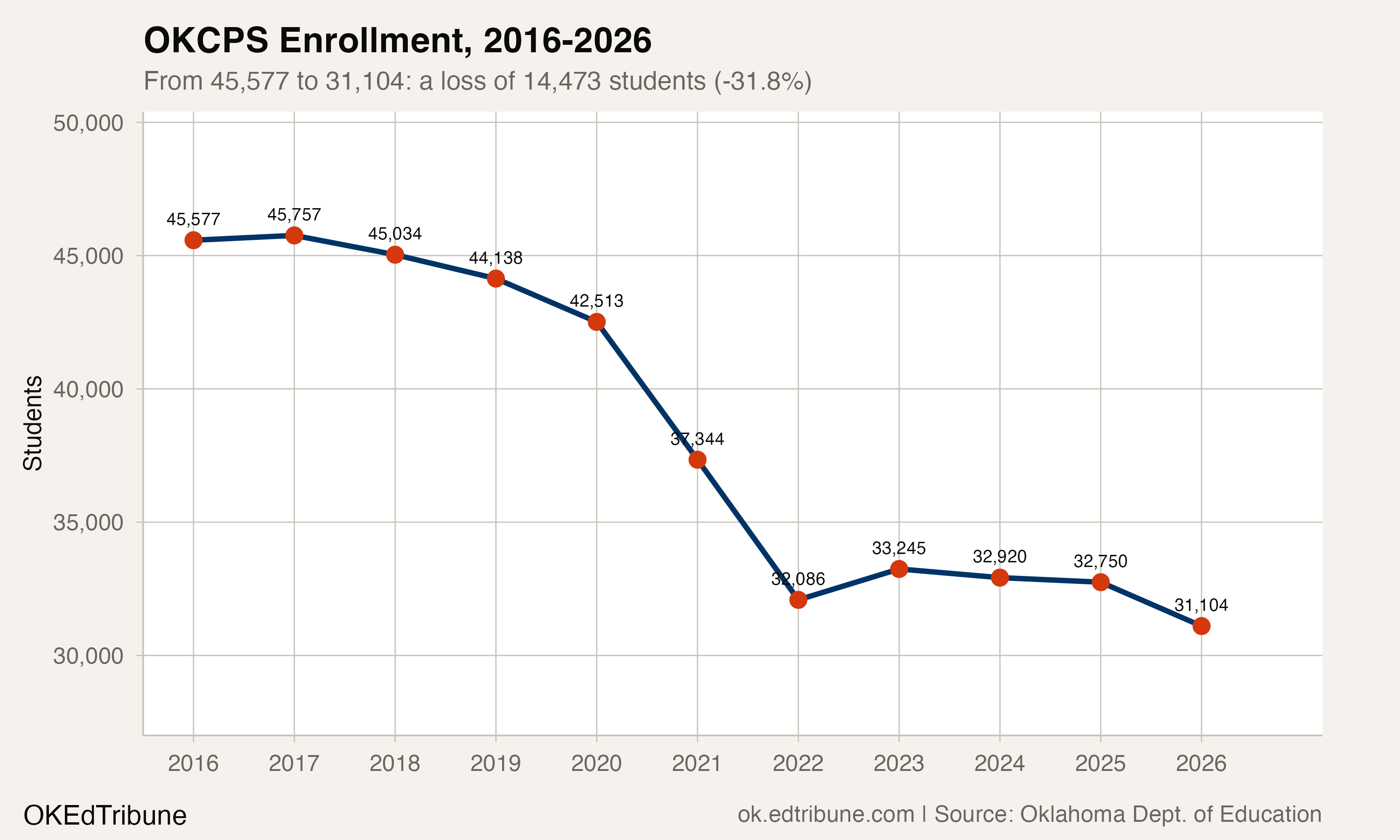
In 2015-16, Oklahoma City↗ET Public Schools enrolled 45,577 students, more than any district in the state. By 2025-26, that number had fallen to 31,104. The loss of 14,473 students, a 31.8% decline, is the largest absolute enrollment drop of any district in Oklahoma over the past decade. It is also larger than the entire state's net enrollment decline of 5,952 students over the same period, meaning growth elsewhere has been masking a collapse at the center.
The district that once defined public education in Oklahoma's capital now operates 59 campuses, down from 91. Tulsa↗ET passed it in enrollment in 2021-22 and leads by 1,346 students. OKCPS's share of statewide enrollment has fallen from 6.6% to 4.5%.
Three phases of decline
The 14,473-student loss did not arrive evenly. It came in three distinct waves, each with different drivers and different velocities.
Before COVID (2016-2020): OKCPS lost 3,064 students over four years, an average of 766 per year, a 6.7% decline. The district was already shrinking, but slowly. Families were trickling outward to suburban districts, and the first wave of virtual charter growth was pulling students statewide.
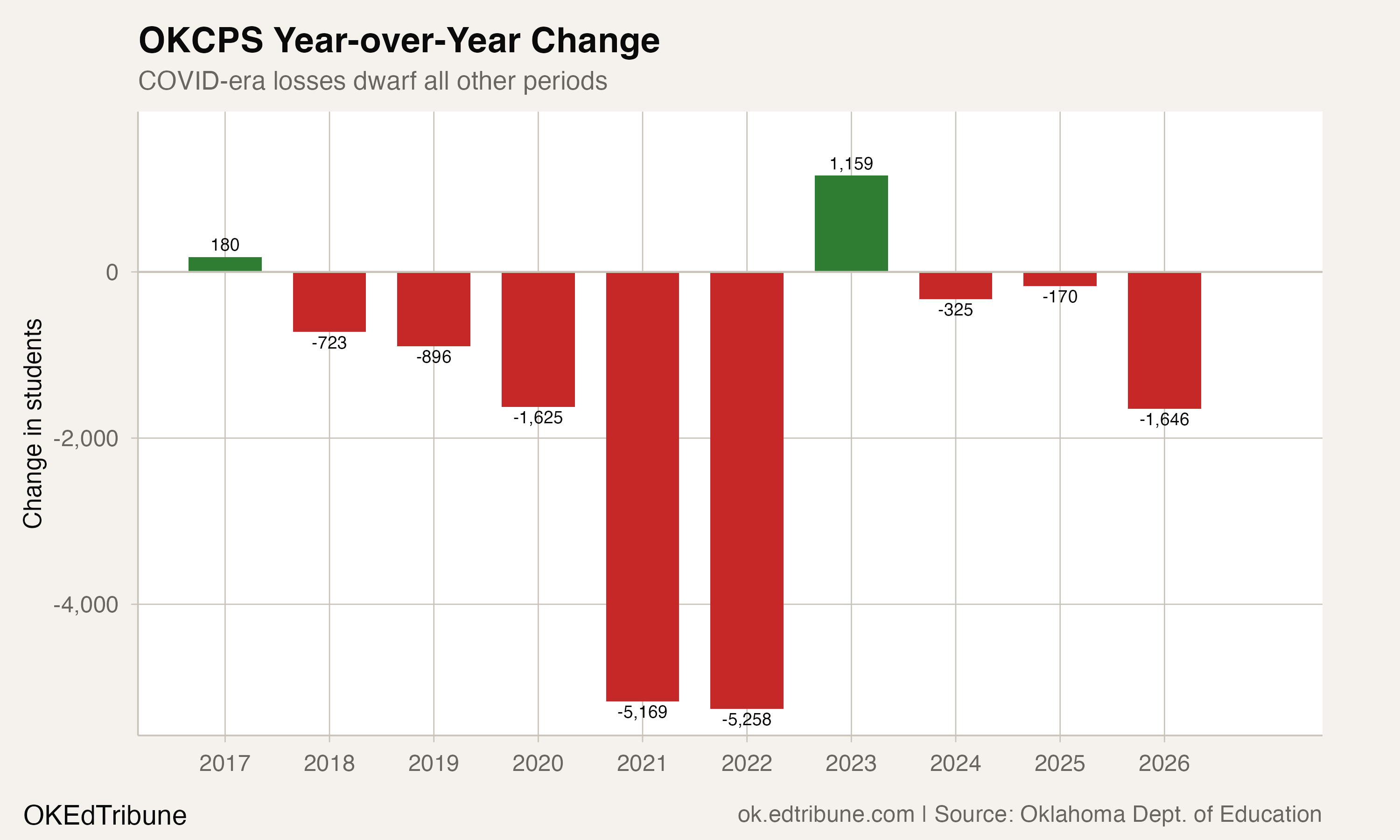
The COVID crash (2020-2022): Two years erased 10,427 students, a 24.5% plunge. This is where the trajectory broke. OKCPS lost 5,169 students in 2020-21 and another 5,258 in 2021-22. Epic Charter Schools↗ET, which had enrolled 28,068 students statewide before the pandemic, surged to 59,445 in 2020-21 as families across Oklahoma fled to virtual instruction. OKCPS was not the only district hit, but it was hit hardest in absolute terms.
Post-COVID (2022-2026): The district stabilized briefly, gaining 1,159 students in 2022-23 as some families returned, but then resumed losing ground. The net loss over four post-COVID years is 982 students, an average of 246 per year. Stabilization, not recovery.
No longer No. 1
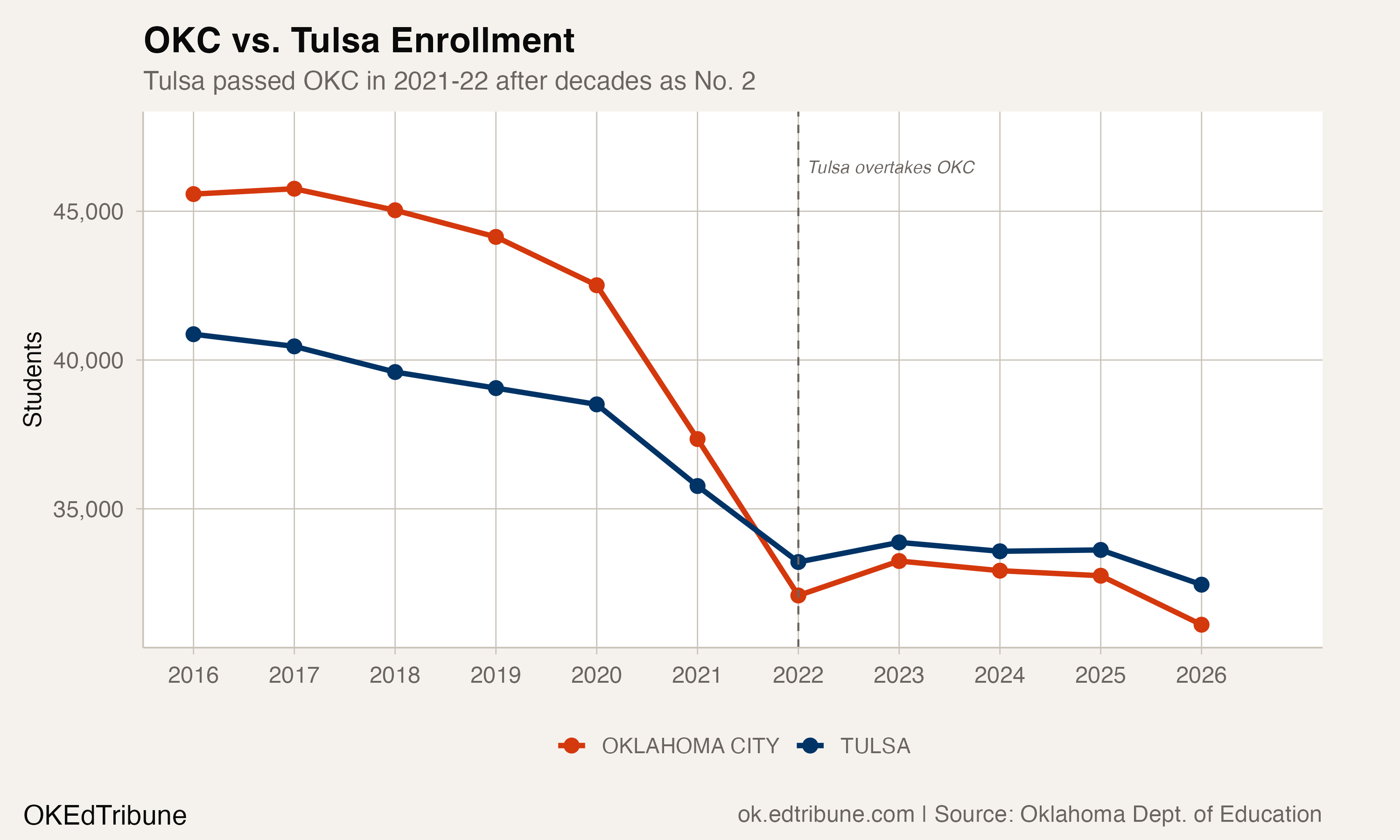
For decades, Oklahoma City was the state's largest district. That ended in 2021-22, when Tulsa's enrollment of 33,211 surpassed OKC's 32,086. The gap has widened since. Both districts are declining, but OKC has declined faster: 31.8% over ten years compared to Tulsa's 20.6%.
By 2025-26, Tulsa enrolls 32,450 students to OKC's 31,104. Epic Charter School, at 29,201, is closing in on both from below.
The suburban donut
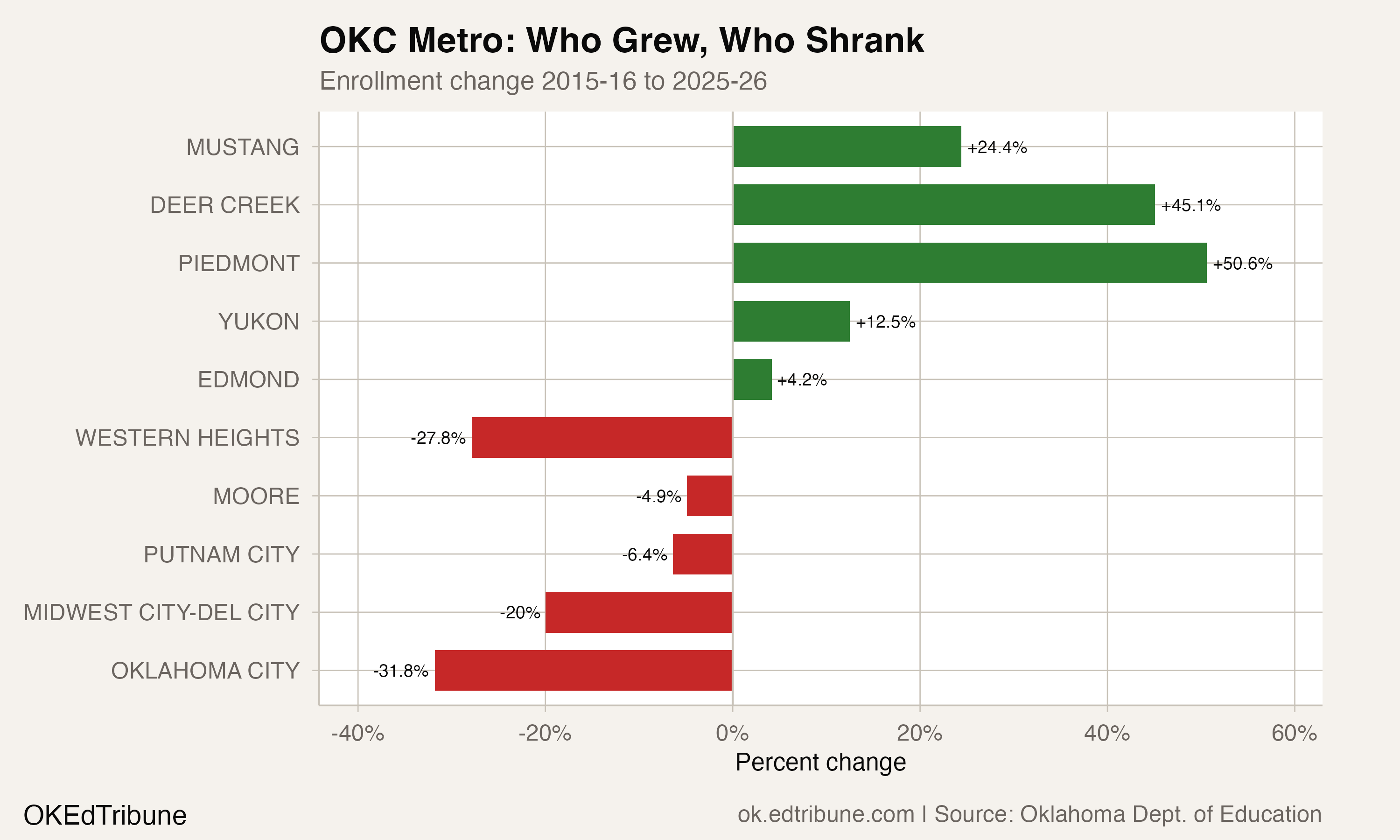
The OKC metro tells a story of centrifugal force. While the core district shrank by 31.8%, outer-ring suburbs boomed. Piedmont↗ET, northwest of the city, grew 50.6% (from 3,649 to 5,497). Deer Creek↗ET, also on the north side, grew 45.1% (5,628 to 8,165). Mustang↗ET, to the west, grew 24.4% (10,798 to 13,428).
The inner ring tells a different story. Midwest City-Del City↗ET lost 20.0% of its students (14,574 to 11,666). Western Heights↗ET, which borders OKC to the west, lost 27.8% (3,852 to 2,782). Putnam City↗ET and Moore↗ET, two of the metro's largest suburban systems, both lost ground: Putnam City by 6.4%, Moore by 4.9%.
Edmond↗ET, long the metro's most affluent suburban district, barely grew: 4.2% over ten years. Yukon↗ET fared better at 12.5%, but neither kept pace with the outer-ring boomtowns.
The pattern is clear: families are not leaving the OKC metro. They are leapfrogging the inner suburbs for newer development on the metropolitan fringe.
32 fewer schools
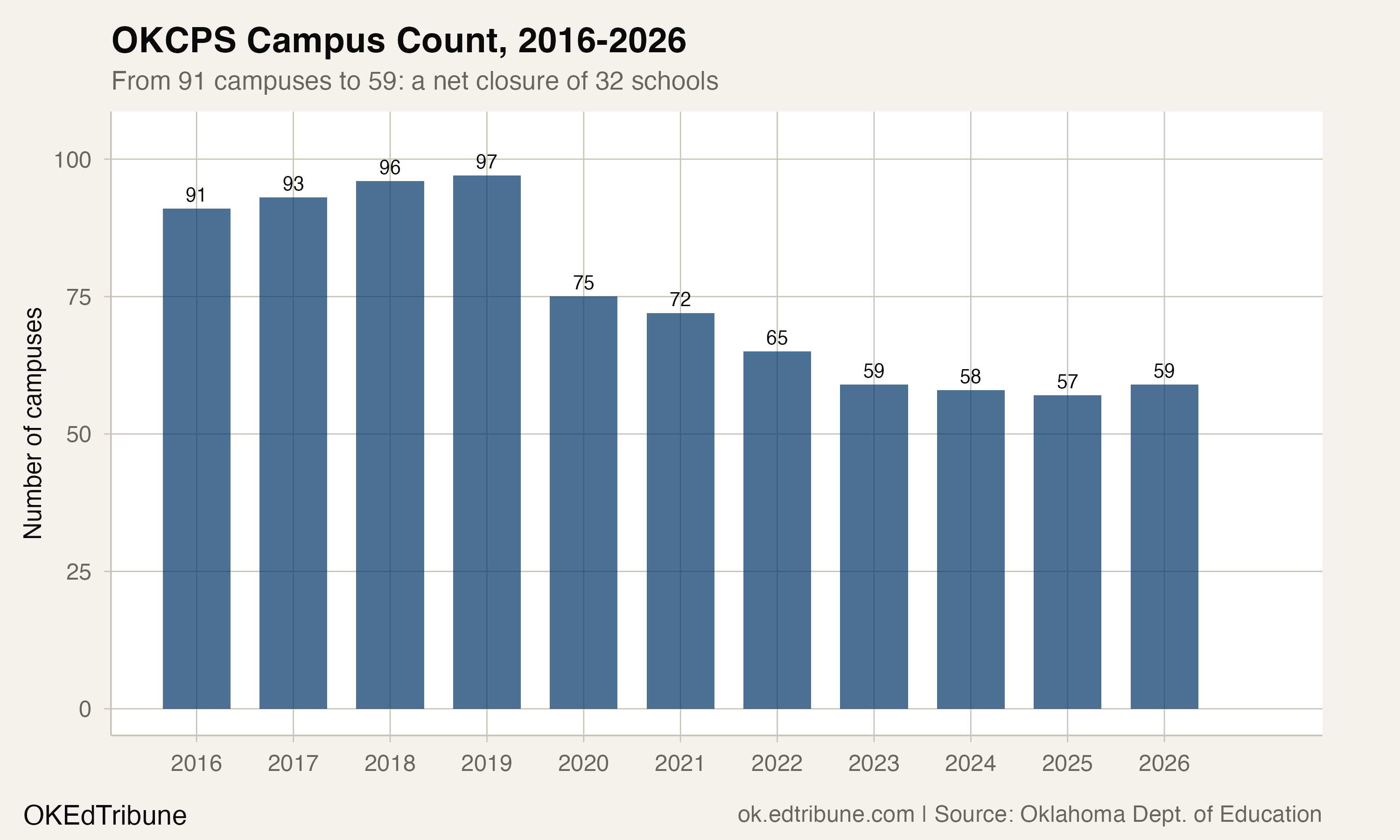
OKCPS went from 91 campuses in 2015-16 to 59 in 2025-26. Much of this contraction was deliberate. In 2019, Superintendent Sean McDaniel launched the Pathway to Greatness plan, which closed 15 schools and reconfigured 17 others. The rationale was straightforward: only 18 of 54 elementary schools had full-time art, music, and PE teachers. Consolidation would spread those resources across fewer buildings.
The board approved the plan 8-0. But COVID arrived months after implementation began, and the campus network kept shrinking: from 97 in 2018-19 to 75 in 2019-20, then to 65 in 2021-22, and 59 by 2022-23. The average campus now serves 527 students, up from 501 in 2015-16. The consolidation achieved its stated goal of concentrating students into fewer, better-resourced buildings. What it could not do was stop the enrollment decline that made consolidation necessary in the first place.
Where the students went
Enrollment data shows where students are, not why they moved. But the timing and magnitude of the losses point to several contributing forces.
The most visible is Epic Charter Schools. Epic grew from 6,037 students in 2015-16 to a peak of 59,445 in 2020-21, becoming the largest school system in the state during COVID. It has since contracted to 29,201 students in 2025-26, partly because families returned to brick-and-mortar schools and partly because the organization collapsed into financial crisis. A forensic investigation ordered by the Statewide Charter School Board found that Epic's budget swung from a $3.1 million surplus to a projected $8.7 million deficit in two weeks. The school laid off more than 500 employees across two rounds of cuts in 2024 and 2025. Its co-founders face felony racketeering and embezzlement charges in what state investigators called a $22 million scheme.
Epic's implosion did not return students to OKCPS. The district's 2025-26 enrollment of 31,104 is its lowest in the dataset, a fresh 1,646-student drop. The students Epic lost after 2021 appear to have scattered across suburban districts and other virtual providers rather than returning downtown.
Suburban migration compounds the picture. Federal Reserve Bank of Kansas City research on Oklahoma's pandemic-era population shifts found that Oklahoma County lost residents to other parts of the state while surrounding counties, particularly Canadian County (home to Mustang and Yukon), absorbed substantial growth. The school enrollment data mirrors this: Mustang added 2,630 students over the decade while OKC lost 14,473.
Oklahoma's Parental Choice Tax Credit, signed into law in December 2023, adds another outflow channel. The program provides $5,000 to $7,500 per child for private school tuition. In its second year (2025-26), 36,860 students statewide have been approved for credits, with 2,999 switching directly from public to private schools. By June 2025, approvals had grown to 37,428 children. How many of those transfers came from OKCPS specifically is unknown; the state does not publish district-level breakdowns of tax credit usage.
The pipeline is thinning
The grade-level data reveals a district that is shrinking from the bottom up. OKCPS kindergarten enrollment fell from 4,129 in 2015-16 to 2,231 in 2025-26, a 46.0% decline. Pre-K fell 46.4%, from 3,119 to 1,672. First grade dropped 45.3%.
At the top of the pipeline, twelfth grade barely moved: 2,192 to 2,110, a decline of just 3.7%. The cohorts that entered OKCPS a decade ago are largely still there. The cohorts entering now are half the size.
Fewer young children are enrolling each year. The decline is structural — smaller incoming cohorts will compound as they move through the grades.
What the budget absorbs
The fiscal consequences are direct. Oklahoma funds districts primarily through a per-pupil formula. When OKCPS's average daily membership fell by nearly 3,000 students compared to pre-COVID levels, funding followed. The district simultaneously saw federal pandemic relief funds (ESSER) expire, money that had temporarily subsidized smaller class sizes.
The result: class size caps rose across every grade band in 2024-25. Kindergarten went from 22 to 26 students. Grades 1-2 went from 22 to 28. High school loads increased by 10 students per teacher, to 155. The district is simultaneously managing a $955 million voter-approved bond for building improvements while operating fewer buildings for fewer students.
What comes next
OKCPS accounted for 15.5% of Oklahoma's record 10,640-student statewide loss in 2025-26, from a district that represents just 4.5% of state enrollment. The suburban growth that masked OKC's decline for years is itself slowing: Edmond grew just 4.2% over the decade, and Moore actually shrank.
The district is not approaching a floor. A floor implies a surface you can stand on. OKCPS enrolled 4,129 kindergartners in 2016 and 2,231 in 2025-26. Those smaller classes will move through the system grade by grade for the next decade, each one replacing a larger cohort above it. The $955 million bond will improve the buildings. It cannot fill them.
Detailed code that reproduces the analysis and figures in this article is available exclusively to EdTribune subscribers.
Discussion
Sign in to join the discussion.
Loading comments...