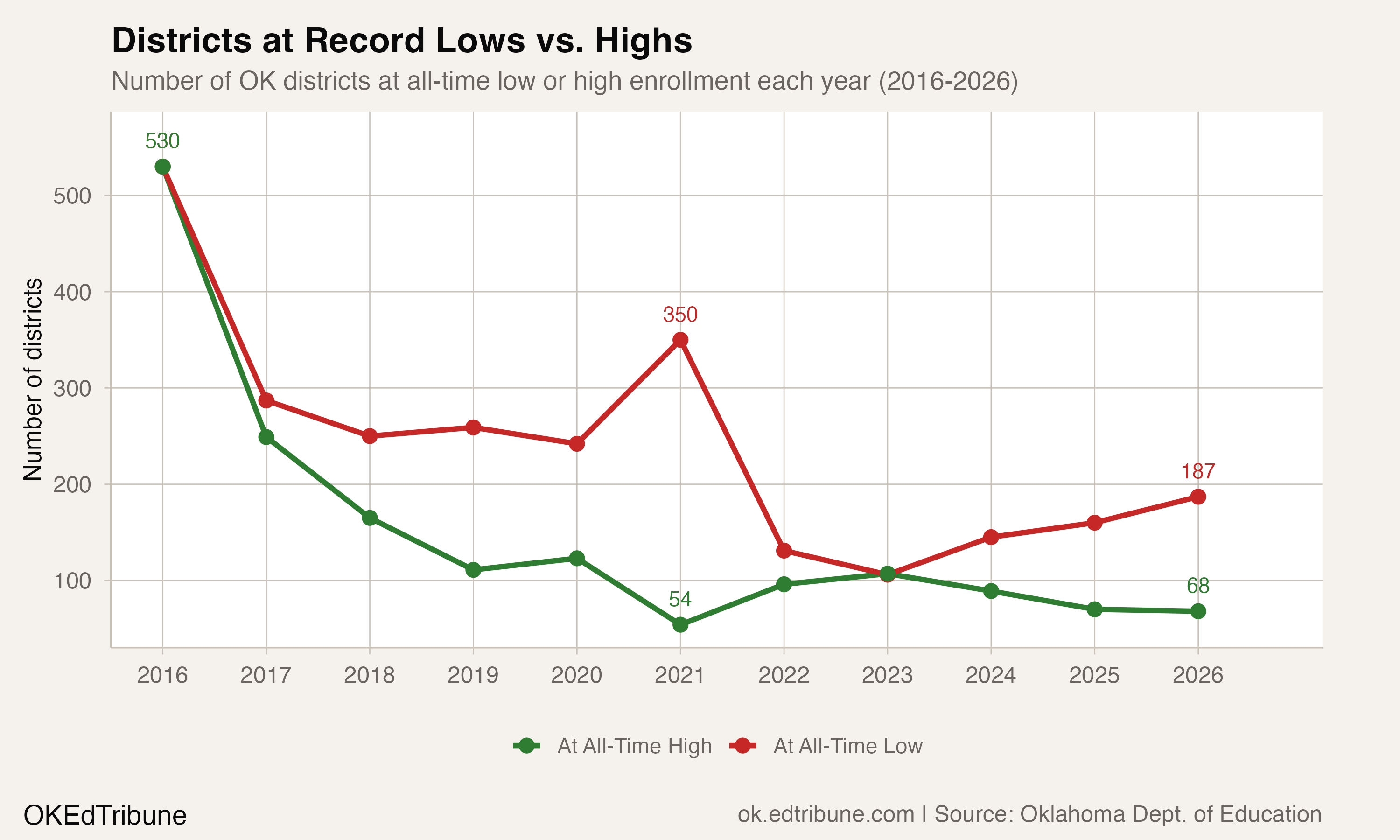
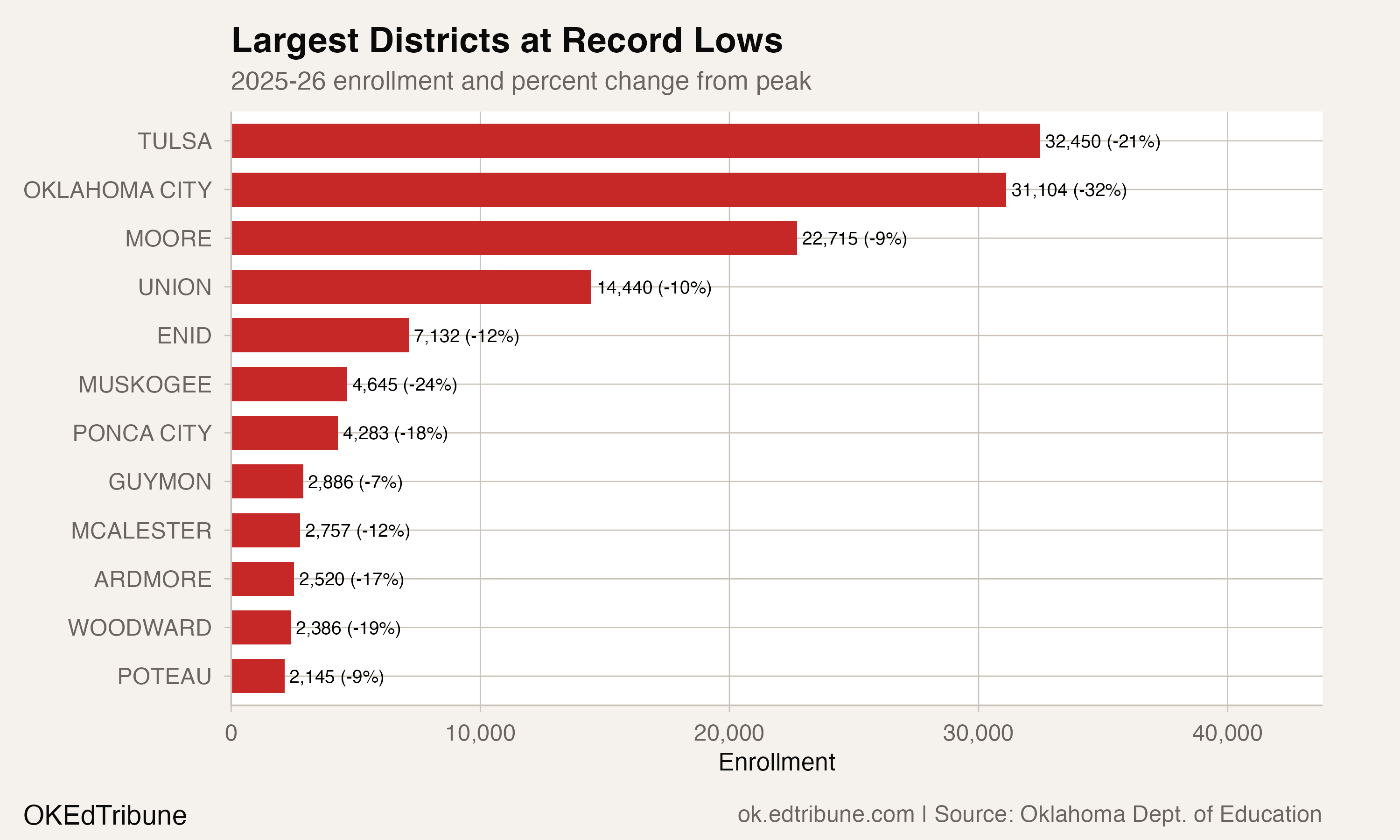
Tulsa↗ET is at its lowest enrollment in at least 11 years. So is Oklahoma City↗ET. So are Moore↗ET, Union↗ET, and Enid↗ET. In total, 187 of Oklahoma's 541 public school districts recorded their lowest enrollment in at least 11 years of available data in 2025-26, more than one in three. Tulsa, OKC, Moore, and Union are on the list alongside hundreds of smaller districts. The decline spans every size class.
The 187 districts at all-time lows collectively enroll 214,793 students, 31.3% of the state's public school population. Only 68 districts, 12.6%, are at all-time highs. The ratio is nearly three to one, and it is the widest gap in the dataset outside the COVID year of 2020-21.
The 10,640-student cliff
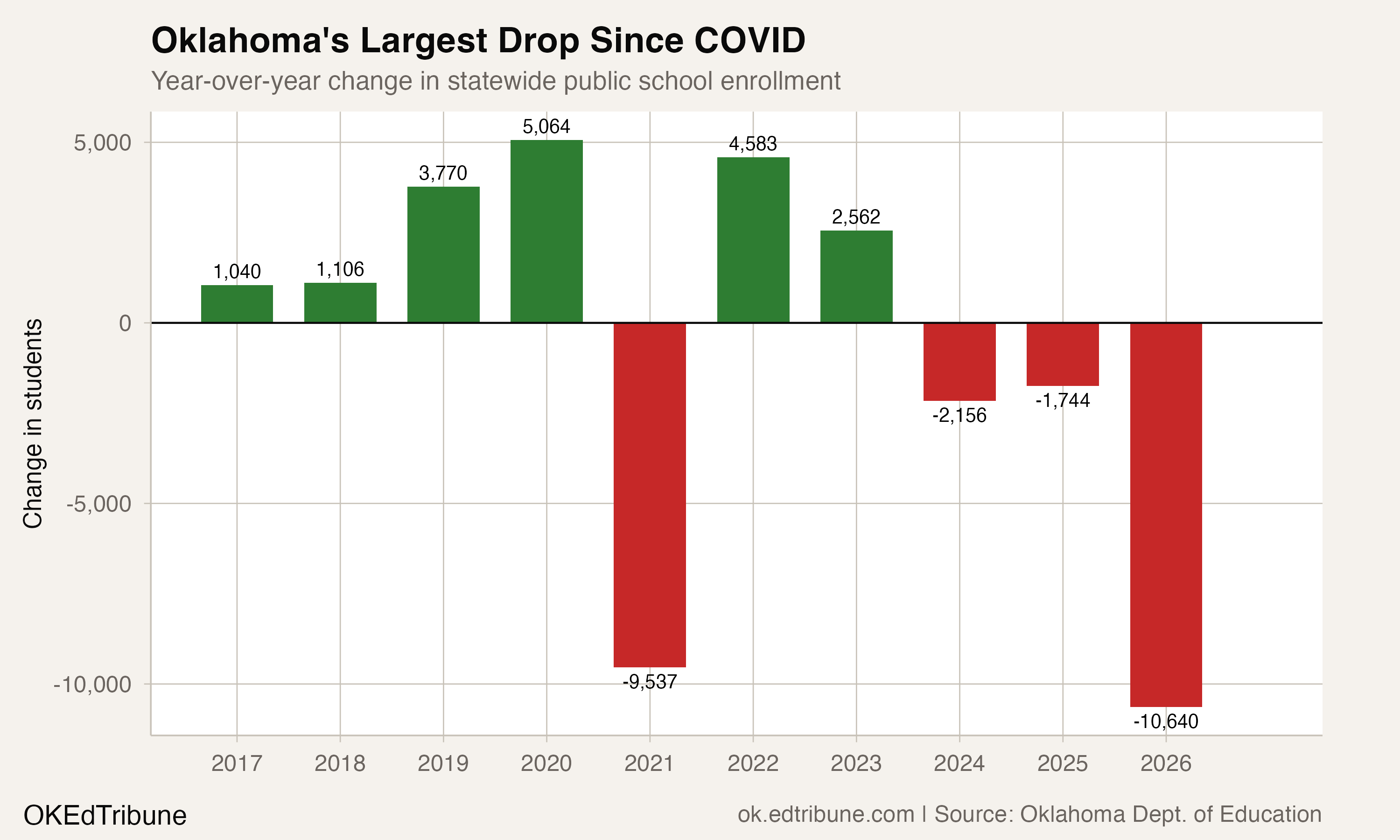
Oklahoma lost 10,640 students between 2024-25 and 2025-26, a 1.5% drop that exceeds even the pandemic-year loss of 9,537 students in 2020-21. The state peaked at 703,650 students in 2019-20, briefly recovered to 701,258 by 2022-23, and has now fallen to 686,718, a new floor.
The pattern since the peak is unmistakable: three years of modest recovery followed by three years of accelerating decline. The losses went from 2,156 in 2023-24 to 1,744 in 2024-25 to 10,640 in 2025-26. That final drop is not a gradual erosion. It is the largest single-year loss in the 11-year dataset.
The big districts are not immune
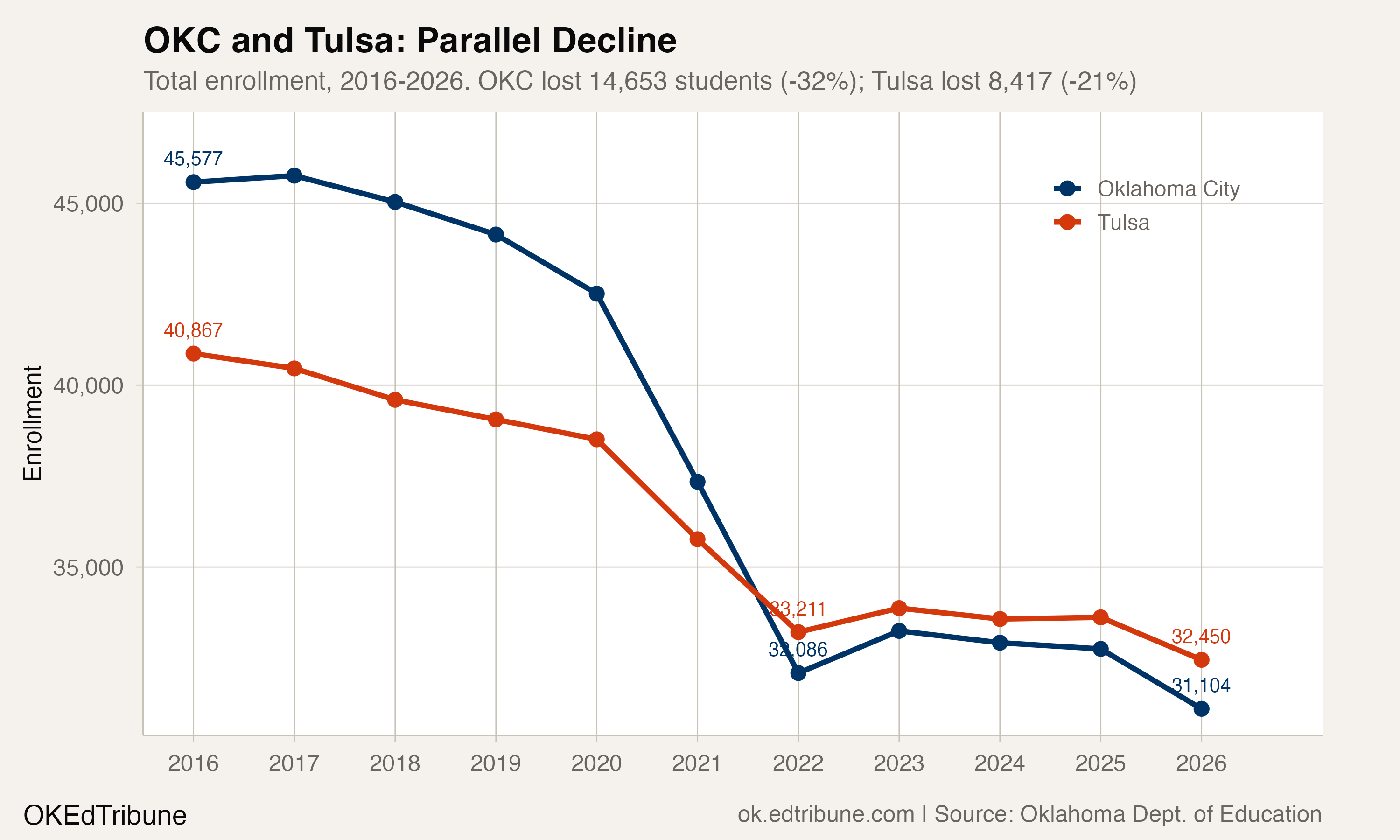
The conventional wisdom about enrollment decline is that it is a rural problem. Oklahoma's data contradicts that. Four of the state's 10 largest traditional districts are at record lows: Tulsa (32,450 students), Oklahoma City (31,104), Moore (22,715), and Union (14,440). A fifth top-10 district, Putnam City↗ET (18,122), sits just 1.6% above its own floor.
The losses at the top are severe. Oklahoma City has lost 14,653 students since its 2016-17 peak of 45,757, a 32.0% decline. The district once enrolled 14,000 more students than Tulsa. By 2021-22, Tulsa had passed it, and the gap has held since. Tulsa has shed 8,417 students from its own 2015-16 peak of 40,867, a 20.6% decline.
Midwest City-Del City↗ET lost 2,541 students since 2019-20, a 17.9% drop. Muskogee↗ET is down 722 students (13.5%) over the same period. Ponca City↗ET fell 9.7%. Among the top 20 districts, only Norman↗ET, Bixby↗ET, Deer Creek↗ET, and Mustang↗ET gained students since the pre-COVID peak, and all four are suburban systems on the edges of the Oklahoma City or Tulsa metros.
Decline touches every size class
The all-time-low pattern is not concentrated in any single tier. Among the state's 13 districts enrolling 10,000 or more students, four (30.8%) are at record lows. Among the 277 districts in the 100-to-499 range, 103 (37.2%) are at their floor. Even the smallest districts, those under 100 students, have an ATL rate of 41.7%.
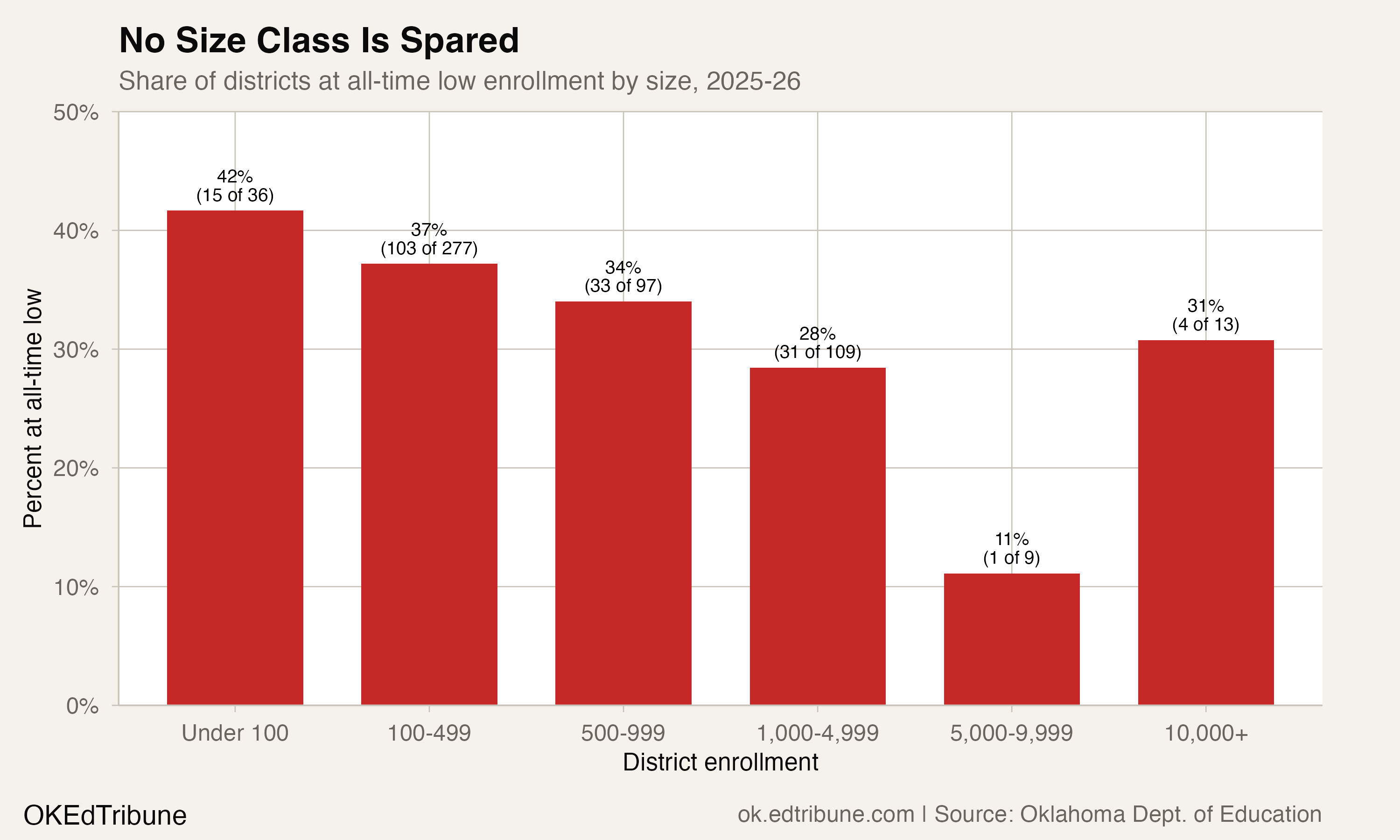
The only size class with a relatively low ATL rate is the 5,000-to-9,999 bracket, where just one of nine districts (Enid) is at its lowest point. The mid-sized and large brackets track closely, between 28% and 42%, suggesting a statewide structural force rather than a phenomenon confined to any one type of community.
Birth rates, school choice, and the pipeline
The most likely driver of this breadth of decline is demographic. Oklahoma's kindergarten enrollment has fallen from 53,453 in 2015-16 to 45,680 in 2025-26, a 14.5% drop. Fewer children are entering the system each year, and the outgoing 12th-grade cohorts are larger than the incoming ones.
"Observers say falling birth rates are the main culprit." — Oklahoma Watch, January 2026
School choice adds a second pressure. The Oklahoma Parental Choice Tax Credit, launched in 2024, approved 39,373 students for $248.4 million in credits for the 2025-26 school year, nearly exhausting its $250 million annual cap. Of those, 3,724 were prior public school students who transferred to private schools. The program also funds a separate homeschool credit that served 2,692 returns in tax year 2024. The direct public-to-private flow of 3,724 students is a fraction of the 10,640-student statewide loss, but it compounds a demographic decline that was already underway.
Virtual charter schools absorb a larger share. Oklahoma's virtual and charter sector enrolled 57,136 students in 2025-26 across 28 entities, 8.3% of statewide enrollment. Epic Charter Schools↗ET alone enrolls 29,201 students and is at an all-time high, making it the state's third-largest district by enrollment. Epic faces ongoing legal and financial scrutiny: its co-founders face racketeering and embezzlement charges, and a forensic investigation found that financial mismanagement led to roughly 500 employee terminations between October 2024 and July 2025.
125 districts in multi-year freefall
The record-low count captures a snapshot. The streak data captures a trajectory. Of Oklahoma's 541 districts, 122 (22.6%) have declined for three or more consecutive years through 2025-26. Thirteen have declined for five or more years. Anadarko↗ET and Locust Grove↗ET have each declined for 10 consecutive years, the longest streaks in the dataset.
The median district has lost 11.2% of its enrollment since 2015-16. Of the 509 districts with data in both the first and last years, 372 (73.1%) have fewer students now than they did 11 years ago. Only 135 have grown.
COVID recovery has been limited. Of 516 districts present in both 2019-20 and 2025-26, just 147 (28.5%) have returned to their pre-pandemic enrollment. The other 369 have not. Many of those 369 are now at all-time lows.
The rural edge
Oklahoma has more than 500 districts for roughly 687,000 students, a ratio that makes consolidation a recurring policy debate. More than half of the state's districts enroll fewer than 500 students.
"I see what's coming. I can see it down the road ... we're going to start losing programs." — David Morris, Superintendent of Paoli↗ET Public Schools, on the possibility of annexation. KGOU, May 2025
For districts with 180 students or fewer, like Paoli, enrollment decline is existential. With single-digit class sizes in some grades, programs shrink, extracurriculars disappear, and parents begin looking elsewhere. That departure accelerates the decline. The state maintains a School Consolidation Assistance Fund, backed by the Oklahoma Education Lottery Trust Fund, to help districts that voluntarily annex. But annexation requires affirmative votes from both communities, and it rarely comes without grief.
"It was a gut punch. Oh, my god, my school's closing. That was really hard." — Kevin Flowers, McLish Public Schools alumnus, on his district's annexation to Stonewall 20 years ago. KGOU, May 2025
Where the growth is
Not every district is shrinking. The 68 districts at all-time highs are disproportionately suburban and charter. Epic Charter Schools (29,201) leads, followed by Norman (16,630), Bixby (8,532), Deer Creek (8,165), and Piedmont↗ET (5,497). Deer Creek has grown 18.8% since 2019-20; Bixby has grown 26.9%. Both are outer-ring suburbs that have absorbed families leaving Oklahoma City and Tulsa.
The pattern is familiar from other states: urban cores losing enrollment to an expanding suburban ring, while virtual charters capture families statewide. Edmond↗ET (24,993) and Broken Arrow↗ET (19,765) are the fourth- and sixth-largest districts and have held relatively stable, losing 2.4% and declining modestly, neither at record lows nor highs.
What 187 record lows mean for school finance
Oklahoma ranks 49th nationally in per-pupil funding according to the National Education Association. Because per-pupil funding follows students, every lost student reduces a district's state aid allocation. The state education budget was reduced by $108 million (3%) for fiscal year 2025, even as districts faced the expiration of federal pandemic relief funds.
For the 187 districts at record lows, the math is punishing. Fixed costs, building maintenance, transportation routes, administrative overhead, do not scale down proportionally when enrollment drops 10% or 15%. A district like Ponca City, down 458 students from its 2019-20 count, still runs the same bus routes and heats the same buildings.
Kindergarten enrollment has declined for four consecutive years and is now 14.5% below its 2015-16 level. Those smaller classes will move through the system, reaching each grade level and pushing its enrollment lower. When they do, a new set of districts will join the 187. The October count that matters most is not the one that just happened. It is the one in 2030, when the children born during the pandemic's fertility trough enter fifth grade and the last of the large cohorts graduates out.
Detailed code that reproduces the analysis and figures in this article is available exclusively to EdTribune subscribers.
Discussion
Sign in to join the discussion.
Loading comments...