In 2016, Oklahoma's public schools enrolled 127 kindergartners for every 100 seniors. A decade later, that ratio has collapsed to 93. For the first time in the state's available enrollment history, fewer five-year-olds are starting school than 18-year-olds are finishing it.
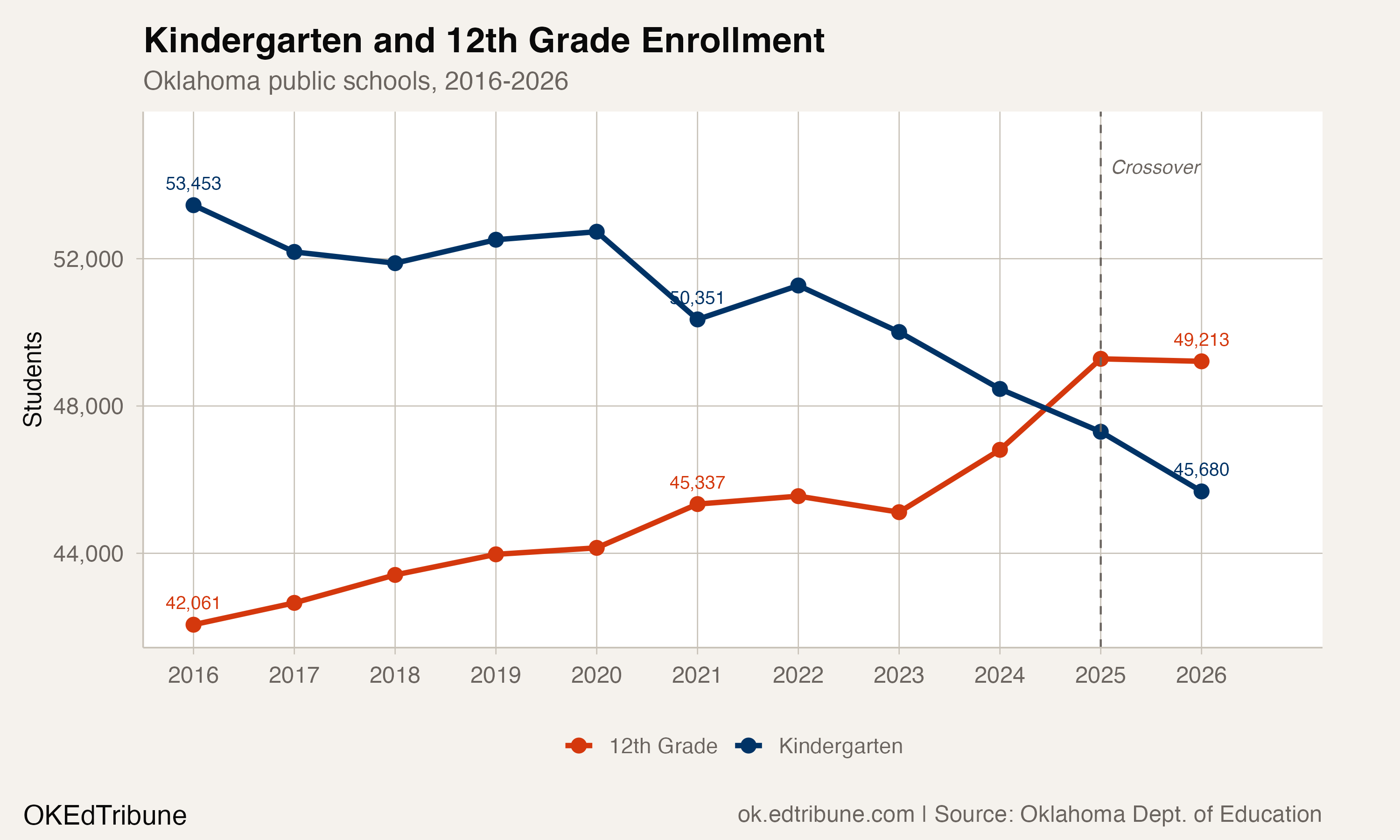
The crossover happened in 2024-25, when kindergarten enrollment fell to 47,300 while 12th grade climbed to 49,281. In 2025-26 the gap widened: 45,680 kindergartners against 49,213 seniors, a deficit of 3,533 students. The inversion is not a one-year anomaly. It is the endpoint of two converging trends that have been running for a decade, and it locks in continued enrollment losses through at least the early 2030s.
A ratio in freefall
The kindergarten-to-senior ratio is a simple measure of a school system's demographic momentum. Above 100, more students are entering than leaving. Below 100, the system is shrinking from the bottom up.
Oklahoma's ratio held near 120 from 2017 through 2020, then dropped sharply. The COVID-19 pandemic accelerated the decline: kindergarten fell by 2,381 students in a single year (2020 to 2021), while 12th grade kept climbing. By 2024, the ratio had narrowed to 103.5. By 2025, it crossed the parity line at 96.0. In 2025-26 it sits at 92.8.

The decline on the kindergarten side is steep and sustained: from 53,453 in 2016 to 45,680 in 2026, a loss of 7,773 students, or 14.5%. The 12th-grade side moved in the opposite direction, climbing from 42,061 to 49,213, a gain of 7,152 students, or 17.0%. The combined swing of nearly 15,000 students between the two grades produced a gap that did not exist a decade ago.
The bottom falls out, grade by grade
The inversion at kindergarten and 12th grade is the most visible expression of a structural shift that runs through the entire grade distribution. Every grade from pre-K through 3rd lost students between 2016 and 2026. Every grade from 4th through 12th gained.
The losses are concentrated at the youngest levels. First grade lost 8,164 students (14.6%), the largest absolute decline of any grade. Kindergarten lost 7,773 (14.5%). Pre-K lost 6,614 (15.9%). The gains are concentrated at the top: 12th grade added 7,152 students (17.0%), 11th grade added 6,930 (15.4%), and 10th grade added 3,697 (7.6%).
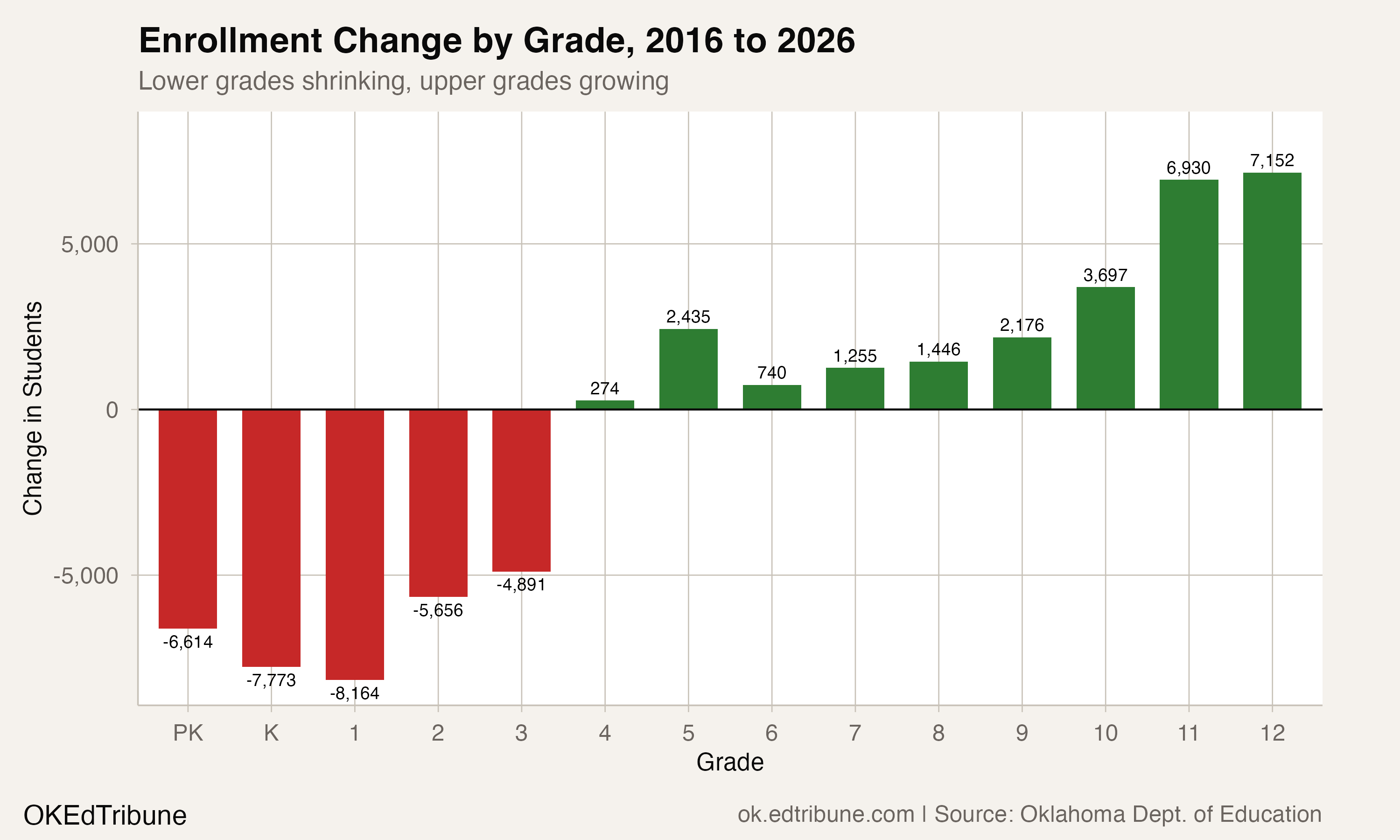
Fourth grade is the approximate pivot point, gaining just 274 students over the decade. The result is a system that is tilting: elementary enrollment (K-5) has fallen from 48.5% of K-12 students in 2016 to 44.8% in 2026, a loss of 23,775 students. Secondary enrollment (6-12) grew by 23,396 over the same period. For every three students Oklahoma's elementary schools lost, its secondary schools gained three.
What is shrinking the front end
The most likely driver of falling kindergarten enrollment is fewer births. Oklahoma's fertility rate dropped 12.2% between 2011 and 2023, from 67.3 to 59.1 births per 1,000 women of childbearing age, according to March of Dimes PeriStats data. The national total fertility rate fell to a record low of 1.6 children per woman in 2024, well below the 2.1 replacement level. Children born in 2020 and 2021, at the trough of pandemic-era fertility, are entering kindergarten now.
School choice is a contributing but secondary factor. Oklahoma's Parental Choice Tax Credit program approved 37,428 students for 2025-26, with 3,278 switching from public to private school for the first time. The tax credit provides up to $7,500 per child. Whether the program is pulling disproportionately from kindergarten is unknown; the program does not publish a grade-level breakdown.
"Public school enrollment fell across the U.S. and is largely attributed to plummeting birth rates and shifting attitudes toward school post-pandemic." -- Oklahoma Watch, Jan. 2026
Homeschooling adds another unknown. Oklahoma does not require homeschool families to register, so no reliable count exists. One analysis estimated that nearly one in four Oklahoma school-age children may now be educated outside their zoned public school, whether through homeschooling, virtual charters, open transfers, or private school.
What is inflating the back end
The 12th-grade surge is real, but part of it reflects structural features of how Oklahoma counts high school students. The 8th-to-9th grade transition has consistently run between 104% and 106% every year since 2016, meaning 9th grade is always larger than the 8th-grade class that preceded it. Some of this reflects students re-entering from private school, homeschool, or virtual programs at the high school level.
The 11th-to-12th transition runs at 94-96%, meaning about 5% of 11th graders do not appear as 12th graders the following year. But the 12th-grade total has still grown because the cohorts feeding into it were larger than the cohorts that came before. The 12th-grade class of 2026 (49,213) traces back to the 9th-grade class of 2023 (56,166 students), with normal attrition along the way.
Oklahoma's graduation indicator includes both four-year and fifth-year graduates, suggesting some retained students inflate 12th-grade counts in a given year. The state's four-year graduation rate of 81% is among the lowest nationally, which is consistent with some students cycling through 12th grade more than once.
The pipeline deficit
The pipeline deficit matters more than the K-versus-G12 headline: the gap between students entering the system and students leaving it.
In 2016, Oklahoma enrolled 95,096 students in pre-K and kindergarten combined, against 87,163 in 11th and 12th grade. The entry surplus was 7,933 students. By 2021, the lines crossed: 87,495 entering versus 93,524 exiting, a deficit of 6,029. In 2025-26, the deficit hit 20,536. The system is losing more than 20,000 students per year through graduation and attrition than it is gaining through new enrollment.
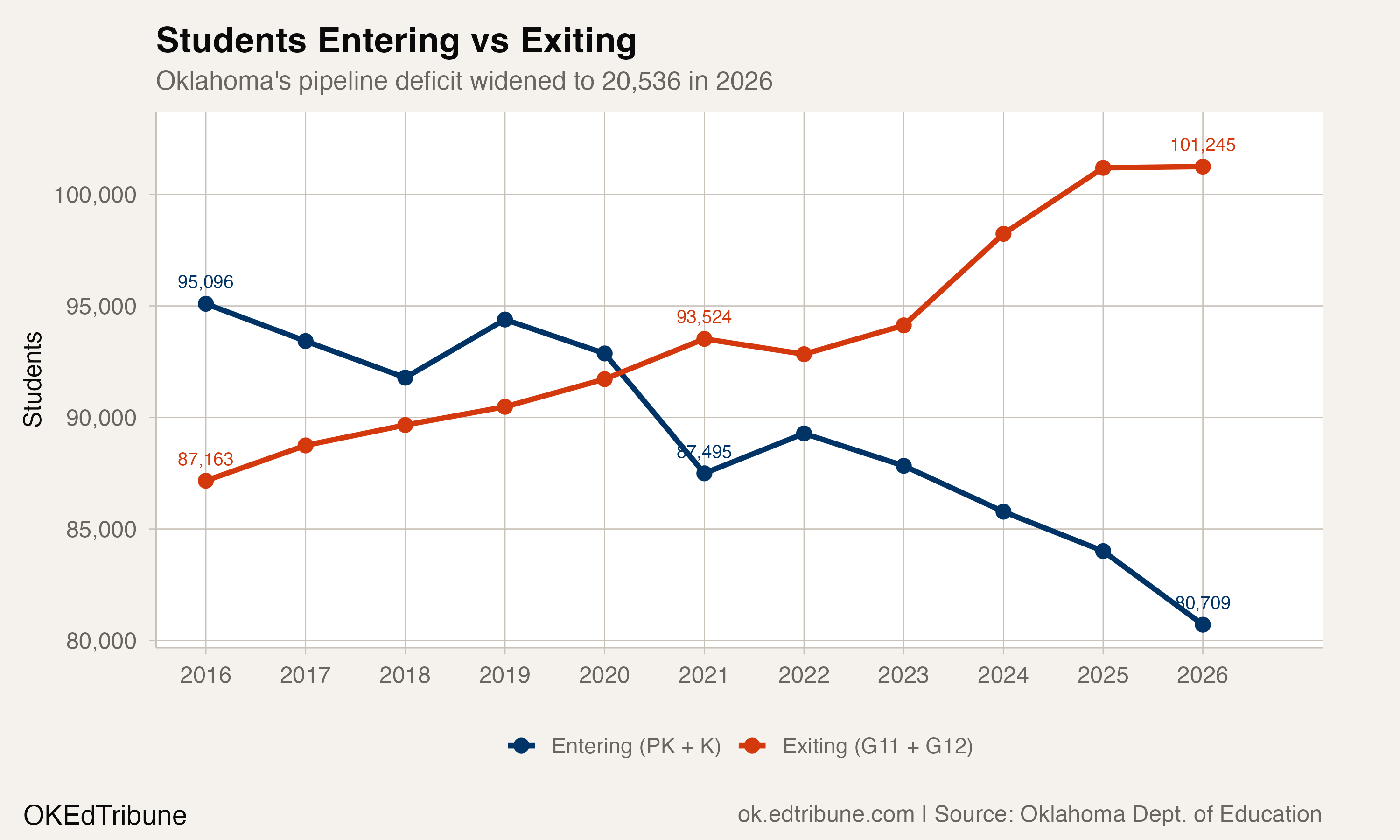
This deficit has direct consequences for statewide totals. Oklahoma enrolled 686,718 students in 2025-26, its lowest figure in at least 11 years and down 16,932 from the 2020 peak of 703,650. The pipeline math makes continued decline nearly certain: the current K-12 enrollment of 649,046 (excluding pre-K) contains 290,922 students in grades K-5 and 358,124 in grades 6-12. As smaller elementary cohorts replace larger graduating classes, the total will keep falling even if kindergarten enrollment stabilizes at current levels.
Nearly two-thirds of districts are inverted
The statewide inversion is not driven by a handful of large districts. In 2016, 151 of 422 districts with both K and 12th-grade enrollment (35.8%) had fewer kindergartners than seniors. By 2026, that figure had climbed to 262 of 425 districts, or 61.6%.
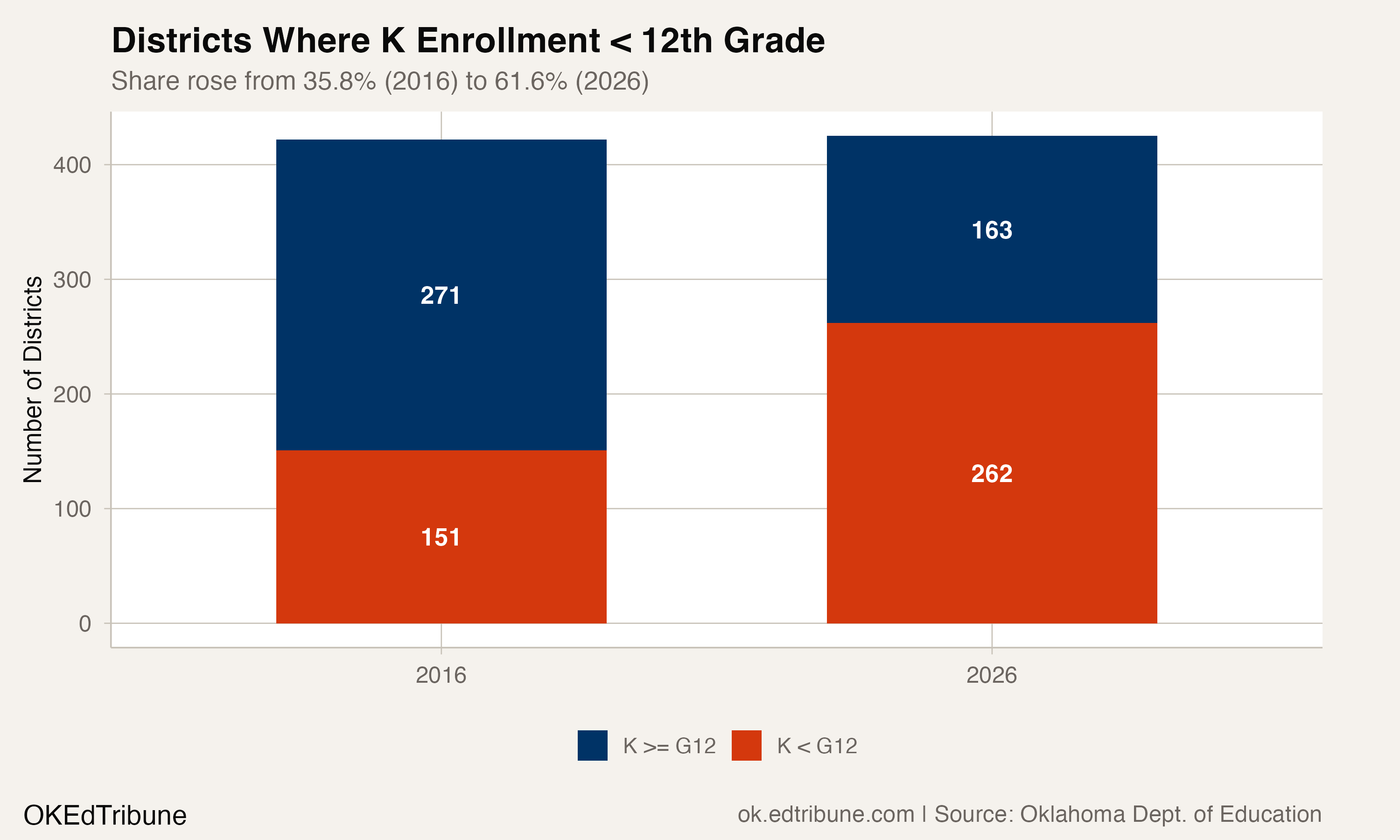
Among the 10 largest districts, only three enrolled more kindergartners than seniors in 2026: Mustang↗ET (ratio of 101.4), Oklahoma City↗ET (105.7), and Tulsa↗ET (119.8). The suburban ring tells a different story. Union↗ET enrolled 72 kindergartners for every 100 seniors. Moore↗ET enrolled 73. Edmond↗ET enrolled 80. Broken Arrow↗ET enrolled 85. These are districts whose elementary schools are shrinking while their high schools remain full.
The most extreme case among large districts is Epic Charter School↗ET, Oklahoma's largest virtual operator, where kindergarten enrollment (935) is less than a third of its 12th-grade count (3,186), a ratio of 29.3. Virtual schools skew heavily toward older students, and Epic's grade distribution amplifies the statewide pattern.
Oklahoma City's ratio fell from 188.4 in 2016 to 105.7 in 2026. The district enrolled 4,129 kindergartners a decade ago. In 2025-26: 2,231. Tulsa's ratio dropped from 219.9 to 119.8, with kindergarten falling from 3,566 to 2,523.
Pre-K signals more to come
Pre-K enrollment, which feeds kindergarten the following year, has fallen from 41,643 in 2016 to 35,029 in 2026, a decline of 15.9%. The year-over-year drop in 2026 was 1,679 students, the third-largest single-year loss in the series after the pandemic-era drops in 2021 (-2,993) and 2020 (-1,738). If the historical relationship between pre-K and kindergarten holds, next year's kindergarten class will be smaller still.
Enrollment will keep falling -- the pipeline math guarantees it. A building that served 500 kindergartners a decade ago and served 420 in 2025-26 still needs a roof, a principal, and heat. Oklahoma's per-pupil funding formula sends dollars where students sit. When fewer five-year-olds show up each September, the money leaves too, even if the building stays.
Detailed code that reproduces the analysis and figures in this article is available exclusively to EdTribune subscribers.
Discussion
Sign in to join the discussion.
Loading comments...